
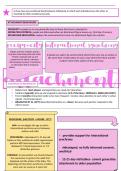
A close two-way emotional bond between individuals in which each individual sees the other as
essential for their emotional security
ATTACHMENT BEHAVIOURS
PROXIMITY= people try to stay physically close to those that they’re attached to
SEPERATION DISTRESS= people are distressed when an attachment figure leaves e.g., first day of nursery
SECURE BASE BEHAVIOUR= explore the environment but return to attachment figure for comfort.
-Babies and their mothers spend a
long time interacting with each other 2 people are said to be synchronised where they carry out an action at
-Mothers typically pick-up and the same time. It takes place in such a way where the infant and the
respond to the infant’s alertness
mother mirror their actions in the same way.
-This develops by about 3 months by
an interaction that is reciprocal
where- each person responds to the
other and elicits a response from
them
EXAMPLES OF RECIPROCITY
Babies have ‘alert phases’ and signal they are ready for interaction
Mothers (typically) pick up and respond to alertness (2/3 of the time)- FIEDMAN + EIDELMAN (2007)
From 3 months interaction tends to be more frequent + involve close attention to each other’s verbal
signals + facial expressions
BRAZELTON ET AL (1975) described interaction as a ‘dance’ because each partner responds to the
others moves.
PROCEDURE- (MELTZOFF + MOORE- 1977)
AIM= to investigate the age at which
interactional synchrony occurs between
mother and child.
PROCEDURE= videotaped 12–21-day old
+ provides support for interactional
babies as they watched an adult experimenter synchrony
perform diff facial expressions. The adult
displayed 1/3 facial expressions or 1/3
distinctive gestures.
- videotaped, no fully informed consent,
unethical
FINDINGS= An association was found between
the expression or gesture the adult had
displayed and the action of the baby. The
- 12-21-day old babies- cannot generalise
beginnings of interaction synchrony in babies attachment to older population
were seen as young as 2 years old.
, SCHAFFER + EMERSON (1964)
STAGE CAME
1= ASOCIAL STAGE UP WITH 4 STAGES FOR
(0-8 WEEKS)
HOW ATTCAHMENT DEVELOPS
The baby will display AS
same behaviour to A RESULT
objects OF
+ humans- THEIR
cannot
Babies show some preference for familiar adults
STUDY.
differentiate.
STAGE 2= INDISCRIMINATE ATTACHMENT (2-7 MONTHS)
The baby displays more social behaviour- more human contact
Show a preference for humans
Accept cuddles/ comfort from any adult (indiscriminate)
Don’t show stranger/ separation anxiety
STAGE 3= SPECIFIC ATTACHMENT (7-12 MONTHS)
Baby will display anxiety towards strangers
Become anxious when separated from primary caregiver
-Specific attachment- responds to baby’s signals
-Reciprocity (3 months)/ interactional (2 weeks)
STAGE 4= MULTIPLE ATTACHMENTS (1 YEAR+)
Babies will extend levels of attachment to others (multiple)- secondary attachment
29% of babies/ children formed secondary attachments within a month of forming a primary
attachment
Scottish babies- culture bias
Babies- cannot generalise to other babies
from different cultures and adults
AIM= to investigate the formation of Working class families- can’t generalise to
all members of society
early attachments (in particular the Diary (self- report)- retrospective
age they were formed) evidence- own perceptions
Social desirability bias- mother may not
report accurate behaviour of child to
METHOD= they observed 60 Scottish
appear like the ‘perfect parent’
Longitudinal study- time consuming,
babies for 18 months, mostly from expensive
Obtaining more results over long period of
skilled working-class families. The time- high internal validity- higher
babies were visited once a month for reliability.
1 year and then again at 18 months.
Researchers asked the parents to
observe their children in different
circumstances, keep a diary of their
observations + report back to the
researchers- separation anxiety,
stranger anxiety.
essential for their emotional security
ATTACHMENT BEHAVIOURS
PROXIMITY= people try to stay physically close to those that they’re attached to
SEPERATION DISTRESS= people are distressed when an attachment figure leaves e.g., first day of nursery
SECURE BASE BEHAVIOUR= explore the environment but return to attachment figure for comfort.
-Babies and their mothers spend a
long time interacting with each other 2 people are said to be synchronised where they carry out an action at
-Mothers typically pick-up and the same time. It takes place in such a way where the infant and the
respond to the infant’s alertness
mother mirror their actions in the same way.
-This develops by about 3 months by
an interaction that is reciprocal
where- each person responds to the
other and elicits a response from
them
EXAMPLES OF RECIPROCITY
Babies have ‘alert phases’ and signal they are ready for interaction
Mothers (typically) pick up and respond to alertness (2/3 of the time)- FIEDMAN + EIDELMAN (2007)
From 3 months interaction tends to be more frequent + involve close attention to each other’s verbal
signals + facial expressions
BRAZELTON ET AL (1975) described interaction as a ‘dance’ because each partner responds to the
others moves.
PROCEDURE- (MELTZOFF + MOORE- 1977)
AIM= to investigate the age at which
interactional synchrony occurs between
mother and child.
PROCEDURE= videotaped 12–21-day old
+ provides support for interactional
babies as they watched an adult experimenter synchrony
perform diff facial expressions. The adult
displayed 1/3 facial expressions or 1/3
distinctive gestures.
- videotaped, no fully informed consent,
unethical
FINDINGS= An association was found between
the expression or gesture the adult had
displayed and the action of the baby. The
- 12-21-day old babies- cannot generalise
beginnings of interaction synchrony in babies attachment to older population
were seen as young as 2 years old.
, SCHAFFER + EMERSON (1964)
STAGE CAME
1= ASOCIAL STAGE UP WITH 4 STAGES FOR
(0-8 WEEKS)
HOW ATTCAHMENT DEVELOPS
The baby will display AS
same behaviour to A RESULT
objects OF
+ humans- THEIR
cannot
Babies show some preference for familiar adults
STUDY.
differentiate.
STAGE 2= INDISCRIMINATE ATTACHMENT (2-7 MONTHS)
The baby displays more social behaviour- more human contact
Show a preference for humans
Accept cuddles/ comfort from any adult (indiscriminate)
Don’t show stranger/ separation anxiety
STAGE 3= SPECIFIC ATTACHMENT (7-12 MONTHS)
Baby will display anxiety towards strangers
Become anxious when separated from primary caregiver
-Specific attachment- responds to baby’s signals
-Reciprocity (3 months)/ interactional (2 weeks)
STAGE 4= MULTIPLE ATTACHMENTS (1 YEAR+)
Babies will extend levels of attachment to others (multiple)- secondary attachment
29% of babies/ children formed secondary attachments within a month of forming a primary
attachment
Scottish babies- culture bias
Babies- cannot generalise to other babies
from different cultures and adults
AIM= to investigate the formation of Working class families- can’t generalise to
all members of society
early attachments (in particular the Diary (self- report)- retrospective
age they were formed) evidence- own perceptions
Social desirability bias- mother may not
report accurate behaviour of child to
METHOD= they observed 60 Scottish
appear like the ‘perfect parent’
Longitudinal study- time consuming,
babies for 18 months, mostly from expensive
Obtaining more results over long period of
skilled working-class families. The time- high internal validity- higher
babies were visited once a month for reliability.
1 year and then again at 18 months.
Researchers asked the parents to
observe their children in different
circumstances, keep a diary of their
observations + report back to the
researchers- separation anxiety,
stranger anxiety.


