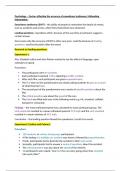
Psychology – Factors affecting the accuracy of eyewitness testimony: Misleading
information:
Eyewitness testimony (EWT) – the ability of people to remember the details of events,
such as accidents and crimes, which they themselves have observed.
Leading questions - Questions which, because of the way they are phrased, suggest a
certain answer
One reason why the accuracy of EWT is often very poor, could be because of leading
questions, used by the police after the event:
Research on leading questions:
Experiment 1:
Aim: Elizabeth Loftus and John Palmer wanted to see the effect of language, upon
estimates of speed.
Procedure:
The participants were 45 students.
Each participant watched 7 films depicting a traffic accident.
After each film, each participant was given a questionnaire.
The first item on the questionnaire was simply asking students to give an account
of what they had seen.
The second part of the questionnaire was a series of specific questions about the
film.
The critical question was about the speed of the cars.
The blank was filled with one of the following words e.g. hit, smashed, collided,
bumped or contacted.
Findings – the mean estimated speed was calculated for each participant group. The
verb contacted resulted in a mean estimated speed of 31.8 mph and the verb smashed
resulted in a mean estimate of 40.5 mph.
Conclusion – the leading question biased the eyewitness’s recall of an event.
Experiment 2 (Loftus and Palmer):
Procedure:
150 students, in various sized groups participated.
A film lasting of a multiple car accident was shown, followed by a questionnaire.
Firstly, participants had to describe the accident in their own words.
Secondly, participants had to answer a series of questions about the accident.
The critical question was also about the speed of the vehicles.
50 participants were asked, ‘how fast the cars were going when they smashed
into each other?’
information:
Eyewitness testimony (EWT) – the ability of people to remember the details of events,
such as accidents and crimes, which they themselves have observed.
Leading questions - Questions which, because of the way they are phrased, suggest a
certain answer
One reason why the accuracy of EWT is often very poor, could be because of leading
questions, used by the police after the event:
Research on leading questions:
Experiment 1:
Aim: Elizabeth Loftus and John Palmer wanted to see the effect of language, upon
estimates of speed.
Procedure:
The participants were 45 students.
Each participant watched 7 films depicting a traffic accident.
After each film, each participant was given a questionnaire.
The first item on the questionnaire was simply asking students to give an account
of what they had seen.
The second part of the questionnaire was a series of specific questions about the
film.
The critical question was about the speed of the cars.
The blank was filled with one of the following words e.g. hit, smashed, collided,
bumped or contacted.
Findings – the mean estimated speed was calculated for each participant group. The
verb contacted resulted in a mean estimated speed of 31.8 mph and the verb smashed
resulted in a mean estimate of 40.5 mph.
Conclusion – the leading question biased the eyewitness’s recall of an event.
Experiment 2 (Loftus and Palmer):
Procedure:
150 students, in various sized groups participated.
A film lasting of a multiple car accident was shown, followed by a questionnaire.
Firstly, participants had to describe the accident in their own words.
Secondly, participants had to answer a series of questions about the accident.
The critical question was also about the speed of the vehicles.
50 participants were asked, ‘how fast the cars were going when they smashed
into each other?’