Psychology – The multi-store model of memory
Key terms:
Multi-store model – a representation of how memory works in terms of three stores
called the sensory register, short-term memory (STM) and long-term memory (LTM).
Sensory register – the memory stores for each of our five senses e.g. vision (iconic store)
and hearing (echoic) store. The capacity of the sensory memory is huge and information
lasts for a very short time (less than half a second).
Short-term memory – The limited-capacity memory store. Coding is mainly acoustic
(sounds) and capacity is 7 plus or minus 2 items, on average. Duration is about 18
seconds.
Long – term memory – The permanent memory store. Coding is mainly semantic
(meaning), it has unlimited capacity and can store memories for up to a lifetime.
Capacity – the amount of information that can be held in a memory store.
Encoding – the format in which information is stored in the various memory stores.
Duration – the length of time information can be held in a memory.
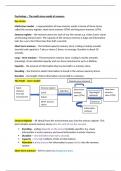
The Multi – store model: Maintenance rehearsal
Input: Sensory register
Short-term Long-term
stimulus Attention
Iconic memory Meaningful memory
from the
store (STM) rehearsal store (LTM)
environment Echoic
Other sensory Retrieval
stores
Information
retrieval
Sensory Register – All stimuli from the environment pass into the sensory register. This
part includes several memory stores (one for each of our five senses).
Encoding – coding depends on the sense (modality-specific). E.g. visual
information is iconic memory and sound information is echoic memory.
Duration – very brief (less than half a second).
Capacity – very high (millions of bits of information).
Attention is a key process for information to pass further into the memory
system.
Short-term memory – STM is more of a temporary store.
Key terms:
Multi-store model – a representation of how memory works in terms of three stores
called the sensory register, short-term memory (STM) and long-term memory (LTM).
Sensory register – the memory stores for each of our five senses e.g. vision (iconic store)
and hearing (echoic) store. The capacity of the sensory memory is huge and information
lasts for a very short time (less than half a second).
Short-term memory – The limited-capacity memory store. Coding is mainly acoustic
(sounds) and capacity is 7 plus or minus 2 items, on average. Duration is about 18
seconds.
Long – term memory – The permanent memory store. Coding is mainly semantic
(meaning), it has unlimited capacity and can store memories for up to a lifetime.
Capacity – the amount of information that can be held in a memory store.
Encoding – the format in which information is stored in the various memory stores.
Duration – the length of time information can be held in a memory.
The Multi – store model: Maintenance rehearsal
Input: Sensory register
Short-term Long-term
stimulus Attention
Iconic memory Meaningful memory
from the
store (STM) rehearsal store (LTM)
environment Echoic
Other sensory Retrieval
stores
Information
retrieval
Sensory Register – All stimuli from the environment pass into the sensory register. This
part includes several memory stores (one for each of our five senses).
Encoding – coding depends on the sense (modality-specific). E.g. visual
information is iconic memory and sound information is echoic memory.
Duration – very brief (less than half a second).
Capacity – very high (millions of bits of information).
Attention is a key process for information to pass further into the memory
system.
Short-term memory – STM is more of a temporary store.