

Voting behaviour
Classed-based voting and other factors including voting patterns, such as partisanship and voting
attachments
The study of voting behaviour and trends in elections is called psephology. Voting behaviour is affected by
various factors. The influence of certain factors has changed over time and can also change between elections.
Often, voting behaviour can be different depending on the type of election that is being held. For example,
people may demonstrate different voting habits in a local election to a general election.
We refer to the idea of class when we use terms such as working-class and middle-class and in past decades
and centuries these labels have been of importance in social terms. However, in today’s society we do not
generally refer to a person’s class, but for the purposes of psephology and other demographic studies, people
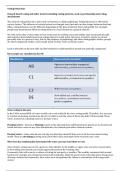
are often categorised within a class model based on their ‘socio-economic status’.
Look at the table on the next slide and the textbook to understand how people are generally categorised.
How people are classified in the UK
Class-voting in the past
In the 1960s around 80% of voters would cast a vote which fit the class-voting model. Therefore, it is accurate
to say that an election would come down to a battle to win the votes of those who didn’t fit the model. These
voters are known as floating voters or deviant voters.
Floating voters – termed as ‘floating’ based on the idea that they will float between parties at an election and
would not base a vote on any class determinants, but instead upon other rational reasons.
Deviant voters – those who do not vote the way that they should if they were to fit the class-based voting
model. They are deviating (moving away) from their class stereotype in the way they cast a vote.
Why class has traditionally determined the ways a person was likely to vote.
Class identity: voting was part of a person’s class identity. To be middle or upper class was to be conservative;
to be working class meant you would support the party of the working class
Community links with a party: a culture of voting for one party or another. The wealthy commuter belt around
London, for example, was steeped in Conservative attitudes, while the poorer east of London had a strong sense
of being a Labour-led community. Such roots were strengthened by Labour’s associations with strong trade
unions
, Selfish reasons: the Conservative party was perceived to govern more in the interests of the middle class and
the better off, while Labour developed policies to help the working class and the poor. It was therefore rational
to choose the party associated with your class.
D/E voting patterns A/B voting patterns
We can see form these graphs that voting on the basis of class has declined, despite a slight resurgence for
Labour among D/E voters in 2017 which fell back in 2019
Class de-alignment
It is the name for the phenomenon of a decline over time of voters casting a vote based on their class and in
fact making a choice at the polling booth based on other factors.
In 1964, 78% of AB groups voted Conservative compared to 40% in 2010, 37% in 2017 and 45% in 2019.
One reason for this could be attributed to ‘New Labour’ taking the middle-class vote from 1997 onwards.
In which ‘classification’ of the class model does class-based voting remain strongest? What reasons are
given for why some ‘deviant’ working class voters have voted Conservative?
- Conservative support among the working class was understood to be the result of a factor known as
‘deference’. This was a tendency for some members of this class to ‘defer’ to or respect those whom they
considered to be their superiors i.e., members of the upper and middle classes who were perceived to
be Conservatives
- Some lower-middle- and working-class voters aspired to be middle class and so voted Conservative as
evidence of their aspiration
- The correlation between AB and Conservative voting has always been stronger. There have been fewer
swing voters in this class
Class Voting in 2017
Jeremy Corbyn made dramatic inroads into the AB category and Theresa May made striking gains with DE
voters. This is thought to be because higher social classes wanted to punish Conservatives for Brexit by voting
Labour, while large numbers of DE voters felt the Conservatives would be more likely to deliver Brexit and
control immigration.
How does class affect votes for smaller parties?
Classed-based voting and other factors including voting patterns, such as partisanship and voting
attachments
The study of voting behaviour and trends in elections is called psephology. Voting behaviour is affected by
various factors. The influence of certain factors has changed over time and can also change between elections.
Often, voting behaviour can be different depending on the type of election that is being held. For example,
people may demonstrate different voting habits in a local election to a general election.
We refer to the idea of class when we use terms such as working-class and middle-class and in past decades
and centuries these labels have been of importance in social terms. However, in today’s society we do not
generally refer to a person’s class, but for the purposes of psephology and other demographic studies, people
are often categorised within a class model based on their ‘socio-economic status’.
Look at the table on the next slide and the textbook to understand how people are generally categorised.
How people are classified in the UK
Class-voting in the past
In the 1960s around 80% of voters would cast a vote which fit the class-voting model. Therefore, it is accurate
to say that an election would come down to a battle to win the votes of those who didn’t fit the model. These
voters are known as floating voters or deviant voters.
Floating voters – termed as ‘floating’ based on the idea that they will float between parties at an election and
would not base a vote on any class determinants, but instead upon other rational reasons.
Deviant voters – those who do not vote the way that they should if they were to fit the class-based voting
model. They are deviating (moving away) from their class stereotype in the way they cast a vote.
Why class has traditionally determined the ways a person was likely to vote.
Class identity: voting was part of a person’s class identity. To be middle or upper class was to be conservative;
to be working class meant you would support the party of the working class
Community links with a party: a culture of voting for one party or another. The wealthy commuter belt around
London, for example, was steeped in Conservative attitudes, while the poorer east of London had a strong sense
of being a Labour-led community. Such roots were strengthened by Labour’s associations with strong trade
unions
, Selfish reasons: the Conservative party was perceived to govern more in the interests of the middle class and
the better off, while Labour developed policies to help the working class and the poor. It was therefore rational
to choose the party associated with your class.
D/E voting patterns A/B voting patterns
We can see form these graphs that voting on the basis of class has declined, despite a slight resurgence for
Labour among D/E voters in 2017 which fell back in 2019
Class de-alignment
It is the name for the phenomenon of a decline over time of voters casting a vote based on their class and in
fact making a choice at the polling booth based on other factors.
In 1964, 78% of AB groups voted Conservative compared to 40% in 2010, 37% in 2017 and 45% in 2019.
One reason for this could be attributed to ‘New Labour’ taking the middle-class vote from 1997 onwards.
In which ‘classification’ of the class model does class-based voting remain strongest? What reasons are
given for why some ‘deviant’ working class voters have voted Conservative?
- Conservative support among the working class was understood to be the result of a factor known as
‘deference’. This was a tendency for some members of this class to ‘defer’ to or respect those whom they
considered to be their superiors i.e., members of the upper and middle classes who were perceived to
be Conservatives
- Some lower-middle- and working-class voters aspired to be middle class and so voted Conservative as
evidence of their aspiration
- The correlation between AB and Conservative voting has always been stronger. There have been fewer
swing voters in this class
Class Voting in 2017
Jeremy Corbyn made dramatic inroads into the AB category and Theresa May made striking gains with DE
voters. This is thought to be because higher social classes wanted to punish Conservatives for Brexit by voting
Labour, while large numbers of DE voters felt the Conservatives would be more likely to deliver Brexit and
control immigration.
How does class affect votes for smaller parties?


