
Enquiry question 1: Why are some locations more at risk from tectonic hazards?
1.1 Key idea: The global distribution of tectonic hazards can be explained by plate boundary and other tectonic
processes.
a. The global distribution and causes of earthquakes, volcanic eruptions and tsunamis.
b. The distribution of plate boundaries resulting from divergent, convergent and conservative plate movements.
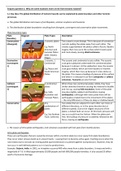
Plate boundary types
Plate Diagram Plate Types Description
Boundary
Constructive 2 oceanic plates Two oceanic crusts diverge. This is because of convection
(divergent) currents pulling the plates away from each other. This
E.g. North creates a gap between the plates called a fissure. Basaltic
American and magma then rises up to the surface which travels quick
Eurasian Plates and cools slowly causing shield volcanoes.
(Mid- Atlantic
Ridge)
Destructive 1 oceanic, 1 The oceanic and continental crusts collide. The oceanic
(convergent Continental crust gets subducted underneath the continental plate
1) because it is denser. At the subduction zone, the oceanic
E.g. Nazca and crust gets melted, which can form basaltic or rhyolitic
South American magma, which then rises up because it is less dense as
Plates the plate. This causes a buildup of pressure at the surface
and when it is released it can form composite or caldera
volcanoes. Tsunamis are also formed.
Collision 2 continental When these two continental plates collide, they have
(convergent plates similar densities therefore causing the material to buddle
2) and rise up, causing fold mountains. Some of the plate
E.g. Indo- may also slightly subduct and therefore causing
Australian and earthquakes. (although with every plate there will be
Eurasian Plates earthquakes created due to the movement of the plates
– the only difference is if they are deep or shallow based)
Conservative Any Two plates that are adjacent to each other can move at
combination of different directions, or in the same direction but at
plates different speeds. Due to the ridged structures of the
plates, a locked fault can occur. At this fault, pressure will
E.g. San Andreas rise as a result from the friction. When the plates jerk
Fault, California free, this buildup of pressure is suddenly released at the
focus, causing an earthquake.
c. The causes of intra-plate earthquakes, and volcanoes associated with hot spots from mantle plumes.
Intra-plate earthquakes
These are earthquakes that are caused by stresses within a tectonic plate (so occur away from plate boundaries).
They occur when stresses build up in ancient faults – causing them to become active again. Faulting occurs when the
rock breaks due to stresses by it being pulled apart (extension) or pushed together (compression). However, they do
not occur in well-defined patterns so it is hard to predict them.
Example: Gujarat, India: in 2001, an intraplate occurred 400 miles away from a plate boundary. It measured with a
magnitude of 7.6. It killed approximately 20,000 people and left 600,000 people homeless. It also caused $5 billion
worth of economic damage.
, Intra-plate volcanoes
Volcanoes can also appear in the middle of a plate, as opposed to along plate margins, such as those in Hawaii. This
is due to the presence of hotspots.
1. A hotspot is a stationary point in the mantle which generates intense heat.
2. The intense heat creates a column of superhot magma to rise as it is less dense than the surrounding
magma.
3. As the magma rises in the mantle plume, it collects at the base of the lithosphere where this intense heat
and lower pressure causes the rock to melt and form magma. The magma erupts through the lithosphere
where it is thin and weak creating a shield volcano.
4. As the magma extrudes onto the surface of the
earth, a volcanic island will form on the sea floor. If
the flow of magma is constant allowing lava to
build up, a volcano will form high enough to
emerge above the ocean surface.
5. As the tectonic plate is moved over the stationary
hotspot, the old volcanoes are rafted away and
new volcanoes are made.
6. Eventually, a chain of islands is created such as the
Hawaiian Islands.
1.2 Key idea: There are theoretical frameworks that attempt to explain plate movements.
a. The theory of plate tectonics and its key elements.
The earth’s internal structure
Layer Description Thickness Temperature
Inner Core Solid and very dense. Made up 1,300 km 4000-5000
of nickel and iron.
Outer Core Liquid and very dense. Made up 2,200 km 4000-5000
of nickel and iron.
Mantle Most of the mantle is molten 2,900 km 1000-4000
rock. The asthenosphere is the
top bit of the mantle where the Asthenosphere
rock is semi-molten (100 km)
Crust Made up of continental and Up to 100 km Up to 900
oceanic crust
Different types of crust
Oceanic: made up of dense basaltic rock. It is thinner (around 7km) and
subducts under the continental plate.
Continental: made up of light granitic rock. It is thicker (around 70km)
and floats.
Mantle convection
There is a hot inner core due to the radioactive decay of elements such as uranium, and the pressure of overlying
materials. The current ascends as it moves away from the hot core.
The current goes into horizontal directions as it comes closer to the cooler
surface of the earth. The currents tug, push and pull the plates causing them to
move.
As the current cools down, it becomes denser and descends back down further
to the core. The core heats up the current and the cycle continues


