

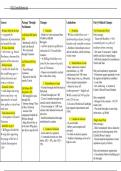
1832 Great Reform Act
Causes Passage Through Changes Limitations Party Political Changes
Parliament
- Pressure from the m/class 1. Franchise 1. Franchise Tory/Conservative Party
→ recognised the 1st Reform Bill March - Number of voters increased from - W/class excluded from vote → Party message:
limitations of protectionism 1831 478,000 to 800,000 landownership exclusive, borough - Tamworth Manifesto → Peel
and wanted free trade - Introduced in HoC by Boroughs: franchise only extended to artisans committed party to a policy of
Lord John Russell → uniform property qualification moderate reform correcting
- W/class discontent - Abolition of potwalloper and scot
- Was not passed enfranchised £10 householders and lot franchises, which held many - New name ‘Conservative’ implied
→ int’l events, e.g. French
through Commons Counties: w/class voters stability and lack of rapid change
Revolution, threatened the
→ 40 Shilling Freeholders were - Still firmly attached to Constitution in
position of the aristocracy 2nd Reform Bill July
joined by the tenants who paid a 2. Redistribution of seats Church and State
- Political unions 1831
min. of £50/annum - Many small towns retained
→ landed elite feared that - Passed through representation, e.g. >600 Party and constituency organisation
this would bring tgt w + Commons - Clauses were intended to exclude
the w/class from voting constituencies had <300 voters - Professional agents appointed to work
m/class discontent and - Rejected by the HoL - Many large towns, e.g. Doncaster, the register and publicise candidates
(mostly Tories) had no separate representation - Local clubs
create a revolution 2. Redistribution of seats
- Economic context - 56 rotten boroughs lost both seats in - Industrial areas still - New central org. w/ creation of
3rd Reform Bill Carlton Club and Francis Bonham
→ trade slumps and swing December 1831 Parliament underrepresented → English and
riots in rural areas - esp - Bill struggled to pass - 30 small boroughs lost 1 MP Welsh counties had 50% pop but
- 22 new 2-member boroughs were Party strongholds:
important b/c of switch through HoL only 32% of seats - Strongest in the counties - 136/154
- Extreme rioting (‘Days created, mainly industrial towns - Uni seats of Oxford and Cambridge
from apathy to action from county seats
of May’) followed - 20 new boroughs w/ 1 MP were kept separate representation (until
rural areas created, older industrial towns and - Won small boroughs in some large
- Actions of the 1950) urban areas, e.g. Bristol
- Trade union activity spa towns
campaigners helped the
→ development of General Bill pass through - Small disenfranchised boroughs 3. Conduct of elections Whig/Liberal Party
Unionism - King allowed Grey to redistributed to counties - No secret ballot Party message:
- Instability in gov’t invite more Whig peers - Bribery and corruption still
3. Conduct of elections - Didn’t immediately form a distinctive
→ Wellington divided the into HoL to pass the bill prevalent
- Voters had to be registered party due to the heterogeneity of the
R-wing after supporting - No limit on election expenses Lichfield House Compact
- % contested elections rose from - Tradition of patronage survived w/
the passage of the Act of - Passed important legislation to retain
before 1832 = 30%, after 1832 = high no. seats
Catholic Emancipation 59% reputation as party of reform
1829
Party and constituency organisation
- Concentrated efforts on building up in
the boroughs
, - Adopted a central organisation, the
reform club, with Joseph Parkes
- Fielded both Whig and radical
candidates in many constituencies
- Municipal Corporations Act 1835
stimulated m/class support
Party strongholds:
- Manufacturing-based constituencies
- Larger boroughs in Midlands and
North
Causes Passage Through Changes Limitations Party Political Changes
Parliament
- Pressure from the m/class 1. Franchise 1. Franchise Tory/Conservative Party
→ recognised the 1st Reform Bill March - Number of voters increased from - W/class excluded from vote → Party message:
limitations of protectionism 1831 478,000 to 800,000 landownership exclusive, borough - Tamworth Manifesto → Peel
and wanted free trade - Introduced in HoC by Boroughs: franchise only extended to artisans committed party to a policy of
Lord John Russell → uniform property qualification moderate reform correcting
- W/class discontent - Abolition of potwalloper and scot
- Was not passed enfranchised £10 householders and lot franchises, which held many - New name ‘Conservative’ implied
→ int’l events, e.g. French
through Commons Counties: w/class voters stability and lack of rapid change
Revolution, threatened the
→ 40 Shilling Freeholders were - Still firmly attached to Constitution in
position of the aristocracy 2nd Reform Bill July
joined by the tenants who paid a 2. Redistribution of seats Church and State
- Political unions 1831
min. of £50/annum - Many small towns retained
→ landed elite feared that - Passed through representation, e.g. >600 Party and constituency organisation
this would bring tgt w + Commons - Clauses were intended to exclude
the w/class from voting constituencies had <300 voters - Professional agents appointed to work
m/class discontent and - Rejected by the HoL - Many large towns, e.g. Doncaster, the register and publicise candidates
(mostly Tories) had no separate representation - Local clubs
create a revolution 2. Redistribution of seats
- Economic context - 56 rotten boroughs lost both seats in - Industrial areas still - New central org. w/ creation of
3rd Reform Bill Carlton Club and Francis Bonham
→ trade slumps and swing December 1831 Parliament underrepresented → English and
riots in rural areas - esp - Bill struggled to pass - 30 small boroughs lost 1 MP Welsh counties had 50% pop but
- 22 new 2-member boroughs were Party strongholds:
important b/c of switch through HoL only 32% of seats - Strongest in the counties - 136/154
- Extreme rioting (‘Days created, mainly industrial towns - Uni seats of Oxford and Cambridge
from apathy to action from county seats
of May’) followed - 20 new boroughs w/ 1 MP were kept separate representation (until
rural areas created, older industrial towns and - Won small boroughs in some large
- Actions of the 1950) urban areas, e.g. Bristol
- Trade union activity spa towns
campaigners helped the
→ development of General Bill pass through - Small disenfranchised boroughs 3. Conduct of elections Whig/Liberal Party
Unionism - King allowed Grey to redistributed to counties - No secret ballot Party message:
- Instability in gov’t invite more Whig peers - Bribery and corruption still
3. Conduct of elections - Didn’t immediately form a distinctive
→ Wellington divided the into HoL to pass the bill prevalent
- Voters had to be registered party due to the heterogeneity of the
R-wing after supporting - No limit on election expenses Lichfield House Compact
- % contested elections rose from - Tradition of patronage survived w/
the passage of the Act of - Passed important legislation to retain
before 1832 = 30%, after 1832 = high no. seats
Catholic Emancipation 59% reputation as party of reform
1829
Party and constituency organisation
- Concentrated efforts on building up in
the boroughs
, - Adopted a central organisation, the
reform club, with Joseph Parkes
- Fielded both Whig and radical
candidates in many constituencies
- Municipal Corporations Act 1835
stimulated m/class support
Party strongholds:
- Manufacturing-based constituencies
- Larger boroughs in Midlands and
North


