

M1
HOW ACCURACY MAY BE ENSURED IN THE TECHNIQUES USED
We carried out the titration by following the procedures the procedures
by using instruments provided to us by the technicians, to make our
results as accurate as possible. During the practical, we used;
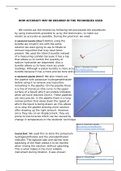
A volumetric burette (50cm3): Before using the
burette we rinsed it out with the same
solution we were going to use to titrate to
remove impurities that may have been
present. We used the 50cm3 burette instead
of a measuring cylinder because it has a tap
that allows us to control the quantity of
sodium hydroxide we dispensed. Also a
burette allows us to have more accurate
Figure 1: Volumetric burette
readings. Although a piston burette is more accurate than a volumetric
https://vinmetrica.com/wp-
burette because it has a more precise bore and plunger.
content/uploads/2015/03/Vinmetrica-303.jpg
A volumetric pipette (25cm3): We also rinsed out
the pipette with potassium hydrogenphthalate
before using it to remove any impurities
remaining in the pipette. On the pipette there
is a line of meniscus (the curve in the upper
surface of a liquid) which accurately indicates
when we have reached 25cm3. These pipettes
are very precise. In the pipette there is a long
narrow portion that slows down the speed at
which the liquid is being drawn up; this allows
us to stop the pipette drawing more solution
after drawing up the right amount. However,
since they rely on air displacement, they are
prone to inaccuracies which can be caused by
change in temperature or the students’ technique
Figure 2: Volumetric pipette
http://3.imimg.com/data3/BK/JA/MY-
12051470/volumetric-pipette-500x500.jpg
Conical flask: We used this to store the potassium
hydrogenphthalate and the phenolphthalein
indicator. The tapered side and narrow neck
splashing of the flash allows it to be swirled
when mixing the solution, without splashing.
This is what makes it the most reliable
instrument during titration. It was chosen
Figure 3: Conical flask
http://www.drinkstuff.com/productimg/89776_large.jp
g
HOW ACCURACY MAY BE ENSURED IN THE TECHNIQUES USED
We carried out the titration by following the procedures the procedures
by using instruments provided to us by the technicians, to make our
results as accurate as possible. During the practical, we used;
A volumetric burette (50cm3): Before using the
burette we rinsed it out with the same
solution we were going to use to titrate to
remove impurities that may have been
present. We used the 50cm3 burette instead
of a measuring cylinder because it has a tap
that allows us to control the quantity of
sodium hydroxide we dispensed. Also a
burette allows us to have more accurate
Figure 1: Volumetric burette
readings. Although a piston burette is more accurate than a volumetric
https://vinmetrica.com/wp-
burette because it has a more precise bore and plunger.
content/uploads/2015/03/Vinmetrica-303.jpg
A volumetric pipette (25cm3): We also rinsed out
the pipette with potassium hydrogenphthalate
before using it to remove any impurities
remaining in the pipette. On the pipette there
is a line of meniscus (the curve in the upper
surface of a liquid) which accurately indicates
when we have reached 25cm3. These pipettes
are very precise. In the pipette there is a long
narrow portion that slows down the speed at
which the liquid is being drawn up; this allows
us to stop the pipette drawing more solution
after drawing up the right amount. However,
since they rely on air displacement, they are
prone to inaccuracies which can be caused by
change in temperature or the students’ technique
Figure 2: Volumetric pipette
http://3.imimg.com/data3/BK/JA/MY-
12051470/volumetric-pipette-500x500.jpg
Conical flask: We used this to store the potassium
hydrogenphthalate and the phenolphthalein
indicator. The tapered side and narrow neck
splashing of the flash allows it to be swirled
when mixing the solution, without splashing.
This is what makes it the most reliable
instrument during titration. It was chosen
Figure 3: Conical flask
http://www.drinkstuff.com/productimg/89776_large.jp
g


