
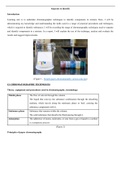
Separate to identify
Introduction
Learning aim is to undertake chromatographic techniques to identify components in mixture. Here, I will be
demonstrating my knowledge and understanding the skills used in a range of practical procedures and techniques,
which is required to identify substances. I will be recording the range of chromatographic techniques used to separate
and identify components in a mixture. In a report, I will explain the use of the technique, analyse and evaluate the
results and suggest improvements.
(Figure 1 - Simple-paper-chromatography-various-inks.jpg)
C1 CHROMATOGRAPHIC TECHNIQUES
Theory, equipment and procedures used in chromatography, terminology:
Mobile phase The flow of solvent through the column.
The liquid that conveys the substance combination through the absorbing
medium, which travels along the stationary phase or 'bed,' carrying the
substance components with it.
Stationary phase Substance that remains within the column.
The solid substance that absorbs the fluid passing through it.
Adsorption The adherence of atoms, molecules, or ions from a gas or liquid to a surface
is a temporary process.
(Figure 2)
Principles of paper chromatography
, (Figure 2 - Principle-of-Paper-chromatography.jpeg)
This technique is a type of partition chromatography in which the substances are distributed between two liquids, one
of which is the stationary liquid (usually water) held in the paper fibres and referred to as the stationary phase, and the
other of which is the moving liquid, also known as the developing solvent and referred to as the moving phase. In
paper chromatography, cellulose filter paper is frequently employed as the stationary phase. It is generally covered in
a thin coating of water because it is hydrophilic. Liquid-liquid chromatography is a common term for the technique.
The divided components travel at different rates and emerge as spots on the paper at different times. A drop of the test
solution is put as a small spot-on filter paper and dried in this process. The filter paper is held in a small chamber and
the edge is dipped into a solvent called developing solvent. The various compounds are transferred at varying rates by
the solvent system as soon as the filter paper receives the liquid through its capillary axis and reaches the spot of the
test solution. The paper is dried and various areas are visible using a reagent called a visualising agent after the solvent
has moved these substances to a proper height (15-18 cm).
Rf values are used to describe how compounds move in relation to the solvent (retardation factor or retention factor).
Rf: The R is connected to the solute front's movement relative to the solvent front as follows: The partition coefficient
is a function of R. It is constant for a given material if the chromatographic system's conditions are kept constant in
terms of temperature, paper type, development duration and direction, nature, shape, and size of the wick utilised (i.e.,
radial chromatography), amount of liquid in the reservoir humidity, and so on. In a given chromatographic system, the
Rf defines the mobility of the compounds relative to the solvent front.
The Rf value of a chemical is determined by several factors, including:
The solvent that was used was
The separation medium, or the quality of the paper in the case of paper chromatography.
The composition of the mixture
The temperature has risen.
The size of the vessel used to carry out the activity.
Principles of thin layer chromatography
Introduction
Learning aim is to undertake chromatographic techniques to identify components in mixture. Here, I will be
demonstrating my knowledge and understanding the skills used in a range of practical procedures and techniques,
which is required to identify substances. I will be recording the range of chromatographic techniques used to separate
and identify components in a mixture. In a report, I will explain the use of the technique, analyse and evaluate the
results and suggest improvements.
(Figure 1 - Simple-paper-chromatography-various-inks.jpg)
C1 CHROMATOGRAPHIC TECHNIQUES
Theory, equipment and procedures used in chromatography, terminology:
Mobile phase The flow of solvent through the column.
The liquid that conveys the substance combination through the absorbing
medium, which travels along the stationary phase or 'bed,' carrying the
substance components with it.
Stationary phase Substance that remains within the column.
The solid substance that absorbs the fluid passing through it.
Adsorption The adherence of atoms, molecules, or ions from a gas or liquid to a surface
is a temporary process.
(Figure 2)
Principles of paper chromatography
, (Figure 2 - Principle-of-Paper-chromatography.jpeg)
This technique is a type of partition chromatography in which the substances are distributed between two liquids, one
of which is the stationary liquid (usually water) held in the paper fibres and referred to as the stationary phase, and the
other of which is the moving liquid, also known as the developing solvent and referred to as the moving phase. In
paper chromatography, cellulose filter paper is frequently employed as the stationary phase. It is generally covered in
a thin coating of water because it is hydrophilic. Liquid-liquid chromatography is a common term for the technique.
The divided components travel at different rates and emerge as spots on the paper at different times. A drop of the test
solution is put as a small spot-on filter paper and dried in this process. The filter paper is held in a small chamber and
the edge is dipped into a solvent called developing solvent. The various compounds are transferred at varying rates by
the solvent system as soon as the filter paper receives the liquid through its capillary axis and reaches the spot of the
test solution. The paper is dried and various areas are visible using a reagent called a visualising agent after the solvent
has moved these substances to a proper height (15-18 cm).
Rf values are used to describe how compounds move in relation to the solvent (retardation factor or retention factor).
Rf: The R is connected to the solute front's movement relative to the solvent front as follows: The partition coefficient
is a function of R. It is constant for a given material if the chromatographic system's conditions are kept constant in
terms of temperature, paper type, development duration and direction, nature, shape, and size of the wick utilised (i.e.,
radial chromatography), amount of liquid in the reservoir humidity, and so on. In a given chromatographic system, the
Rf defines the mobility of the compounds relative to the solvent front.
The Rf value of a chemical is determined by several factors, including:
The solvent that was used was
The separation medium, or the quality of the paper in the case of paper chromatography.
The composition of the mixture
The temperature has risen.
The size of the vessel used to carry out the activity.
Principles of thin layer chromatography


