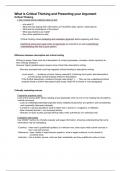
What is Critical Thinking and Presenting your Argument
Critical Thinking
1. Ask yourself some questions about a text
• who said it?
• What are they basing their information on? Scienti c data, opinion, observations
• What are the implications of the piece?
• What assumptions are made?
• (Any other questions to ask)
Critical thinking means analysing and evaluation argument before agreeing with them.
Identifying strong and weak points of arguments are important as well as identifying/
understanding why that is your opinion.
Di erence between descriptive and critical writing
Writing an essay, there must be a description of a topic (processes, concepts, others opinions) to.
a. then critically analyse it.
f
However higher graded essays require more critical then descriptive writing.
Structure example that could hep signpost critical thinking to descriptive writing:
-(main point) ….. (evidence of point: theory example?), Following from (point: add description)
…. ….. we should ask (critical analysis linked to description).
If the (further description, evidence through case study? ), …. Then we can understand (critical.
. analysis linked to further description/case study). (Add link to thesis or main paragraph)
o
Critically evaluating sources
Evaluating academic texts
Look at the source itself, before reading a text (especially when its not on the reading list provided by
module conveyor)
-Look at credibility(credentials/expertise level), reliability (trustworthy and perform well consistently).
. and impartiality (fairness/unbiased).
o
-A article in a journal (academic text) is better than a article in a magazine, or Website.
-Peer-reviewed articles > not reviewed articles
-Directory of open access journals (DOAJ) helps verify authenticity of a article/journal
Evaluating web pages
Use CRAAP method to critically evaluate web page information, showing understanding that some
information may be misleading.
If
-Currency : when was it published/updated, is it relevant now, does topic need current sources or .
o. can it use old sources.
p
-Relevance : does i relate to topic/answer question, what is target audience, is info aimed at. .
. university level.
-Authority : who is author, source, what are their credentials, are they quali ed to write on topic.
n
fi
, -Accuracy : is information supported by evidence/references, is there bias, is it peer reviewed, what
. is URL and is it trusted (is it .org .gov .edu .ac.uk)
i
-Purpose : is it to inform, persuade, sell, entertain ?, what is the main aim of the organisation for the.
. info, how does author bene t from it being read
Critical analysis shows awareness of strengths and weaknesses of source, choosing a source with
many strengths can help back up your argument best.
Evaluating News sources
• fact check using site like factcheck.org to check credibility and tinyeye.com for images
• Verify the URL
• Vet the source: are they who they say they are
• Loaded language: is the headline of the piece highly emotional/sensational, this is called
loaded language which is often manipulative and a form of clickbait.
• Adverts: loads of adverts usually mean they are very pro t based on driven by click-per-view
not journalistic integrity.
Tools to decent misinformation:
- wayback machine (check if its been taken o the net before)
- Snopes (hoax checker)
- Quote Investigator (quote checker)
- TinEye & Google reverse image search (verify images for authenticity)
- Politifact (political fact checker)
Identify and Evaluate arguments
Identifying arguments and reasons
Before being able to evaluate an argument, you need to identify it.
The introduction of a source is good at showing a summary and direction of the argument.
In paragraphs:
Conclusions in paragraphs, show clear argument that author is trying to make.
They are usually indicated by signposting phrases ei: so, therefore, as a result, as a.
. consequence, for this reason.
To nd the reasoning for the conclusion, they may be simply put before the conclusion or.
, signposted by phrases ei: because, since, as, the reasoning being, according to, considering.
There can be more than one reason.
Implicit assumptions
Writers can base their conclusions on assumptions (basic, general or cultural), keep an eye out.
. for them and decide if they a ect the conclusion.
I
From one main assumption, such as assuming that businesses fundamental goal is to be .
. pro t maximising, there can be made many other underlying assumptions.
A
Once these are found, you can decide if you agree with them and explore evidence.
ff fi
Critical Thinking
1. Ask yourself some questions about a text
• who said it?
• What are they basing their information on? Scienti c data, opinion, observations
• What are the implications of the piece?
• What assumptions are made?
• (Any other questions to ask)
Critical thinking means analysing and evaluation argument before agreeing with them.
Identifying strong and weak points of arguments are important as well as identifying/
understanding why that is your opinion.
Di erence between descriptive and critical writing
Writing an essay, there must be a description of a topic (processes, concepts, others opinions) to.
a. then critically analyse it.
f
However higher graded essays require more critical then descriptive writing.
Structure example that could hep signpost critical thinking to descriptive writing:
-(main point) ….. (evidence of point: theory example?), Following from (point: add description)
…. ….. we should ask (critical analysis linked to description).
If the (further description, evidence through case study? ), …. Then we can understand (critical.
. analysis linked to further description/case study). (Add link to thesis or main paragraph)
o
Critically evaluating sources
Evaluating academic texts
Look at the source itself, before reading a text (especially when its not on the reading list provided by
module conveyor)
-Look at credibility(credentials/expertise level), reliability (trustworthy and perform well consistently).
. and impartiality (fairness/unbiased).
o
-A article in a journal (academic text) is better than a article in a magazine, or Website.
-Peer-reviewed articles > not reviewed articles
-Directory of open access journals (DOAJ) helps verify authenticity of a article/journal
Evaluating web pages
Use CRAAP method to critically evaluate web page information, showing understanding that some
information may be misleading.
If
-Currency : when was it published/updated, is it relevant now, does topic need current sources or .
o. can it use old sources.
p
-Relevance : does i relate to topic/answer question, what is target audience, is info aimed at. .
. university level.
-Authority : who is author, source, what are their credentials, are they quali ed to write on topic.
n
fi
, -Accuracy : is information supported by evidence/references, is there bias, is it peer reviewed, what
. is URL and is it trusted (is it .org .gov .edu .ac.uk)
i
-Purpose : is it to inform, persuade, sell, entertain ?, what is the main aim of the organisation for the.
. info, how does author bene t from it being read
Critical analysis shows awareness of strengths and weaknesses of source, choosing a source with
many strengths can help back up your argument best.
Evaluating News sources
• fact check using site like factcheck.org to check credibility and tinyeye.com for images
• Verify the URL
• Vet the source: are they who they say they are
• Loaded language: is the headline of the piece highly emotional/sensational, this is called
loaded language which is often manipulative and a form of clickbait.
• Adverts: loads of adverts usually mean they are very pro t based on driven by click-per-view
not journalistic integrity.
Tools to decent misinformation:
- wayback machine (check if its been taken o the net before)
- Snopes (hoax checker)
- Quote Investigator (quote checker)
- TinEye & Google reverse image search (verify images for authenticity)
- Politifact (political fact checker)
Identify and Evaluate arguments
Identifying arguments and reasons
Before being able to evaluate an argument, you need to identify it.
The introduction of a source is good at showing a summary and direction of the argument.
In paragraphs:
Conclusions in paragraphs, show clear argument that author is trying to make.
They are usually indicated by signposting phrases ei: so, therefore, as a result, as a.
. consequence, for this reason.
To nd the reasoning for the conclusion, they may be simply put before the conclusion or.
, signposted by phrases ei: because, since, as, the reasoning being, according to, considering.
There can be more than one reason.
Implicit assumptions
Writers can base their conclusions on assumptions (basic, general or cultural), keep an eye out.
. for them and decide if they a ect the conclusion.
I
From one main assumption, such as assuming that businesses fundamental goal is to be .
. pro t maximising, there can be made many other underlying assumptions.
A
Once these are found, you can decide if you agree with them and explore evidence.
ff fi