Health and Development
Health, Education and Development
Health and development are fundamental dimensions of human development (Think HDI) and therefore
key inputs in production function. They act as compliminteries (they compliment each other)
Health has a impact on education (direct and indirect):
E.g. considering the rst 7 years matter for cognitive development, infant health can be factor/. . .
H
. (nutrition has impact on cognitive function). TT
. determinant in uencing school attendance (if ill can’t come to school) and educational attainment.
E.g Longer life expectancy increases returns to education.
Education has a impact on education (direct and indirect):
E.g. Education increases chances of higher wages, making better nutrition and better healthcare.
. more attainable (a ordable). p
I E.g. Education leads to improved health literacy, understanding of the healthcare system and.
. response to health programmes. n
E.g. Education may change time and risk preferences (delayed child-bearing, healthier lifestyle).
Growth and population health
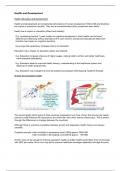
The second graph which looks at three countries progression over time, shows that income per capita
cannot by itself in uence life expectancy, and there are many other factors in uencing it. This is shown
through the di erences in changes between the countries.
Although there is a positive correlation between growth and population health, there is not always
causality.
Progress example: infant mortality in developing world (1950) approx: 280/1000
Infant mortality in developing world (2019) approx: 49/1000
Growth may not be enough to improve population health as public health expenditure may not increase
with GDP per capita: this in turn may fail to improve healthcare coverage, especially amongst the poor.
, Growth may lead to outlet burden of disease, there may be new/increases in diseases such as obesity,
heart disease and diabetes.
Increased income does not always lead to increased investment in health and education (look at
Banerjee & Du o, 2011) - shows that there is more of a demand for ‘backyard doctors’ than healthcare
such as hospital treatment.
Health-based poverty trap
Example: Sachs and Gallup (2001): poverty trap at country level, showing evidence of malaria and.
. poverty being intimately related, with control for in uencing factors, malaria infested. l
. countries were seen to have income levels of 33% of those without malaria. p
H
This cannot show if the malaria impacts income levels or if income levels impact malaria.
. (Correlation and not causation)
This can be rationalised to other illnesses.
Example: poverty trap at individual level, catastrophic health expenditure leading to further poverty.
Observation: low-income countries use mainly out-of-pocket payments (OOPs) as source of.
.
p
.
healthcare nance. A relative lack of prepayment mechanisms (tax and health.
insurance, NHS).
Theory: Health expenditures higher than a given proportion of household expenditure.
I
. (ones that can’t be a orded) are deemed catastrophic and lead to increased.
µ
4
. poverty due to ripples in budget, eg not being able to a ord food.
Practise: up to 5% of households pushed into poverty in developing world due to health.
. payments, according to the WHO.
Diagram on relation between OOP expenditure Diagram on relationship between OOP expenditure
and Gross National Income per capita. And households with catastrophic health .
. expenditure
h
Negative relationship. Positive relationship.
Solutions to Health based poverty trap Economists believe:
Most people are risk-averse (want
-Pooling risks: Healthcare nance in developing countries: to avoid risk) and would be willing
to pay to reduce/eliminate it.
Health, Education and Development
Health and development are fundamental dimensions of human development (Think HDI) and therefore
key inputs in production function. They act as compliminteries (they compliment each other)
Health has a impact on education (direct and indirect):
E.g. considering the rst 7 years matter for cognitive development, infant health can be factor/. . .
H
. (nutrition has impact on cognitive function). TT
. determinant in uencing school attendance (if ill can’t come to school) and educational attainment.
E.g Longer life expectancy increases returns to education.
Education has a impact on education (direct and indirect):
E.g. Education increases chances of higher wages, making better nutrition and better healthcare.
. more attainable (a ordable). p
I E.g. Education leads to improved health literacy, understanding of the healthcare system and.
. response to health programmes. n
E.g. Education may change time and risk preferences (delayed child-bearing, healthier lifestyle).
Growth and population health
The second graph which looks at three countries progression over time, shows that income per capita
cannot by itself in uence life expectancy, and there are many other factors in uencing it. This is shown
through the di erences in changes between the countries.
Although there is a positive correlation between growth and population health, there is not always
causality.
Progress example: infant mortality in developing world (1950) approx: 280/1000
Infant mortality in developing world (2019) approx: 49/1000
Growth may not be enough to improve population health as public health expenditure may not increase
with GDP per capita: this in turn may fail to improve healthcare coverage, especially amongst the poor.
, Growth may lead to outlet burden of disease, there may be new/increases in diseases such as obesity,
heart disease and diabetes.
Increased income does not always lead to increased investment in health and education (look at
Banerjee & Du o, 2011) - shows that there is more of a demand for ‘backyard doctors’ than healthcare
such as hospital treatment.
Health-based poverty trap
Example: Sachs and Gallup (2001): poverty trap at country level, showing evidence of malaria and.
. poverty being intimately related, with control for in uencing factors, malaria infested. l
. countries were seen to have income levels of 33% of those without malaria. p
H
This cannot show if the malaria impacts income levels or if income levels impact malaria.
. (Correlation and not causation)
This can be rationalised to other illnesses.
Example: poverty trap at individual level, catastrophic health expenditure leading to further poverty.
Observation: low-income countries use mainly out-of-pocket payments (OOPs) as source of.
.
p
.
healthcare nance. A relative lack of prepayment mechanisms (tax and health.
insurance, NHS).
Theory: Health expenditures higher than a given proportion of household expenditure.
I
. (ones that can’t be a orded) are deemed catastrophic and lead to increased.
µ
4
. poverty due to ripples in budget, eg not being able to a ord food.
Practise: up to 5% of households pushed into poverty in developing world due to health.
. payments, according to the WHO.
Diagram on relation between OOP expenditure Diagram on relationship between OOP expenditure
and Gross National Income per capita. And households with catastrophic health .
. expenditure
h
Negative relationship. Positive relationship.
Solutions to Health based poverty trap Economists believe:
Most people are risk-averse (want
-Pooling risks: Healthcare nance in developing countries: to avoid risk) and would be willing
to pay to reduce/eliminate it.