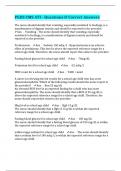
PEDS CMS ATI - Questions & Correct Answers The nurse should identify that vomiting, especially unrelated to feedings, is a manifestation of digoxin toxicity and should be reported to the provider. ✔ Ans - Vomiting - The nurse should identify that vomiting, especially unrelated to feedings, is a manifestation of digoxin toxicity and should be reported to the provider.
Predniosone ✔ Ans - Sodium 150 mEq/L - Hypernatremia is an adverse effect of prednisone. This level is above the expected reference range for a school-age child. Therefore, the nurse should report this value to the provider.
Fasting blood glucose for school age child ✔ Ans - 74mg/dL
Potassium level for school age child ✔ Ans - 4.2 mEq/L
WBC count for a school age child ✔ Ans - 9400 / mm3
A nurse is reviewing the lab results for a school age child who has acute glomerulonephritis. Which of the following results should the nurse report to the provider? ✔ Ans - Bun 25 mg/dL
An elevated BUN level is an expected finding for a child who has acute glomerulonephritis. The nurse should identify that a BUN of 25 mg/dL is above the expected reference range for a school-age child. Therefore, the nurse should report this result to the provider.
Hbg level in school age child ✔ Ans - Hgb 13 g/dL
The nurse should identify that a Hgb of 13 g/dL is within the expected reference range for a school-age child.
Fasting blood glucose for school age child ✔ Ans - 105 mg/dL
The nurse should identify that a fasting blood glucose of 105 mg/dL is within the expected reference range for a school-age child.
within range sodium for school age child ✔ Ans - The nurse should identify that a sodium level of 140 mEq/L is within the expected reference range for a school-age child. A nurse is reviewing the laboratory report of an adolescent who has respiratory alkalosis. Which of the following lab results should the nurse expect? ✔ Ans - pH 7.49
The nurse should identify that a pH of 7.49 is above the expected reference range and indicates respiratory or metabolic alkalosis.
s/s hypernatremia: FRIED ✔ Ans - F: fever
R: restless
I: increased BP
E: edema
D: decreased urinary output
flushed skin Hypernatremia is a condition caused by excessive sodium intake, fever, or renal disease. The manifestations include increased thirst, hoarseness, nausea, vomiting, and flushed skin.
Cobb technique ✔ Ans - Scoliosis - measure degree of curvature to diagnose
curvature < 25 degrees: re assess every 6 months
curvature > 25 degrees: refer for external bracing
curvature > 40 degrees: surgery
Risser scale ✔ Ans - xray to determine skeletal maturity
head circumference of full term newborn ✔ Ans - 33 and 35 cm (13 and 14 in)
Crown to rump length in full term newborn ✔ Ans - 31 to 35 cm (12.5 to 14 in), approx. equal to head circumference
Length of newborn full term ✔ Ans - average head o heel length: 19-21 inche)
Average weight of newborn full term ✔ Ans - 2,700 to 4,000 g ( 6 to 9 lb)
immunizations ✔ Ans - birth: hep B 2 months: diphtheria and tetanus toxoids and pertusssis (DTaP), roavirus vaccine (RV), inactibated poliiovirus (IPV), haemophilus influenzae type B (Hib), pneumoccal vaccine (PCV) and Hep B 4 months: DTaP, RV, IPA, Hib, PCV
6 months: DTaP, IPV (6 to 18 months), PCV, and Hep B (6 to 18 months), RV; Hib
6 - 12 months seasonal influenza vaccination yearly (the inactivated influenza vacccine is aailable as an intramuscular injection)
Sodium level range ✔ Ans - 134-150 mEq/L
potassium range for school age child ✔ Ans - 3.7 to 5.2
which asthma medication for an acute attack? ✔ Ans - Levalbuterol - short actinb beta2 agonist, to the preschooler for acute asthma attacks
Haemophilus influenza type b (HIB) ✔ Ans - series administered by 18 months of age
Rotavirus (RV) ✔ Ans - 2, 4, 6 months
Polio (IPV) ✔ Ans - complete by 6 yo
Tdap vaccine ✔ Ans - 11-12 years
Hgb level ✔ Ans - 10 to 15.5 g/dL
Na (Sodium) ✔ Ans - 135-145
Calcium range ✔ Ans - 9.0-10.5
lead ✔ Ans - lower than 9
creatinine ✔ Ans - 0.5-1.2 critical >7.4, renal insufficiency if 1.5-3
albumin ✔ Ans - 3.5-5 g/dL
WBC ✔ Ans - 5,000 to 13,000
platelets ✔ Ans - 150,000-450,000 cu/mm
Predniosone ✔ Ans - Sodium 150 mEq/L - Hypernatremia is an adverse effect of prednisone. This level is above the expected reference range for a school-age child. Therefore, the nurse should report this value to the provider.
Fasting blood glucose for school age child ✔ Ans - 74mg/dL
Potassium level for school age child ✔ Ans - 4.2 mEq/L
WBC count for a school age child ✔ Ans - 9400 / mm3
A nurse is reviewing the lab results for a school age child who has acute glomerulonephritis. Which of the following results should the nurse report to the provider? ✔ Ans - Bun 25 mg/dL
An elevated BUN level is an expected finding for a child who has acute glomerulonephritis. The nurse should identify that a BUN of 25 mg/dL is above the expected reference range for a school-age child. Therefore, the nurse should report this result to the provider.
Hbg level in school age child ✔ Ans - Hgb 13 g/dL
The nurse should identify that a Hgb of 13 g/dL is within the expected reference range for a school-age child.
Fasting blood glucose for school age child ✔ Ans - 105 mg/dL
The nurse should identify that a fasting blood glucose of 105 mg/dL is within the expected reference range for a school-age child.
within range sodium for school age child ✔ Ans - The nurse should identify that a sodium level of 140 mEq/L is within the expected reference range for a school-age child. A nurse is reviewing the laboratory report of an adolescent who has respiratory alkalosis. Which of the following lab results should the nurse expect? ✔ Ans - pH 7.49
The nurse should identify that a pH of 7.49 is above the expected reference range and indicates respiratory or metabolic alkalosis.
s/s hypernatremia: FRIED ✔ Ans - F: fever
R: restless
I: increased BP
E: edema
D: decreased urinary output
flushed skin Hypernatremia is a condition caused by excessive sodium intake, fever, or renal disease. The manifestations include increased thirst, hoarseness, nausea, vomiting, and flushed skin.
Cobb technique ✔ Ans - Scoliosis - measure degree of curvature to diagnose
curvature < 25 degrees: re assess every 6 months
curvature > 25 degrees: refer for external bracing
curvature > 40 degrees: surgery
Risser scale ✔ Ans - xray to determine skeletal maturity
head circumference of full term newborn ✔ Ans - 33 and 35 cm (13 and 14 in)
Crown to rump length in full term newborn ✔ Ans - 31 to 35 cm (12.5 to 14 in), approx. equal to head circumference
Length of newborn full term ✔ Ans - average head o heel length: 19-21 inche)
Average weight of newborn full term ✔ Ans - 2,700 to 4,000 g ( 6 to 9 lb)
immunizations ✔ Ans - birth: hep B 2 months: diphtheria and tetanus toxoids and pertusssis (DTaP), roavirus vaccine (RV), inactibated poliiovirus (IPV), haemophilus influenzae type B (Hib), pneumoccal vaccine (PCV) and Hep B 4 months: DTaP, RV, IPA, Hib, PCV
6 months: DTaP, IPV (6 to 18 months), PCV, and Hep B (6 to 18 months), RV; Hib
6 - 12 months seasonal influenza vaccination yearly (the inactivated influenza vacccine is aailable as an intramuscular injection)
Sodium level range ✔ Ans - 134-150 mEq/L
potassium range for school age child ✔ Ans - 3.7 to 5.2
which asthma medication for an acute attack? ✔ Ans - Levalbuterol - short actinb beta2 agonist, to the preschooler for acute asthma attacks
Haemophilus influenza type b (HIB) ✔ Ans - series administered by 18 months of age
Rotavirus (RV) ✔ Ans - 2, 4, 6 months
Polio (IPV) ✔ Ans - complete by 6 yo
Tdap vaccine ✔ Ans - 11-12 years
Hgb level ✔ Ans - 10 to 15.5 g/dL
Na (Sodium) ✔ Ans - 135-145
Calcium range ✔ Ans - 9.0-10.5
lead ✔ Ans - lower than 9
creatinine ✔ Ans - 0.5-1.2 critical >7.4, renal insufficiency if 1.5-3
albumin ✔ Ans - 3.5-5 g/dL
WBC ✔ Ans - 5,000 to 13,000
platelets ✔ Ans - 150,000-450,000 cu/mm