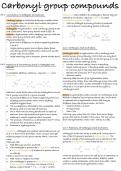
Carbonyl group compounds
26.1 Introduction to aldehydes and ketones: Reduction-when added to an aldehyde or ketone they are
reduced to an alcohol, requires NaBH4, to create
Carbonyl group: a double bond between a carbon atom nucleophile hydride ion (H-).
and oxygen atom, the double bond makes this planar • with an aldehyde a primary alcohol is produced
and therefore allows racemic mixtures. • With a ketone a secondary alcohol is formed.
Aldehydes: a hydrocarbon with a carbonyl group at the
end of the chain, have group RCHO with suffic -al
Ketone: a hydrocarbon with a carbonyl group inside the
chain, have group RCOR with suffix -one.
Physical properties-
• polar due to difference in Electronegativity between
C and O
• Higher boiling point, due to dipole-dipole forces. 26.3 Carboxylic acids and esters:
• Solubility, shorter hydrocarbon chains are soluble
longer ones are insoluble Carboxylic acids: a hydrocarbon with a carbonyl and
• High reactivity due to the polar, planar double bond alcohol group, giving family COOH that can only be at
the end of a chain. A weak acid as the OH group is on the
same carbon as the carbonyl group.
26.2 Reactions of the carbonyl group in aldehydes and • soluble with short chains, due to H bonding
ketones: • higher melting point, H bonding needs more energy
to overcome due to the large electrostatic attraction
Nucleophilic addition reactions- requires KCN and between the molecules (H+ and lone pairs)
dilute HCl. • distinct smells
Naming-take the root of the hydrocarbon chain
including the carbon from the carbonyl group, then add
-oic acid as the suffix. Unless attached to a benzene ring
where the C is not part of the root and the suffix is
-Carboxylic acid.
Reaction would be the same with an aldehyde but one of
the R groups would be a H group instead. Esters: a hydrocarbon chain similar to a Carboxylic acid,
1. Due to the difference in Electronegativity there is a however instead of the OH group there’s OR’, the H atom
slightly positive carbon atom and a slightly is replaced with a hydrocarbon chain that may be
negative oxygen atom different from the original chain. RCOOR’.
2. The nucleophile is attracted to the nucleophile, dative • volatile if chain is short
bonding with it’s lone pair of electrons • Fruity smells
3. The C atom has too many bonds and so a pair of • Fats / oils
electrons from the double bond goes to the O atom, Naming- you name the OR’ chain first as an alkyl
making it overall negative with a lone pair group, this acts as a prefix to the name. The root comes
4. The lone pair of electrons is attracted to the H+ from from the hydrocarbon chain with -oate as a suffix.
the dilute HCl and dative bonds
5. Produces a hydroxynitrile
26.4 Reactions of Carboxylic acids and esters.
Oxidation-aldehydes are oxidised whilst ketones are not
as a C-C bond must be broken, when using a stronger Carboxylic acids can act as a weak acid, losing the H+
oxidising agent it will give a shorter chain, CO2 and ion of the OH group to produce a carboxylate ion. The
water. negative charge of the carboxylate ion is shared over the
Fehling’s test: group as delocalisation, this make the ion more stable.
1. Add fehlings solution and heat
2. If an aldehyde is present the blue solution will turn
a brick red precipitate, if a ketone is present there is
no change
Tollen’s (silver mirror) test: With the equilibrium over to the left as it’s a weak acid. It
1. Add Tollen’s reagent and heat can still form ionic salts with metals, alkalis, metal
2. If an aldehyde is present a silver mirror and/or a oxides or metal carbonates. Salts have the suffix -Oates
black precipitate will from. No change if it’s a with the root of the acid hydrocarbon chain.
ketone. [Ag(NH3)2]+ + e- —-> Ag + 2NH3
26.1 Introduction to aldehydes and ketones: Reduction-when added to an aldehyde or ketone they are
reduced to an alcohol, requires NaBH4, to create
Carbonyl group: a double bond between a carbon atom nucleophile hydride ion (H-).
and oxygen atom, the double bond makes this planar • with an aldehyde a primary alcohol is produced
and therefore allows racemic mixtures. • With a ketone a secondary alcohol is formed.
Aldehydes: a hydrocarbon with a carbonyl group at the
end of the chain, have group RCHO with suffic -al
Ketone: a hydrocarbon with a carbonyl group inside the
chain, have group RCOR with suffix -one.
Physical properties-
• polar due to difference in Electronegativity between
C and O
• Higher boiling point, due to dipole-dipole forces. 26.3 Carboxylic acids and esters:
• Solubility, shorter hydrocarbon chains are soluble
longer ones are insoluble Carboxylic acids: a hydrocarbon with a carbonyl and
• High reactivity due to the polar, planar double bond alcohol group, giving family COOH that can only be at
the end of a chain. A weak acid as the OH group is on the
same carbon as the carbonyl group.
26.2 Reactions of the carbonyl group in aldehydes and • soluble with short chains, due to H bonding
ketones: • higher melting point, H bonding needs more energy
to overcome due to the large electrostatic attraction
Nucleophilic addition reactions- requires KCN and between the molecules (H+ and lone pairs)
dilute HCl. • distinct smells
Naming-take the root of the hydrocarbon chain
including the carbon from the carbonyl group, then add
-oic acid as the suffix. Unless attached to a benzene ring
where the C is not part of the root and the suffix is
-Carboxylic acid.
Reaction would be the same with an aldehyde but one of
the R groups would be a H group instead. Esters: a hydrocarbon chain similar to a Carboxylic acid,
1. Due to the difference in Electronegativity there is a however instead of the OH group there’s OR’, the H atom
slightly positive carbon atom and a slightly is replaced with a hydrocarbon chain that may be
negative oxygen atom different from the original chain. RCOOR’.
2. The nucleophile is attracted to the nucleophile, dative • volatile if chain is short
bonding with it’s lone pair of electrons • Fruity smells
3. The C atom has too many bonds and so a pair of • Fats / oils
electrons from the double bond goes to the O atom, Naming- you name the OR’ chain first as an alkyl
making it overall negative with a lone pair group, this acts as a prefix to the name. The root comes
4. The lone pair of electrons is attracted to the H+ from from the hydrocarbon chain with -oate as a suffix.
the dilute HCl and dative bonds
5. Produces a hydroxynitrile
26.4 Reactions of Carboxylic acids and esters.
Oxidation-aldehydes are oxidised whilst ketones are not
as a C-C bond must be broken, when using a stronger Carboxylic acids can act as a weak acid, losing the H+
oxidising agent it will give a shorter chain, CO2 and ion of the OH group to produce a carboxylate ion. The
water. negative charge of the carboxylate ion is shared over the
Fehling’s test: group as delocalisation, this make the ion more stable.
1. Add fehlings solution and heat
2. If an aldehyde is present the blue solution will turn
a brick red precipitate, if a ketone is present there is
no change
Tollen’s (silver mirror) test: With the equilibrium over to the left as it’s a weak acid. It
1. Add Tollen’s reagent and heat can still form ionic salts with metals, alkalis, metal
2. If an aldehyde is present a silver mirror and/or a oxides or metal carbonates. Salts have the suffix -Oates
black precipitate will from. No change if it’s a with the root of the acid hydrocarbon chain.
ketone. [Ag(NH3)2]+ + e- —-> Ag + 2NH3