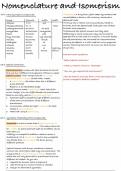
Nomenclature and Isomerism
25.1 Naming organic compounds: Thalidomide-a drug from 1950s taken by mothers that
caused babies to be born with missing, shortened or
Group formula suffix prefix deformed limbs.
Alkenes. C=C -ene The drug was to reduce morning sickness, tested on
Halogenoalkanes R—X Halo- animals and was deemed safe, although none of these
Carboxylate acids RCOOH -oic acid animals were pregnant.
Anhydrides RCOOCOR’ -anhydride Thalidomide has optical isomers and they react
Esters RCOOR’ -oate differently to chiral molecules, they were too hard to
Acyl chlorides RCOCl -oyl chloride separate and so were sold as a mixture. In human bodies
Amides RCONH2 -amide the safe enantiomer was converted into the enantiomer
Aldehydes RCHO -al causing the defects. It is still used but not on pregnant
Ketones RCOR’ -one women, following this event we must now have human
Alcohols ROH -ol hydroxy- drug trials.
Amines RNH2. -amine amino-
Arenes C6H5R
Common exam questions:
“Define optical isomerism”
25.2 Optical Isomerism: “What’s a racemic mixture / racemate?”
Stereoisomerism: compounds have the same structural “How can you separate the enantiomers?”
formula but a different arrangement of atoms in space
Optical isomers: when compounds are non-super “How do racemic mixtures form?, Draw the mechanism
impossible mirror images of each other. Needs; for the nucleophilic addition reaction”
• a chiral carbon, the carbon atom has 4 different
group attached
• Based on a 3D tetrahedral shape
Optical isomers create enantiomers (each side of the
mirror image). You can differ between the enantiomers
based on how they react to plane polarised light.
1. Polarised light is passed through different solutions
of the same concentration of the different
enantiomers.
2. One solution rotates the light clockwise, the other
rotates it anti-clockwise
3. Measured using a polarimeter.
25.3 synthesis of optically active compounds:
Racemate: a mixture where there’s equal amounts of
each enantiomer in a 50:50 ratio. This means there will
be no effect on plane polarised light as the effects cancel
each other out.
Made by a nucleophillic addition reaction across a
double bond, it’s a planar bond and so the nucleophile
can attack from above or below the bond, giving
different products.
Optical isomers with drugs, sometime a racemic
mixture can work others need only one enantiomer. The
enzyme has a specific tertiary structure and so the
active site will only bind with 1 enantiomer due to the
different 3D shapes. So you can,
1. separate the isomers which is expensive
2. Sell the drug as a mixture which is wasteful
3. Design an alternative synthesis
25.1 Naming organic compounds: Thalidomide-a drug from 1950s taken by mothers that
caused babies to be born with missing, shortened or
Group formula suffix prefix deformed limbs.
Alkenes. C=C -ene The drug was to reduce morning sickness, tested on
Halogenoalkanes R—X Halo- animals and was deemed safe, although none of these
Carboxylate acids RCOOH -oic acid animals were pregnant.
Anhydrides RCOOCOR’ -anhydride Thalidomide has optical isomers and they react
Esters RCOOR’ -oate differently to chiral molecules, they were too hard to
Acyl chlorides RCOCl -oyl chloride separate and so were sold as a mixture. In human bodies
Amides RCONH2 -amide the safe enantiomer was converted into the enantiomer
Aldehydes RCHO -al causing the defects. It is still used but not on pregnant
Ketones RCOR’ -one women, following this event we must now have human
Alcohols ROH -ol hydroxy- drug trials.
Amines RNH2. -amine amino-
Arenes C6H5R
Common exam questions:
“Define optical isomerism”
25.2 Optical Isomerism: “What’s a racemic mixture / racemate?”
Stereoisomerism: compounds have the same structural “How can you separate the enantiomers?”
formula but a different arrangement of atoms in space
Optical isomers: when compounds are non-super “How do racemic mixtures form?, Draw the mechanism
impossible mirror images of each other. Needs; for the nucleophilic addition reaction”
• a chiral carbon, the carbon atom has 4 different
group attached
• Based on a 3D tetrahedral shape
Optical isomers create enantiomers (each side of the
mirror image). You can differ between the enantiomers
based on how they react to plane polarised light.
1. Polarised light is passed through different solutions
of the same concentration of the different
enantiomers.
2. One solution rotates the light clockwise, the other
rotates it anti-clockwise
3. Measured using a polarimeter.
25.3 synthesis of optically active compounds:
Racemate: a mixture where there’s equal amounts of
each enantiomer in a 50:50 ratio. This means there will
be no effect on plane polarised light as the effects cancel
each other out.
Made by a nucleophillic addition reaction across a
double bond, it’s a planar bond and so the nucleophile
can attack from above or below the bond, giving
different products.
Optical isomers with drugs, sometime a racemic
mixture can work others need only one enantiomer. The
enzyme has a specific tertiary structure and so the
active site will only bind with 1 enantiomer due to the
different 3D shapes. So you can,
1. separate the isomers which is expensive
2. Sell the drug as a mixture which is wasteful
3. Design an alternative synthesis