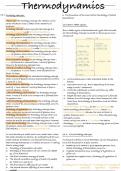
Thermodynamics
17.1 Enthalpy changes: 6. The formation of the ionic lattice (Enthalpy of lattice
association)
Hess’s law: the Enthalpy change of a reaction is the
same whichever route is taken from reactants to
17.2 Born-Haber cycles:
products.
Enthalpy change: measuring the heat change at a
Born-Haber cycle: a thermochemical cycle that includes
constant pressure under standard conditions.
all the enthalpy changes involved in forming an ionic
Enthalpy of formation: the Enthalpy change when 1
compound.
mole of a product is made from it’s elements in their
standard states under standard conditions.
Enthalpy of combustion: the enthalpy change when 1
mole of a substance is completely burnt in oxygen,
whilst in it’s standard state under standard conditions
Enthalpy of atomisation: the Enthalpy change when 1
mole of gaseous atoms form from it’s element in it’s
statute state under standard conditions.
First ionisation energy: the Enthalpy change when 1
mole of electrons is removed from 1 mole of gaseous
atoms to for positively charged ions
Second ionisation energy: the enthalpy change when 1
mole of gaseous +1 ions loses 1 mole of electrons to
form +2 ions.
First electron affinity: the standard Enthalpy change
when a mole of gaseous atoms receives electrons to form 1. Write substances in their standard states at the
1 mole of -1 ions bottom.
second electron affinity: the Enthalpy change when 1 2. Next draw arrow up / down depending if the next
mole of -1 ions receives 1 mole of electrons to form 1 stage is endo / exothermic
mole of gaseous -2 ions. 3. Write the substances in there next from eg. After
Lattice Enthalpy of formation: the Enthalpy change enthalpy of atomisation
when 1 mole of a solid ionic compound is formed from 4. Repeat for each step until ionic compound is formed
its gaseous ions 5. Bottom line will always show ionic compound, with
Lattice Enthalpy of dissociation: the enthalpy change lines from the enthalpy of formation and the lattice
when 1 mole of an ionic compound dissociates into it’s association.
gaseous ions. Trend for lattice Enthalpy, as the ions get larger the
Enthalpy of hydration: the Enthalpy change when lattice enthalpy dissociation decreases, there’s less
water molecules surround one mole of gaseous ions electrostatic attraction between the ions as there’s a
Enthalpy of solution: the Enthalpy change when one greater distance and more shielding from the positively
mole of a solute dissolves in enough solvent so the changed nucleus.
molecules are far enough apart that they don’t interact. When using ions with a +/- 2 charge the lattice
Mean bond enthalpy: the enthalpy change when 1 mole Enthalpy increases as there’s more energy given out from
of gaseous molecules breaks a covalent bond to form two ions coming together.
free radicals, averaged over many compounds.
In ionic bonding a metal and a non metal react, where 17.3 More Enthalpy changes:
the metal donates an electron (is oxidised) and the non-
metal receives the electron (is reduced) forming ions To dissolve a lattice is must be broken up into the gaseous
that arrange themselves in a lattice structure. In reality ions and dissolved in a polar solvent.
there’s many steps. 1. breaking ionic lattice to give separate gaseous ions,
1. Enthalpy of atomisation of metal lattice Enthalpy of dissociation is put in.
2. Enthalpy of atomisation of non-metal (if needed 2. Hydrate the positive ions, enthalpy of hydration is
eg. If it’s diatomic) given out
3. The first ionisation energy of metal 3. Hydrate the negative ions, Enthalpy of hydration is
4. The second ionisation energy of metal (if needed, given out
eg. Metal is in group 2)
5. The first electron affinity of non-metal Enthalpy of sol.=enthalpy of + enthalpy of + enthalpy of
6. The second electron affinity of non-metal (if Lattice dis. Hydration. Hydration
needed)
17.1 Enthalpy changes: 6. The formation of the ionic lattice (Enthalpy of lattice
association)
Hess’s law: the Enthalpy change of a reaction is the
same whichever route is taken from reactants to
17.2 Born-Haber cycles:
products.
Enthalpy change: measuring the heat change at a
Born-Haber cycle: a thermochemical cycle that includes
constant pressure under standard conditions.
all the enthalpy changes involved in forming an ionic
Enthalpy of formation: the Enthalpy change when 1
compound.
mole of a product is made from it’s elements in their
standard states under standard conditions.
Enthalpy of combustion: the enthalpy change when 1
mole of a substance is completely burnt in oxygen,
whilst in it’s standard state under standard conditions
Enthalpy of atomisation: the Enthalpy change when 1
mole of gaseous atoms form from it’s element in it’s
statute state under standard conditions.
First ionisation energy: the Enthalpy change when 1
mole of electrons is removed from 1 mole of gaseous
atoms to for positively charged ions
Second ionisation energy: the enthalpy change when 1
mole of gaseous +1 ions loses 1 mole of electrons to
form +2 ions.
First electron affinity: the standard Enthalpy change
when a mole of gaseous atoms receives electrons to form 1. Write substances in their standard states at the
1 mole of -1 ions bottom.
second electron affinity: the Enthalpy change when 1 2. Next draw arrow up / down depending if the next
mole of -1 ions receives 1 mole of electrons to form 1 stage is endo / exothermic
mole of gaseous -2 ions. 3. Write the substances in there next from eg. After
Lattice Enthalpy of formation: the Enthalpy change enthalpy of atomisation
when 1 mole of a solid ionic compound is formed from 4. Repeat for each step until ionic compound is formed
its gaseous ions 5. Bottom line will always show ionic compound, with
Lattice Enthalpy of dissociation: the enthalpy change lines from the enthalpy of formation and the lattice
when 1 mole of an ionic compound dissociates into it’s association.
gaseous ions. Trend for lattice Enthalpy, as the ions get larger the
Enthalpy of hydration: the Enthalpy change when lattice enthalpy dissociation decreases, there’s less
water molecules surround one mole of gaseous ions electrostatic attraction between the ions as there’s a
Enthalpy of solution: the Enthalpy change when one greater distance and more shielding from the positively
mole of a solute dissolves in enough solvent so the changed nucleus.
molecules are far enough apart that they don’t interact. When using ions with a +/- 2 charge the lattice
Mean bond enthalpy: the enthalpy change when 1 mole Enthalpy increases as there’s more energy given out from
of gaseous molecules breaks a covalent bond to form two ions coming together.
free radicals, averaged over many compounds.
In ionic bonding a metal and a non metal react, where 17.3 More Enthalpy changes:
the metal donates an electron (is oxidised) and the non-
metal receives the electron (is reduced) forming ions To dissolve a lattice is must be broken up into the gaseous
that arrange themselves in a lattice structure. In reality ions and dissolved in a polar solvent.
there’s many steps. 1. breaking ionic lattice to give separate gaseous ions,
1. Enthalpy of atomisation of metal lattice Enthalpy of dissociation is put in.
2. Enthalpy of atomisation of non-metal (if needed 2. Hydrate the positive ions, enthalpy of hydration is
eg. If it’s diatomic) given out
3. The first ionisation energy of metal 3. Hydrate the negative ions, Enthalpy of hydration is
4. The second ionisation energy of metal (if needed, given out
eg. Metal is in group 2)
5. The first electron affinity of non-metal Enthalpy of sol.=enthalpy of + enthalpy of + enthalpy of
6. The second electron affinity of non-metal (if Lattice dis. Hydration. Hydration
needed)