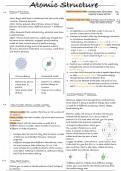
Atomic Structure
Il
1.1 History of the Atom: Relative atomic mass: average mass of an atom X1
mass of 1 atom of C12. 12
1661: Boyle said there’s substances that cannot be made
Relative molecular mass:average mass of molecule X 1
smaller, chemical elements
mass of 1 atom of C12. 12
1803: Dalton proposes idea of atoms, atoms of same
element have same mass, different element = different
Process-
mass
1. all apparatus must be kept under a vacuum to
1896: becquerel finds radioactivity, particles come from
prevent interruptions from the air
inside the atom
2. Sample is ionised, either by electrospray ionisation
1897: Thomas finds electrons, negatively charged and
or via electron bombardment.
the same across elements, suggests plum pudding
- electrospray, the sample is dissolved in a volatile
model as there must be source of positive energy.
solution and passed through a fine needle attached
1911: Rutherford says most of the positive mass is
to the positive terminal of a high-voltage battery.
found in the centre of the atom in a nucleus, made from
X(g) + H+ ——-> XH(g)
sub-atomic particles
- electron bombardment, sample has an electron
knocked off as it’s fired at by a high energy
electron gun
X(g) ———> X+1 (g) + e-
3. Positive ions created are attracted to the negatively
charged plate, atoms are accelerated to the same
kinetic energy
4. Ions then drift through the tube at speeds depending
Plum pudding Rutherford Model on their mass/charge ratio. The smaller highly
charged atoms meet the detector first
• electrons as plums • electrons in orbitals 5. The ions are detected at the plate, the positive ions
• Whole atom is • positive charge in accept an electron, are reduced to produce a current
positive nucleus that’s directly proportional to their abundance
• Mass across whole • Mass in the nucleus
of atom only
1.5 Arrangement of Electrons:
Electrons shapes have changed from solid particles
to the idea of it being a spread of charge, each model
1.2 Mass Number, Atomic number, isotopes: is used for a different purpose eg. Shells, shapes,
bond polarity etc.
Atomic number: the number of protons in the nucleus of
an element Electron shells, the amount of shells will tell you
Mass number: the total number of protons and neutrons what period the element is in, the number of
in nucleus electrons in it’s outer shell will tell you it’s group
Isotope: atoms with the same mass number but a and therefore the chemical properties
different atomic number, same number of neutrons, A simple configuration shows you
different number of protons. the number of electrons in each
shell, a complex configurations
• isotopes react the same as they have the same number shows which electrons are in each
of electrons and therefore the same chemical orbital and then the spin of each
properties electron.
• Different isotopes have different abundances, some 3 types of orbital, s can hold 2 e-, p can hold 6, and
are more common than others eg. C14 vs. C13 d can hold 10, you fist fill 1 e- in each orbital due to
• some isotopes are unstable and parts of the nucleus spin and then start to pair them. Makes the atom
come apart, making It radioactive, leading to decay, most stable and reduces repulsion
half lives and carbon dating
1.4 Mass Spectrometry:
Different electron orbitals have different energy
Allows you to measure the abundance of each isotope of levels, you must the fill the orbitals starting from
an element the lowest energy level
Il
1.1 History of the Atom: Relative atomic mass: average mass of an atom X1
mass of 1 atom of C12. 12
1661: Boyle said there’s substances that cannot be made
Relative molecular mass:average mass of molecule X 1
smaller, chemical elements
mass of 1 atom of C12. 12
1803: Dalton proposes idea of atoms, atoms of same
element have same mass, different element = different
Process-
mass
1. all apparatus must be kept under a vacuum to
1896: becquerel finds radioactivity, particles come from
prevent interruptions from the air
inside the atom
2. Sample is ionised, either by electrospray ionisation
1897: Thomas finds electrons, negatively charged and
or via electron bombardment.
the same across elements, suggests plum pudding
- electrospray, the sample is dissolved in a volatile
model as there must be source of positive energy.
solution and passed through a fine needle attached
1911: Rutherford says most of the positive mass is
to the positive terminal of a high-voltage battery.
found in the centre of the atom in a nucleus, made from
X(g) + H+ ——-> XH(g)
sub-atomic particles
- electron bombardment, sample has an electron
knocked off as it’s fired at by a high energy
electron gun
X(g) ———> X+1 (g) + e-
3. Positive ions created are attracted to the negatively
charged plate, atoms are accelerated to the same
kinetic energy
4. Ions then drift through the tube at speeds depending
Plum pudding Rutherford Model on their mass/charge ratio. The smaller highly
charged atoms meet the detector first
• electrons as plums • electrons in orbitals 5. The ions are detected at the plate, the positive ions
• Whole atom is • positive charge in accept an electron, are reduced to produce a current
positive nucleus that’s directly proportional to their abundance
• Mass across whole • Mass in the nucleus
of atom only
1.5 Arrangement of Electrons:
Electrons shapes have changed from solid particles
to the idea of it being a spread of charge, each model
1.2 Mass Number, Atomic number, isotopes: is used for a different purpose eg. Shells, shapes,
bond polarity etc.
Atomic number: the number of protons in the nucleus of
an element Electron shells, the amount of shells will tell you
Mass number: the total number of protons and neutrons what period the element is in, the number of
in nucleus electrons in it’s outer shell will tell you it’s group
Isotope: atoms with the same mass number but a and therefore the chemical properties
different atomic number, same number of neutrons, A simple configuration shows you
different number of protons. the number of electrons in each
shell, a complex configurations
• isotopes react the same as they have the same number shows which electrons are in each
of electrons and therefore the same chemical orbital and then the spin of each
properties electron.
• Different isotopes have different abundances, some 3 types of orbital, s can hold 2 e-, p can hold 6, and
are more common than others eg. C14 vs. C13 d can hold 10, you fist fill 1 e- in each orbital due to
• some isotopes are unstable and parts of the nucleus spin and then start to pair them. Makes the atom
come apart, making It radioactive, leading to decay, most stable and reduces repulsion
half lives and carbon dating
1.4 Mass Spectrometry:
Different electron orbitals have different energy
Allows you to measure the abundance of each isotope of levels, you must the fill the orbitals starting from
an element the lowest energy level