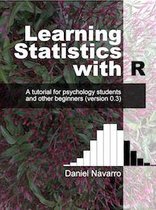
Learning statistics with R:
A tutorial for psychology students and other beginners
(Version 0.6)
Selected chapters from Navarro, D. (2015). Learning statistics
with R. Retrievable from https://learningstatisticswithr.com/.
Chapters: 2, 3, 4, 5, 6, 7, 10 , 11, 12 and 13
Summary
Made by: A.Azzam
, 2. A brief introduction to research design
2.1 Introduction to psychological measurement
2.1.2 Operationalisation: defining your measurement
• Operationalisation is the process by which we take a meaningful but somewhat vague concept
and turn it into a precise measurement
• The process involve several different things:
o Being precise about what you are trying to measure
o Determining what method you will use to measure it
o Defining the set of the allowable values that the measurement can take
• Four different things that are closely related to each other:
o Theoretical construct: The thing that you take a measurement of: age, gender, an opinion
o A measure: Refers to the method or the tool that you use to make your observations
o An operationalisation: The logical connection between the measure & theoretical construct/process
o A variable: Is what we end up with when we apply to our measure to something in the world.
Are the actual data that we end up with in our data sets
2.2 Scales of measurement
Scales of measurement = Useful concept for distinguishing between different types of variables
2.2.1 Nominal scale
• Also referred to as a categorical variable
• There is no particular relationship between the different possibilities
• Example:
o Gender (Male isn’t better or worse than female / also there is no average gender
o Eyes: (can be blue, green and brown but there is no one better than the other and no average)
2.2.2 Ordinal scale
• Which there is a natural meaningful way to order the different possibilities but nothing more
• Example:
o Finishing position in a race
(say that the person who finished first was faster than second but don’t know how much faster)
(so 1st > 2nd and 2nd > 3rd / but difference between 1st and 2nd might be larger then 2nd and 3rd)
2.2.3 Interval scale
• The numerical value is genuinely meaningful
• Differences between numbers are interpretable, but variable doesn’t have “natural” zero value.
• Addition and subtraction are meaningful for interval scale variables.
• Example:
o measuring temperature in degrees Celsius:
if it was 15˝ yesterday and 18˝ today, the 3˝ difference between the two is genuinely meaningful.
2.2.4 Ratio scale
• Zero really means zero, and it’s okay to multiply and divide.
• The numerical value is genuinely meaningful
• Differences between numbers are interpretable, but variable doesn’t have “natural” zero value.
• Example:
o Response time (RT):
Alan takes 2.3 seconds to respond to a question, whereas Ben takes 3.1 seconds
Ben took 3.1/2.3 = 1.35 times as long as Alan did to answer the question
For a ratio scale variable such as RT, “zero seconds” really does mean “no time at all”.
Summary
Made by: A.Azzam
,2.2.5 Continuous versus discrete variables
Continuous variable
• For any two values, it's always logically possible to have another value in between.
• Example:
o Interval: Temperature in degrees Celsius
o Ratio: If A → 3.1 seconds & B→ 2.3 seconds to respond then it's possible for C to lie in between → 3.0 seconds
Discrete variable
• It's sometimes the case that there's nothing in the middle.
• Example:
o Nominal: There isn't a type of transportation that falls “in between" trains and bicycles → Always Discrete
o Ordinal: There's nothing that can logically fall in between “1st place" and “2nd place" → Always Discrete
o Interval: the year you went to school. There’s no year in between 2002 and 2003
o Ratio: The number of questions you get right on a true-or-false test since a true-or-false question doesn’t allow
you to be “partially correct”, there’s nothing in between 5/10 and 6/10
2.2.6 Some complexities
• Likert scale: a psychological measurement tool
• Example:
o (1) Strongly disagree (2) Disagree (3) Neither agree nor disagree (4) Agree (5) Strongly agree
• what kind of variable are they?
o not nominal scale since the items are ordered / not ratio scale since there’s no natural zero.
o suggests that we ought to treat Likert scales as ordinal variables? Because they not the same at all
o a lot of researchers treat Likert scale data as if it were interval scale. It’s not interval scale,
o but in practice it’s close enough that we usually think of it as being quasi-interval scale.
2.3 Assessing the reliability of a measurement
Reliability
• Tells you how precisely you are measuring something / the repeatability-consistency of the m.
• Example:
o Measurement of weight by means of a “bathroom scale” is very reliable
o If I step on and off the scales over and over again, it’ll keep giving me the same answer
• Reliable but invalid measurement
o Holding a sack of potatoes and step on/off, the m. still be reliable: it will give the same answer.
o But, this highly reliable answer doesn’t match up to the true weight, so it’s wrong. (not correct)
• Unreliable but valid measurement
o While my mum’s estimate of my intelligence is a bit unreliable, she might be right.
o Maybe I’m not too bright, and so her estimate of my intelligence fluctuates day to day, it’s still right
Different ways in which we might measure reliability:
• Test-retest reliability: This relates to consistency over time:
o if we repeat the measurement at a later date, do we get a the same answer?
• Inter-rater reliability: This relates to consistency across people:
o if someone else repeats the measurement (rates my intelligence) will it produce the same answer?
• Parallel forms reliability: This relates to consistency across theoretically-equivalent measurements:
o if I use a different set of bathroom scales to measure my weight, does it give the same answer?
• Internal consistency reliability: If a measurement is constructed from lots of different parts that perform
similar functions (e.g., a personality questionnaire result is added up across several questions) do the
individual parts tend to give similar answers.
Summary
Made by: A.Azzam
, 2.4 The “role” of variables: predictors and outcomes
Independent variable (IV)
• is the variable that you use to do the explaining (i.e., X)
Dependent variable (DV)
• is the variable being explained (i.e., Y )
Other terms for IV and DV
• The terms that I’ll use in these notes are predictors and outcomes.
o The idea = what you’re trying to do is use X (the predictors) to make guesses about Y (the outcomes)
2.5 Experimental and non-experimental research
2.5.1 Experimental research
• The key features:
o That the researcher controls all aspects of the study, especially what participants experience during the study.
o The researcher manipulates the predictor variables (IVs) & allows the outcome variable (DV) to vary naturally.
o The idea here is to deliberately vary the predictors (IVs) to see if they have any causal effects on the outcomes
• Randomisation:
o Randomly assign people to different groups, and give each group a different treatment
(i.e., assign them different values of the predictor variables).
o Minimise (but not eliminate) the chances that there are any systematic difference between groups.
2.5.2 Non-experimental research
• The key features:
o That covers “any study in which the researcher doesn’t have quite as much control as they do in an experiment
• Difference between quasi-experimental research and case studies
o quasi-experimental design
it’s the same as an experiment but we don’t control the predictors (IVs).
We can still use statistics to analyse the results, it’s just that we have to be a lot more careful
o case studies
aims to provide a very detailed description of one or a few instances.
you can’t use statistics to analyse the results of case studies,
it’s usually very hard to draw any general conclusions about “people in general” from a few isolated examples
Summary
Made by: A.Azzam
A tutorial for psychology students and other beginners
(Version 0.6)
Selected chapters from Navarro, D. (2015). Learning statistics
with R. Retrievable from https://learningstatisticswithr.com/.
Chapters: 2, 3, 4, 5, 6, 7, 10 , 11, 12 and 13
Summary
Made by: A.Azzam
, 2. A brief introduction to research design
2.1 Introduction to psychological measurement
2.1.2 Operationalisation: defining your measurement
• Operationalisation is the process by which we take a meaningful but somewhat vague concept
and turn it into a precise measurement
• The process involve several different things:
o Being precise about what you are trying to measure
o Determining what method you will use to measure it
o Defining the set of the allowable values that the measurement can take
• Four different things that are closely related to each other:
o Theoretical construct: The thing that you take a measurement of: age, gender, an opinion
o A measure: Refers to the method or the tool that you use to make your observations
o An operationalisation: The logical connection between the measure & theoretical construct/process
o A variable: Is what we end up with when we apply to our measure to something in the world.
Are the actual data that we end up with in our data sets
2.2 Scales of measurement
Scales of measurement = Useful concept for distinguishing between different types of variables
2.2.1 Nominal scale
• Also referred to as a categorical variable
• There is no particular relationship between the different possibilities
• Example:
o Gender (Male isn’t better or worse than female / also there is no average gender
o Eyes: (can be blue, green and brown but there is no one better than the other and no average)
2.2.2 Ordinal scale
• Which there is a natural meaningful way to order the different possibilities but nothing more
• Example:
o Finishing position in a race
(say that the person who finished first was faster than second but don’t know how much faster)
(so 1st > 2nd and 2nd > 3rd / but difference between 1st and 2nd might be larger then 2nd and 3rd)
2.2.3 Interval scale
• The numerical value is genuinely meaningful
• Differences between numbers are interpretable, but variable doesn’t have “natural” zero value.
• Addition and subtraction are meaningful for interval scale variables.
• Example:
o measuring temperature in degrees Celsius:
if it was 15˝ yesterday and 18˝ today, the 3˝ difference between the two is genuinely meaningful.
2.2.4 Ratio scale
• Zero really means zero, and it’s okay to multiply and divide.
• The numerical value is genuinely meaningful
• Differences between numbers are interpretable, but variable doesn’t have “natural” zero value.
• Example:
o Response time (RT):
Alan takes 2.3 seconds to respond to a question, whereas Ben takes 3.1 seconds
Ben took 3.1/2.3 = 1.35 times as long as Alan did to answer the question
For a ratio scale variable such as RT, “zero seconds” really does mean “no time at all”.
Summary
Made by: A.Azzam
,2.2.5 Continuous versus discrete variables
Continuous variable
• For any two values, it's always logically possible to have another value in between.
• Example:
o Interval: Temperature in degrees Celsius
o Ratio: If A → 3.1 seconds & B→ 2.3 seconds to respond then it's possible for C to lie in between → 3.0 seconds
Discrete variable
• It's sometimes the case that there's nothing in the middle.
• Example:
o Nominal: There isn't a type of transportation that falls “in between" trains and bicycles → Always Discrete
o Ordinal: There's nothing that can logically fall in between “1st place" and “2nd place" → Always Discrete
o Interval: the year you went to school. There’s no year in between 2002 and 2003
o Ratio: The number of questions you get right on a true-or-false test since a true-or-false question doesn’t allow
you to be “partially correct”, there’s nothing in between 5/10 and 6/10
2.2.6 Some complexities
• Likert scale: a psychological measurement tool
• Example:
o (1) Strongly disagree (2) Disagree (3) Neither agree nor disagree (4) Agree (5) Strongly agree
• what kind of variable are they?
o not nominal scale since the items are ordered / not ratio scale since there’s no natural zero.
o suggests that we ought to treat Likert scales as ordinal variables? Because they not the same at all
o a lot of researchers treat Likert scale data as if it were interval scale. It’s not interval scale,
o but in practice it’s close enough that we usually think of it as being quasi-interval scale.
2.3 Assessing the reliability of a measurement
Reliability
• Tells you how precisely you are measuring something / the repeatability-consistency of the m.
• Example:
o Measurement of weight by means of a “bathroom scale” is very reliable
o If I step on and off the scales over and over again, it’ll keep giving me the same answer
• Reliable but invalid measurement
o Holding a sack of potatoes and step on/off, the m. still be reliable: it will give the same answer.
o But, this highly reliable answer doesn’t match up to the true weight, so it’s wrong. (not correct)
• Unreliable but valid measurement
o While my mum’s estimate of my intelligence is a bit unreliable, she might be right.
o Maybe I’m not too bright, and so her estimate of my intelligence fluctuates day to day, it’s still right
Different ways in which we might measure reliability:
• Test-retest reliability: This relates to consistency over time:
o if we repeat the measurement at a later date, do we get a the same answer?
• Inter-rater reliability: This relates to consistency across people:
o if someone else repeats the measurement (rates my intelligence) will it produce the same answer?
• Parallel forms reliability: This relates to consistency across theoretically-equivalent measurements:
o if I use a different set of bathroom scales to measure my weight, does it give the same answer?
• Internal consistency reliability: If a measurement is constructed from lots of different parts that perform
similar functions (e.g., a personality questionnaire result is added up across several questions) do the
individual parts tend to give similar answers.
Summary
Made by: A.Azzam
, 2.4 The “role” of variables: predictors and outcomes
Independent variable (IV)
• is the variable that you use to do the explaining (i.e., X)
Dependent variable (DV)
• is the variable being explained (i.e., Y )
Other terms for IV and DV
• The terms that I’ll use in these notes are predictors and outcomes.
o The idea = what you’re trying to do is use X (the predictors) to make guesses about Y (the outcomes)
2.5 Experimental and non-experimental research
2.5.1 Experimental research
• The key features:
o That the researcher controls all aspects of the study, especially what participants experience during the study.
o The researcher manipulates the predictor variables (IVs) & allows the outcome variable (DV) to vary naturally.
o The idea here is to deliberately vary the predictors (IVs) to see if they have any causal effects on the outcomes
• Randomisation:
o Randomly assign people to different groups, and give each group a different treatment
(i.e., assign them different values of the predictor variables).
o Minimise (but not eliminate) the chances that there are any systematic difference between groups.
2.5.2 Non-experimental research
• The key features:
o That covers “any study in which the researcher doesn’t have quite as much control as they do in an experiment
• Difference between quasi-experimental research and case studies
o quasi-experimental design
it’s the same as an experiment but we don’t control the predictors (IVs).
We can still use statistics to analyse the results, it’s just that we have to be a lot more careful
o case studies
aims to provide a very detailed description of one or a few instances.
you can’t use statistics to analyse the results of case studies,
it’s usually very hard to draw any general conclusions about “people in general” from a few isolated examples
Summary
Made by: A.Azzam