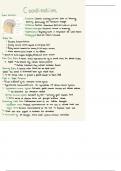
Gross Structure :
Cerebrum Controls
voluntary actions such as
learning
· :
,
and conscious thought
memory ,
personality
Cerebellum Controls functions
·
unconscious such as posture
:
Medrila Autonomic control
Oblongata ie
breathing
·
:
·Hypothalamus :
Regulatory centre ie .
temperature and water balance
Pituitary gland stores and releases hormones
·
:
Reflex Arc :
1 .
Receptor detects stimulus
2 .
Sensory neurone carries
impulse to the Spinal Cord
3 .
Relay neurone connects the
sensory
to the motor neurone
4 Motor neurone carries effector
.
impulse to the
↳ present actions and
at birth , support everyday assist survival
Knee-Jerk Reflex A extend when the patellar tendon
neural circuit that causes the
leg to
:
is tapped .
An abscence
may
indicate nevous problems
multiple extensions
may indicate cerebellar disease
Blinking Reflex A Cranial reflex (brain not the spinal cord)
:
.
,
stimulated both
When the cornea is
eyes should blink
↳ If the corneal reflex is present a patient cannot be brain dead
Fight or
flight Response :
Threat detected
is the
by autonomic nervous
:.
system
2.
and adrenal
Hypothalamus communicates with the
sympathetic cortical
Systems
3 Activates and adrenal medulla
Sympathetic system glands smooth muscles
:
nevous
.
,
↳
nor advenaline and adrenaline released
system Activated by spituitary gland
·
Adrenal Cortical - :
CRE Secretes ACTH
↳ ACTH arrives adrenal cortex and hormone release
at
prompts
Cardiovascular medulla
Controlling Heart Rate centre in the
oblongata
:
Accelerator nerve: Releases neurotransmitter at the SAN to increase heart rate
·
vagus neve
:
Releases neurotransmitter at the SAN To decrease heat rate
↳ Heat to hormones like adrenaline
can also respond
↳ stimulated
by pH stress blood muscular contraction
changes
:
, ,
pressure ,
Cerebrum Controls
voluntary actions such as
learning
· :
,
and conscious thought
memory ,
personality
Cerebellum Controls functions
·
unconscious such as posture
:
Medrila Autonomic control
Oblongata ie
breathing
·
:
·Hypothalamus :
Regulatory centre ie .
temperature and water balance
Pituitary gland stores and releases hormones
·
:
Reflex Arc :
1 .
Receptor detects stimulus
2 .
Sensory neurone carries
impulse to the Spinal Cord
3 .
Relay neurone connects the
sensory
to the motor neurone
4 Motor neurone carries effector
.
impulse to the
↳ present actions and
at birth , support everyday assist survival
Knee-Jerk Reflex A extend when the patellar tendon
neural circuit that causes the
leg to
:
is tapped .
An abscence
may
indicate nevous problems
multiple extensions
may indicate cerebellar disease
Blinking Reflex A Cranial reflex (brain not the spinal cord)
:
.
,
stimulated both
When the cornea is
eyes should blink
↳ If the corneal reflex is present a patient cannot be brain dead
Fight or
flight Response :
Threat detected
is the
by autonomic nervous
:.
system
2.
and adrenal
Hypothalamus communicates with the
sympathetic cortical
Systems
3 Activates and adrenal medulla
Sympathetic system glands smooth muscles
:
nevous
.
,
↳
nor advenaline and adrenaline released
system Activated by spituitary gland
·
Adrenal Cortical - :
CRE Secretes ACTH
↳ ACTH arrives adrenal cortex and hormone release
at
prompts
Cardiovascular medulla
Controlling Heart Rate centre in the
oblongata
:
Accelerator nerve: Releases neurotransmitter at the SAN to increase heart rate
·
vagus neve
:
Releases neurotransmitter at the SAN To decrease heat rate
↳ Heat to hormones like adrenaline
can also respond
↳ stimulated
by pH stress blood muscular contraction
changes
:
, ,
pressure ,