Learning and Memory
- learning = acquisition of new knowledge and skills
- memory = retention of learned information
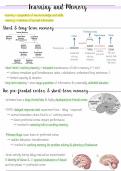
Short & long-term memory
-
-
-
In
non-declarative
. .
.
- short-term/ working memory = transient maintenance of info in memory (< 1 min)
=> achieve immediate goal (simultaneous tasks, calculations, understand long sentences...)
=> limited capacity & duration
- long-term memory = store large quantities of information for potentially unlimited duration
The pre-frontal cortex & short-term memory
- primates have a large frontal lobe & highly developed pre-frontal cortex
!
- 1930: delayed response task experiment (cue - delay - response)
=> animal remembers where food is w/ working memory
=> lesion prefrontal cortex impairs performance
=> involved in retaining info in working memory
- Phineas Gage case: lesion in prefrontal cortex
=> sudden behaviour transformation
=> involved in working memory for problem solving & planning of behaviour
- brain activity during delay interval bw memorisation 1: 2:
(1: identity of faces & 2: spacial localisation of faces)
and test phase => prefrontal cortex
, Declarative long term memory
↑
- declarative/ explicit memory: retain facts & events accessible to your consciousness
autobi
=> episodic: learn, store & retrieve info about personal experiences (time, place, details event)
ograp
hical => semantic: knowledge of facts that have been learned (objects categories, history, x tables...)
=> hippocampus + adjacent regions within medial temporal lobe
important for acquisition & storage (min to h)
SEE AF-ER
I
- H.M. case study: removal hippocampus
=> anterograde amnesia (impaired capacity for new learning: no
consolidation declarative m // memories from before & non-d & short-term m remain intact)
- retrograde amnesia: no memory from before (events, identity...) // intact working & non-d memory
also medial temporal lobe & hippo affected => often temporary (except the accident: interrupt consolidation)
autobiographical memory
Non-declarative memory
- non-declarative memory: subconscious behavioural or physiological responses to events or stimuli
=> skills & habits (swimming, riding...) => striatum, motor areas, cerebellum
=> emotional memory/ association (change in behaviour as a result of an experience) => amygdala
=> conditioned reflexes (Pavlov’s dog experiment) => cerebellum (acquisition + consolidation)
=> stronger memory
when emotional stimuli
Classical conditioning
- unconditioned stimulus (= normal): food
=> unconditioned response: salivation dog
- conditioned stimulus (neutral stimulus before training): bell
=> conditioned response: salivation dog => association made
Spatial memory
- hippocampus also important in spatial memory of the location of objects
=> Morris water maze experiment: rodents learn to find a platform in water within a few sessions
=> fail to learn location if bilateral hippocampal lesion
- learning = acquisition of new knowledge and skills
- memory = retention of learned information
Short & long-term memory
-
-
-
In
non-declarative
. .
.
- short-term/ working memory = transient maintenance of info in memory (< 1 min)
=> achieve immediate goal (simultaneous tasks, calculations, understand long sentences...)
=> limited capacity & duration
- long-term memory = store large quantities of information for potentially unlimited duration
The pre-frontal cortex & short-term memory
- primates have a large frontal lobe & highly developed pre-frontal cortex
!
- 1930: delayed response task experiment (cue - delay - response)
=> animal remembers where food is w/ working memory
=> lesion prefrontal cortex impairs performance
=> involved in retaining info in working memory
- Phineas Gage case: lesion in prefrontal cortex
=> sudden behaviour transformation
=> involved in working memory for problem solving & planning of behaviour
- brain activity during delay interval bw memorisation 1: 2:
(1: identity of faces & 2: spacial localisation of faces)
and test phase => prefrontal cortex
, Declarative long term memory
↑
- declarative/ explicit memory: retain facts & events accessible to your consciousness
autobi
=> episodic: learn, store & retrieve info about personal experiences (time, place, details event)
ograp
hical => semantic: knowledge of facts that have been learned (objects categories, history, x tables...)
=> hippocampus + adjacent regions within medial temporal lobe
important for acquisition & storage (min to h)
SEE AF-ER
I
- H.M. case study: removal hippocampus
=> anterograde amnesia (impaired capacity for new learning: no
consolidation declarative m // memories from before & non-d & short-term m remain intact)
- retrograde amnesia: no memory from before (events, identity...) // intact working & non-d memory
also medial temporal lobe & hippo affected => often temporary (except the accident: interrupt consolidation)
autobiographical memory
Non-declarative memory
- non-declarative memory: subconscious behavioural or physiological responses to events or stimuli
=> skills & habits (swimming, riding...) => striatum, motor areas, cerebellum
=> emotional memory/ association (change in behaviour as a result of an experience) => amygdala
=> conditioned reflexes (Pavlov’s dog experiment) => cerebellum (acquisition + consolidation)
=> stronger memory
when emotional stimuli
Classical conditioning
- unconditioned stimulus (= normal): food
=> unconditioned response: salivation dog
- conditioned stimulus (neutral stimulus before training): bell
=> conditioned response: salivation dog => association made
Spatial memory
- hippocampus also important in spatial memory of the location of objects
=> Morris water maze experiment: rodents learn to find a platform in water within a few sessions
=> fail to learn location if bilateral hippocampal lesion