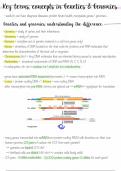
Key terms, concepts in Genetics & Genomics
- useful in our lives: diagnose diseases, predict future health, manipulate genes/ genomes ...
Genetics and genomics: understanding the difference
- Genetics = study of genes and their inheritance
- Genomics = study of genome
- Genome = complete set of genetic material in a cell (not genes only)
- Genes = stretches of DNA located on chr that code for proteins and RNA molecules that
determine the characteristics of the host cell or organism
- Chromosome (chr) = long DNA molecules that are inherited during sexual or asexual reproduction
- Nucleotides = structural components of DNA and RNA (A, T, C, G, U)
- in eukaryotes, chr are in nucleus but 1 small chr is in mitochondria
- genes have associated DNA sequences (promoters...) => ensure transcription into RNA
- Exons = protein-coding DNA // Introns = non-coding DNA
- after transcription into pre-RNA, introns are spliced out => mRNA => cytoplasm for translation
- many genes transcribed into ncRNA (non-protein-coding RNA) with functions on their own
- human genome: 23 pairs of nuclear chr (23 from each gamete)
=> gametes are haploid (23 chr)
=> fertilised cells are diploid (46 chr) => somatic cells (body cells)
- 23 pairs - 6 billion nucleotides - 21,000 protein-coding genes (2 alleles for each gene)
, lexons +
introns)
conly exons)
environment
influences epigenome
- transcriptome: all of the RNA in a cell (include ncRNA or not) => also proteome +
transcriptome
- not all genes are expressed in all cells => transcriptome is variable bw cells (even within 1 cell type)
- exome: all exons in the genome (2% of genome) => doesn’t vary
- proteome: complete set of proteins in a particular cell time at a particular time
Genetics and genomics: a brief history
- Gregor Mendel (19th) began work on inheritance using peas
Human Genome Project (HGP): project to
determine the sequence of nucleotides that make up
human DNA + identify all genes of human genome
- useful in our lives: diagnose diseases, predict future health, manipulate genes/ genomes ...
Genetics and genomics: understanding the difference
- Genetics = study of genes and their inheritance
- Genomics = study of genome
- Genome = complete set of genetic material in a cell (not genes only)
- Genes = stretches of DNA located on chr that code for proteins and RNA molecules that
determine the characteristics of the host cell or organism
- Chromosome (chr) = long DNA molecules that are inherited during sexual or asexual reproduction
- Nucleotides = structural components of DNA and RNA (A, T, C, G, U)
- in eukaryotes, chr are in nucleus but 1 small chr is in mitochondria
- genes have associated DNA sequences (promoters...) => ensure transcription into RNA
- Exons = protein-coding DNA // Introns = non-coding DNA
- after transcription into pre-RNA, introns are spliced out => mRNA => cytoplasm for translation
- many genes transcribed into ncRNA (non-protein-coding RNA) with functions on their own
- human genome: 23 pairs of nuclear chr (23 from each gamete)
=> gametes are haploid (23 chr)
=> fertilised cells are diploid (46 chr) => somatic cells (body cells)
- 23 pairs - 6 billion nucleotides - 21,000 protein-coding genes (2 alleles for each gene)
, lexons +
introns)
conly exons)
environment
influences epigenome
- transcriptome: all of the RNA in a cell (include ncRNA or not) => also proteome +
transcriptome
- not all genes are expressed in all cells => transcriptome is variable bw cells (even within 1 cell type)
- exome: all exons in the genome (2% of genome) => doesn’t vary
- proteome: complete set of proteins in a particular cell time at a particular time
Genetics and genomics: a brief history
- Gregor Mendel (19th) began work on inheritance using peas
Human Genome Project (HGP): project to
determine the sequence of nucleotides that make up
human DNA + identify all genes of human genome