100% satisfaction guarantee Immediately available after payment Both online and in PDF No strings attached 4.2 TrustPilot
logo-home
Lecture notes

GEN 4: Comparative Genomics

Rating
-
Sold
-
Pages
3
Uploaded on
04-10-2023
Written in
2022/2023

Lecture notes from Imperial College London, Medical Biosciences BSc, 2nd year, genetics and genomics (GEN) module. By comparing the sequences of different species we can identify sequences that have been conserved over long periods of evolution and so are likely to have important biological functions. You will also see how the extent of such sequence conservation can be used to measure evolutionary relationships between the species. Similarly, when comparing sequences repeats within a single genome, the extent of conservation can indicate when and how such repeats arose during evolution. Finally, learn how, by comparing the genomes of individuals within a species, sequence differences that correlate with a particular phenotype learning objectives: LO1: Identify features shared between the human genome and genomes of model organisms and pathogens. LO2: Infer evolutionary relationships between organisms based on comparison of their genome sequence. LO3: Describe the mechanisms by which genomes can change, and how this change can result in evolution. LO4: Describe the major databases cataloguing human genetic variation and be able to find relative allele frequencies of polymorphic sites. LO5: Appreciate the importance of comparative genomics in modern medicine.

Show more Read less


Whoops! We can’t load your doc right now. Try again or contact support.

Document information

Uploaded on
October 4, 2023
Number of pages
3
Written in
2022/2023
Type
Lecture notes
Professor(s)
Andy porters
Contains
All classes

Subjects

Content preview

Comparative Genomics
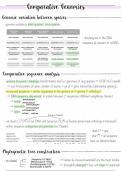
Genomic variation between species
- genome variations: inter-species/ intra-species


- diversity lies in the DNA
sequence & amount of ncDNA


Comparative sequence analysis
- genome browsers/ database: bioinformatics tool w/ genomes of any species => UCSC & Ensembl
=> can find position of gene, number of exons + aa of ≠ gene transcripts (alternative splicing)...
- conserved sequence = similar sequences in the genome of ≠ species (= orthologs)
=> DNA sequence alignement: to match between 2 sequences (different weightings chosen)
=> exact:
=> mismatch:
=> gaps:
50 %
of 2 % Lexons


- we share 0.75% of our DNA with bananas (50% of human genes have orthologs in bananas)
L


- online sequence comparison programmes (ex: Clustal):
- dash (-) = gap
- star (*) = all sequence
have an identical base


Phylogenetic tree construction
- on clustal: => human & mouse (mammals) are the most similar
=> drosophila diverged + has a ≠ origin to mammals

£7.99
Get access to the full document:

100% satisfaction guarantee
Immediately available after payment
Both online and in PDF
No strings attached

Get to know the seller
Seller avatar
lisaribau

Also available in package deal

Thumbnail
Package deal
Genetics & Genomics module Imperial College London
-
9 2023
£ 71.91 More info

Get to know the seller

Seller avatar
lisaribau Imperial College London
View profile
Follow You need to be logged in order to follow users or courses
Sold
1
Member since
2 year
Number of followers
1
Documents
49
Last sold
2 year ago

0.0

0 reviews

5
0
4
0
3
0
2
0
1
0

Recently viewed by you

Why students choose Stuvia

Created by fellow students, verified by reviews

Quality you can trust: written by students who passed their exams and reviewed by others who've used these revision notes.

Didn't get what you expected? Choose another document

No problem! You can straightaway pick a different document that better suits what you're after.

Pay as you like, start learning straight away

No subscription, no commitments. Pay the way you're used to via credit card and download your PDF document instantly.

Student with book image

“Bought, downloaded, and smashed it. It really can be that simple.”

Alisha Student

Frequently asked questions