
Explain the Need for Signal Conversion
Why Do They Need To Be Converted
Analogue signals are something every human emits when they speak, however, they can be
converted so that they can be used in computer systems, TV’s and generally all electronic
devices. Without signal conversion these signals would be useless to us which is why it is
important to convert.
How Are Signals Converted
Analogue signals are first converted digitally into binary, so that the computer can process
the data and create a signal from it. When these signals are being converted there are a few
things that need to be checked such as the sampling rate (How many samples are being
taken for the signal) and sampling precisions (controls the number of different graduations
for the sampling process). However one thing to note is that sampling analogue does not
alter any of the content in the signal itself, to explain this I will demonstrate the conversion of
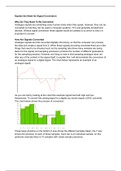
an analogue signal to a digital signal. The chart below represents an example of an
analogue signal:
As you can tell by looking at the chart this example signal has both high and low
frequencies. To convert this analog signal to a digital you would require a DAC converter.
The chart below shows the process of conversion:
These large divisions on the bottom X axis shows the different samples taken, the Y axis
shows the precision of each of these samples. Each bar is an individual sample, on this
particular example there is 10 samples with varied sample precisions.
Why Do They Need To Be Converted
Analogue signals are something every human emits when they speak, however, they can be
converted so that they can be used in computer systems, TV’s and generally all electronic
devices. Without signal conversion these signals would be useless to us which is why it is
important to convert.
How Are Signals Converted
Analogue signals are first converted digitally into binary, so that the computer can process
the data and create a signal from it. When these signals are being converted there are a few
things that need to be checked such as the sampling rate (How many samples are being
taken for the signal) and sampling precisions (controls the number of different graduations
for the sampling process). However one thing to note is that sampling analogue does not
alter any of the content in the signal itself, to explain this I will demonstrate the conversion of
an analogue signal to a digital signal. The chart below represents an example of an
analogue signal:
As you can tell by looking at the chart this example signal has both high and low
frequencies. To convert this analog signal to a digital you would require a DAC converter.
The chart below shows the process of conversion:
These large divisions on the bottom X axis shows the different samples taken, the Y axis
shows the precision of each of these samples. Each bar is an individual sample, on this
particular example there is 10 samples with varied sample precisions.


