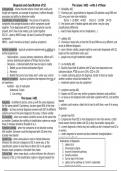
Diagnosis and classification of SZ The issues / AO3 – write 3 of these
Schizophrenia – mental disorder where contact with reality and P – Reliability AO1
insight are impaired, an example of psychosis. It affects thought E – Cheniaux got 2 psychiatrists to diagnose 100 patients using DSM and
processes and ability to determine reality ICD, very poor inter-rater reliability.
Classification of mental disorder – the process of organising Doctor 1 – 26 DSM 44 ICD Doctor 2 – 13 DSM 24 ICD
symptoms into categories based on which symptoms cluster E – the doctors aren’t reliable against each other, may be using
together. To be diagnosed with SZ certain symptoms must be classifications differently
present, don’t have to be related, just cluster together. L – lead to false diagnosis and so (implications...)
ICD-10 – used by WHO Europe. (at least 2 positive OR negative
symptoms) P – validity AO1
DMS-5 – used in America (at least 1 positive symptoms) E – Cheniaux’s study tells us that the ICD and DSM are very different, and
arrive at different diagnosis
Positive symptoms – atypical symptoms experienced in addition to E – poor criterion validity, people might be over/under diagnosed with SZ,
normal experiences based on the classification tools used
- Hallucinations – unusual sensory experiences, affects all 5 L – people may not get treatment needed
senses, distorted perceptions of things that are there
- Delusions – irrational beliefs that have no basis in reality P – co-morbidity AO1
1. Beliefs you are historical/important figure E – Buckley found half of patients with SZ also have depression and
2. Paranoia substance abuse, PTSD occurs in 29%, OCD in 23%
3. Beliefs that part of your body aren’t under your control E – creates confusing picture for diagnosis, harder to treat as maybe
Negative symptoms – atypical symptoms that represent the loss of another condition should be treated first
an experience L – treatment options may be suboptimal
- Avolition – loss of motivation
Andersons 3 signs: P – symptom overlap AO1
1. Low energy E – bipolar and SZ have very similar symptoms (delusions and avolition)
The issues / AO1 E – an issue as one diagnosis tool could label a patient with SZ, and another
Reliability – do different doctors come up with the same diagnosis bipolar
for the same patient? Consistency, doctors agree 80% of the time L – patient could receive a label that is hard to shift from, even if its wrong
Validity – do they correctly diagnose someone with SZ? Do different diagnoses
systems arrive at the same diagnosis? Accuracy. Criteria validity
Co-morbidity – when one medical condition occurs at the same time P – gender bias AO1
as another. Questions the validity of classification system as maybe E – Longenecker found SZ is more diagnosed in men than women, cotton
these 2 illnesses should be thought of as 1 found women function better with SZ as they have better coping skills
Symptom overlap – when the symptoms of one disorder overlap E – current diagnostic criteria may lack validity as don’t measure how SZ is
with another. Someone could be diagnosed with SZ when they in women
actually have bipolar L – under diagnosis for women and less treatment (marginalisation –
Gender bias – when views about a male or female behaviour treated as insignificant)
influence the clinician’s diagnosis of SZ in some way, or the Implications of diagnosis:
1. Labels stick
classification system is only likely to detect SZ in one gender,
2. Unnecessary stigma
females mask symptoms a lot better than males
3. Incorrect treatment pathway
Cultural bias – when views about a culture influence the clinician’s 4. Socially sensitive
diagnosis of SZ, or the classification system is biased towards the 5. Can be sign of the times
norms of one culture, meaning anyone from a difficult who breaks 6. Labels can be pathway to ‘control’ undesirable
behaviours in society
, Biological explanations for SZ Biological therapy for SZ
Genetics – genes consist of DNA strands. DNA produces ‘instructions’ Anti-psychotics – drugs used to reduce the intensity of symptoms,
for general physical features of an organism (eye colour) and specific particular the positive symptoms of psychotics disorders like SZ, can
physical features (neurotransmitters levels). These may impact on be short or long term
psychological features (intelligence/mental disorder). Genes are
transmitted from parents to offspring. Typical anti-psychotics: can be tablets, syrup, or injection, orally is
Family studies: confirms that SZ increases in line with genetic similarity daily up to max does of 1000mg, prescribed doses have decreases in
to a relative with SZ. the last 50yrs
- Gottesman’s large scale family study finds it 48% more likely Dopamine antagonists: chemicals which reduce action of
with an identical twin, 9% with sibling. neurotransmitter
- family members share aspects in the environment as well as - Typical antagonists work by acting as antagonists in the
genes, so correlation represents both dopamine system
candidate genes: next step is to identify candidate genes. Early - Dopamine antagonists work by blocking dopamine receptors in
research looked for a single genetic variation in the belief that one the synapses of the brain, reducing action of the dopamine.
faulty gene could explain SZ however it appears to be multiple - Initially when someone starts chlorpromazine, dopamine levels
different genes involved build up, but then productions slows
- SZ is polygenic so most likely genes would be those coding for - According to dopamine hypothesis this effect normalises
neurotransmitters including dopamine neurotransmitters in key areas of the brain, reducing symptoms
- Ripke et al combined all previous data from genome-wide Sedation effect – chlorpromazine is an effective sedative, often for
studies of SZ (looking at whole human not just for a gene). calming anxiety patients
37,000 diagnosed compared with 113,000 controls: 108 different
variations were associated with higher risk for SZ Atypical anti-psychotic: targets dopamine and serotonin, aim of
- Because different studies have identified different candidate developing newer drugs is to maintain or improve upon the
genes it makes SZ aetiologically heterogenous (different effectiveness of drugs in supressing the symptoms and minimise side
combination of factors can lead to the condition) affects
The role of mutation – SZ can also have genetic origin in the absence Clozapine: was withdrawn due to death from a blood condition,
of a family history of the disorder however, was discovered to be more effective than typical. People on
- Parental DNA which can be caused by radiation, poison, or viral this drug have regular blood tests to ensure they aren’t developing
infection P – supporting evidence
Neural correlates - patterns of structure/activity in the brain that occur E – Thornley reviewed 13 studies, 1121 patients using chlorpromazine =
in conjunction with an experience, may be implicated in the origins of better symptom reduction and lower relapse rate in 512 patients versus
that experience placebo
The original dopamine hypothesis - based on the discovery that drugs E – controlled trials help to validate that the treatment is effective
used to treat SZ (antipsychotics) caused symptoms similar to L – strong argument that bio treatments should be used
Parkinson’s disease (condition with low DA levels). So, SZ might be
result of high DA levels in subcortical areas of the brain P – side effects
- Excess of DA receptors in pathways from subcortex of Broca’s E - typical – neuroleptic, atypical – death from blood condition
area may explain specific symptoms of SZ such as poverty of E – can be fatal
speech and/or auditory hallucinations L – could the SZ end up worse?
Updates dopamine hypothesis – davis found hypodopaminergia (low
DA), hyperdopaminergia (high DA) P – chemical cosh argument
E – are we just giving meds to make it easier to care for the SZ?
P – supporting evidence E – is it humane? Is it ethical?
E – Tienari adoption study: bio children of parents with SZ and cold, L – If a treatment is unethical – should it be used?
controlling adoptive parents got SZ
Schizophrenia – mental disorder where contact with reality and P – Reliability AO1
insight are impaired, an example of psychosis. It affects thought E – Cheniaux got 2 psychiatrists to diagnose 100 patients using DSM and
processes and ability to determine reality ICD, very poor inter-rater reliability.
Classification of mental disorder – the process of organising Doctor 1 – 26 DSM 44 ICD Doctor 2 – 13 DSM 24 ICD
symptoms into categories based on which symptoms cluster E – the doctors aren’t reliable against each other, may be using
together. To be diagnosed with SZ certain symptoms must be classifications differently
present, don’t have to be related, just cluster together. L – lead to false diagnosis and so (implications...)
ICD-10 – used by WHO Europe. (at least 2 positive OR negative
symptoms) P – validity AO1
DMS-5 – used in America (at least 1 positive symptoms) E – Cheniaux’s study tells us that the ICD and DSM are very different, and
arrive at different diagnosis
Positive symptoms – atypical symptoms experienced in addition to E – poor criterion validity, people might be over/under diagnosed with SZ,
normal experiences based on the classification tools used
- Hallucinations – unusual sensory experiences, affects all 5 L – people may not get treatment needed
senses, distorted perceptions of things that are there
- Delusions – irrational beliefs that have no basis in reality P – co-morbidity AO1
1. Beliefs you are historical/important figure E – Buckley found half of patients with SZ also have depression and
2. Paranoia substance abuse, PTSD occurs in 29%, OCD in 23%
3. Beliefs that part of your body aren’t under your control E – creates confusing picture for diagnosis, harder to treat as maybe
Negative symptoms – atypical symptoms that represent the loss of another condition should be treated first
an experience L – treatment options may be suboptimal
- Avolition – loss of motivation
Andersons 3 signs: P – symptom overlap AO1
1. Low energy E – bipolar and SZ have very similar symptoms (delusions and avolition)
The issues / AO1 E – an issue as one diagnosis tool could label a patient with SZ, and another
Reliability – do different doctors come up with the same diagnosis bipolar
for the same patient? Consistency, doctors agree 80% of the time L – patient could receive a label that is hard to shift from, even if its wrong
Validity – do they correctly diagnose someone with SZ? Do different diagnoses
systems arrive at the same diagnosis? Accuracy. Criteria validity
Co-morbidity – when one medical condition occurs at the same time P – gender bias AO1
as another. Questions the validity of classification system as maybe E – Longenecker found SZ is more diagnosed in men than women, cotton
these 2 illnesses should be thought of as 1 found women function better with SZ as they have better coping skills
Symptom overlap – when the symptoms of one disorder overlap E – current diagnostic criteria may lack validity as don’t measure how SZ is
with another. Someone could be diagnosed with SZ when they in women
actually have bipolar L – under diagnosis for women and less treatment (marginalisation –
Gender bias – when views about a male or female behaviour treated as insignificant)
influence the clinician’s diagnosis of SZ in some way, or the Implications of diagnosis:
1. Labels stick
classification system is only likely to detect SZ in one gender,
2. Unnecessary stigma
females mask symptoms a lot better than males
3. Incorrect treatment pathway
Cultural bias – when views about a culture influence the clinician’s 4. Socially sensitive
diagnosis of SZ, or the classification system is biased towards the 5. Can be sign of the times
norms of one culture, meaning anyone from a difficult who breaks 6. Labels can be pathway to ‘control’ undesirable
behaviours in society
, Biological explanations for SZ Biological therapy for SZ
Genetics – genes consist of DNA strands. DNA produces ‘instructions’ Anti-psychotics – drugs used to reduce the intensity of symptoms,
for general physical features of an organism (eye colour) and specific particular the positive symptoms of psychotics disorders like SZ, can
physical features (neurotransmitters levels). These may impact on be short or long term
psychological features (intelligence/mental disorder). Genes are
transmitted from parents to offspring. Typical anti-psychotics: can be tablets, syrup, or injection, orally is
Family studies: confirms that SZ increases in line with genetic similarity daily up to max does of 1000mg, prescribed doses have decreases in
to a relative with SZ. the last 50yrs
- Gottesman’s large scale family study finds it 48% more likely Dopamine antagonists: chemicals which reduce action of
with an identical twin, 9% with sibling. neurotransmitter
- family members share aspects in the environment as well as - Typical antagonists work by acting as antagonists in the
genes, so correlation represents both dopamine system
candidate genes: next step is to identify candidate genes. Early - Dopamine antagonists work by blocking dopamine receptors in
research looked for a single genetic variation in the belief that one the synapses of the brain, reducing action of the dopamine.
faulty gene could explain SZ however it appears to be multiple - Initially when someone starts chlorpromazine, dopamine levels
different genes involved build up, but then productions slows
- SZ is polygenic so most likely genes would be those coding for - According to dopamine hypothesis this effect normalises
neurotransmitters including dopamine neurotransmitters in key areas of the brain, reducing symptoms
- Ripke et al combined all previous data from genome-wide Sedation effect – chlorpromazine is an effective sedative, often for
studies of SZ (looking at whole human not just for a gene). calming anxiety patients
37,000 diagnosed compared with 113,000 controls: 108 different
variations were associated with higher risk for SZ Atypical anti-psychotic: targets dopamine and serotonin, aim of
- Because different studies have identified different candidate developing newer drugs is to maintain or improve upon the
genes it makes SZ aetiologically heterogenous (different effectiveness of drugs in supressing the symptoms and minimise side
combination of factors can lead to the condition) affects
The role of mutation – SZ can also have genetic origin in the absence Clozapine: was withdrawn due to death from a blood condition,
of a family history of the disorder however, was discovered to be more effective than typical. People on
- Parental DNA which can be caused by radiation, poison, or viral this drug have regular blood tests to ensure they aren’t developing
infection P – supporting evidence
Neural correlates - patterns of structure/activity in the brain that occur E – Thornley reviewed 13 studies, 1121 patients using chlorpromazine =
in conjunction with an experience, may be implicated in the origins of better symptom reduction and lower relapse rate in 512 patients versus
that experience placebo
The original dopamine hypothesis - based on the discovery that drugs E – controlled trials help to validate that the treatment is effective
used to treat SZ (antipsychotics) caused symptoms similar to L – strong argument that bio treatments should be used
Parkinson’s disease (condition with low DA levels). So, SZ might be
result of high DA levels in subcortical areas of the brain P – side effects
- Excess of DA receptors in pathways from subcortex of Broca’s E - typical – neuroleptic, atypical – death from blood condition
area may explain specific symptoms of SZ such as poverty of E – can be fatal
speech and/or auditory hallucinations L – could the SZ end up worse?
Updates dopamine hypothesis – davis found hypodopaminergia (low
DA), hyperdopaminergia (high DA) P – chemical cosh argument
E – are we just giving meds to make it easier to care for the SZ?
P – supporting evidence E – is it humane? Is it ethical?
E – Tienari adoption study: bio children of parents with SZ and cold, L – If a treatment is unethical – should it be used?
controlling adoptive parents got SZ