100% satisfaction guarantee Immediately available after payment Both online and in PDF No strings attached 4.2 TrustPilot
logo-home
Exam (elaborations)

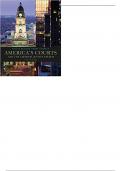
Test Bank For America's Courts and the Criminal Justice System 11th Edition by David W. Neubauer

Rating
-
Sold
-
Pages
328
Grade
A
Uploaded on
28-09-2023
Written in
2022/2023

1. a. b. Chapter 3 FEDERAL COURTS TEST BANK The United States has a dual court system consisting of: district and superior courts. c. criminal and civil courts. trial and appellate courts. d. state and federal courts. MULTIPLE CHOICE ANS: D REF: 57 OBJ: 1 2. Which of the following is true of appellate courts? a. The function of an appellate court is to carefully review the facts that were presented at a defendant’s criminal trial. b. Appellate court decisions are always made by a group of judges; decisions are never made by a single judge. c. Appellate courts, like trial courts, may hear testimony from witnesses, conduct trials, or use juries. d. Appellate court decisions must be unanimous. ANS: B REF: 61 OBJ: 2 3. a. b. Original and appellate jurisdiction fall under what classification of jurisdiction? geographical jurisdiction c. hierarchical jurisdiction subject matter jurisdiction d. general jurisdiction ANS: C REF: 60-61 OBJ: 2 4. a. b. What federal court has original jurisdiction over disputes between states? Legislative Court District Court c. Court of Appeals d. Supreme Court ANS: D REF: 61 OBJ: 1 5. The political dynamics surrounding the role of the federal government in the criminal justice system is based on the imbalance between federal official’s need to be seen as doing something about the crime problem and: a. their limited jurisdiction to do anything. b. lack of support from states to partner in addressing crime rates. c. fear of increased litigation arising from jurisdictional issues. d. double jeopardy issues related to parallel state and federal and federal prosecutions. ANS: A REF: 84-85 OBJ: 8 41 6. During the Constitutional Convention, Anti-Federalists maintained the belief that a strong national government would: a. provide political and economic unity. b. weaken individual liberties. c. abolish state courts. d. create a uniform body of federal law. ANS: B ANS: C 7. a. Article I b. Article II c. Article III d. Article IV ANS: C REF: 65 OBJ: 3 10. In 1968 Congress created this position to alleviate the workload of U.S. District Courts and to replace the former position of U.S. commissioner. REF: 61-62 OBJ: 3 Which Article of the U.S. Constitution provides the basis for the federal judiciary? a. U.S. magistrate judges b. U.S. attorneys ANS: A REF: 65 OBJ: c. U.S. bankruptcy judges d. U.S. circuit justices 3 and 4 11. Which of the examples below does not constitute a federal question, for purposes of REF: 62 OBJ: 3 8. Which of the following is not true of federal district court judges? a. They are nominated by the President. b. They must be confirmed by the U.S. Senate. c. They must reside in their district. d. They are appointed for eight year terms.. ANS: 9. a. 59 b. 78 D REF: 65-66 OBJ: 3 There are ________ U.S. District Courts, with each state having at least one. c. 94 d. 111 review by an Article III court? a. Whether or not a state supreme court misinterpreted the state’s divorce law in an action for marital dissolution. b. Whether or not a disabled person has the right to sue a restaurant for failure to provide access by a wheel chair. c. Whether or not a federally insured bank may manipulate the prime interest rate or collaborate with other banks to set rates. d. Whether or not a person was denied a job because of their race. ANS: A REF: 67 OBJ: 5 42 12. Congress created the Courts of Appeals in a. 1776. b. 1787. ANS: C c. 1891. d. 1929. 13. a. b. In the federal system, which is generally the court of last resort for virtually all federal litigation? U.S. Supreme Court U.S. Court of Appeals c. U.S. District Court d. Federal Magistrate Court ANS: B REF: 72 OBJ: 4 REF: 70 OBJ: 3 14. The “Rule of Four” refers to: a. the number of justices required to vote in favor of granting certiorari to review a case. b. the number of justices required to uphold or overturn a lower court ruling. c. the maximum number of presenters allowed during oral arguments. d. the minimum number of justices required to publish a dissenting opinion. ANS: A REF: 72-73 OBJ: 4 15. The Prison Litigation Reform Act resulted in all of the following, except: a. requiring inmates to pay certain fees from which they had previously been exempt. b. requiring inmates to exhaust all administrative remedies before filing. c. no longer allowing inmates to proceed pro se in civil rights actions. d. barring subsequent cases if previous cases had been dismissed as frivolous. ANS: C REF: 69 OBJ: 5 16. Magistrate judges are a. nominated by the President and confirmed by the Senate. b. elected by voters in their district. c. selected by the U.S. Supreme Court. d. selected by U.S. district court judges. ANS: D REF: 65 OBJ: 4 17. Which of the following gave the U.S. Supreme Court the authority to invalidate an act of Congress as unconstitutional? a. Marbury v. Madison (1803) b. Article III of the U.S. Constitution c. The Judiciary Act of 1789 d. The Judiciary Act of 1801 ANS: A REF: 62 OBJ: 4 43 18. a. 14 b. 50 The U.S. Courts of Appeals is made up of how many judgeships? c. 98 d. 179 ANS: D REF: 71 OBJ: 4 19. a. b. These judges perform virtually all tasks carried out by district court judges, except trying and sentencing felony defendants. Circuit justices Magistrate judges c. Appellate court judges d. Administrative judges OBJ: 4 ANS: B REF: 65 20. Most “federal question” cases present issues concerning: a. the interpretation or application of the U.S. Constitution. b. cases in which two or more states are parties. c. the application and interpretation of a statute enacted by Congress. d. securities and banking regulations relating to the housing market crash. ANS: C REF: 67 OBJ: 21. a. b. The recent upsurge of federal criminal cases is largely attributable to the increase in diversity of jurisdiction cases. c. anti-terrorism initiatives. prosecutions for weapons offenses. d. prosecutions for drug offenses. ANS: 22. a. 10 b. 20 ANS: 23. D REF: 66 OBJ: 4 Drug prosecutions account for approximately what percentage of all federal criminal cases? B REF: 66 OBJ: 4 a. habeas corpus petitions. b. mandamus petitions. ANS: D REF: 69 c. Section 1983 and Bivens actions. d. motion to grant clemency. OBJ: 5 24. A habeas corpus petition may include which of the following? a. A challenge of a criminal conviction based on the argument the trial was constitutionally defective. b. A federal prisoner’s request to get their sentence set aside or corrected because the punishment was harsher than that allowed by law. c. Allegations that prison officials do not allow inmates to practice their religion behind bars. d. Allegations that an inmate’s constitutional rights were violated by a federal official acting under color of law. ANS: A REF: 69-70 OBJ: 4 c. 40 d. 65 Prisoners are permitted to file several types of civil lawsuits in federal courts. These include all of the following, except: 44 25. a. b. Appeals from criminal convictions in the U.S. District Courts constitute ______ of the workload of the U.S. Courts of Appeals. 26. a. b. In 1950, Congress extended significant new due process rights in courts-martial by adopting the: Military Justice Act c. Uniform Code of Military Justice U.S. Joint Service Committee Act d. Armed Forces Court of Appeals Act less than 10 percent about 29 percent c. 43 percent d. over 50 percent ANS: B REF: 72 OBJ: 4 ANS: C REF: 75 OBJ: 6 27. a. b. Which of the following is not one of the differences between military justice and state and federal justice? The burden of proof is less demanding. c. The jurors are military personnel. Three- and five-person juries are used. d. Decisions cannot be appealed. ANS: D REF: 75 OBJ: 6 28. A 2008 decision by this Court declared that the U.S. President was not allowed to imprison enemy combatants indefinitely without the right to habeas corpus review in federal court. a. U.S. District Court c. U.S. Supreme Court b. International Court of Justice d. United Nations Human Rights Court ANS: C REF: 75-77 OBJ: 6 29. a. b. The administrative policymaking organization of the federal judicial system, comprised of 26 federal judges, is the: Judicial Conference of the U.S. c. Federal Judicial Center Administrative Office of the Courts d. U.S. Sentencing Commission ANS: A REF: 81 OBJ: 7 30. The responsibilities of the U.S. Sentencing Commission include which of the following? a. Recommending to Congress appropriate modifications of substantive criminal law and sentencing procedures. b. Making sentencing recommendations after cases are adjudicated in federal court. c. Appointing judges to special tribunals and courts, such as the U.S. Foreign Intelligence Surveillance Court and the Judicial Panel on Multidistrict Litigation. d. Implementing policies established by the Judicial Conference of the United States. ANS: A REF: 82 OBJ: 7 45 31. Between 1789 and 1891, the inadequacy of the federal judicial system was highlighted by all of the following, except: a. the intolerable conditions of circuit riding. b. increased litigation from the growth of federal activity. c. Supreme Court refusal to grant certiorari to large numbers of cases. d. long delays for appeals to be argued before the courts. ANS: C REF: 62-63 OBJ: 3 32. This civilian judicial circuit’s jurisdiction is based on subject matter rather than geographical boundaries and has nationwide jurisdiction to hear specialized appeals involving certain types of government contracts, patents, and trademarks. a. Circuit Court of Appeals for D.C. b. Civilian Court of Appeals c. Court of Appeals for the United States d. Federal Circuit Court of Appeals ANS: D REF: 74 OBJ: 6 33. One of the principal activities of this organization is the education and training of federal judicial personnel, including judges, probation officers, clerks of court, and pretrial service officers. a. Federal Judicial Center b. Administrative Office of the Courts c. FBI Judicial Academy at Quantico d. Judicial Personnel and Training Section of the Judicial Conference ANS: A REF: 82 OBJ: 7 34. The Foreign Intelligence Surveillance Court of Review’s only function is to: a. hear appeals regarding constitutional violations of individual privacy rights. b. review warrant applications related to national security investigations. c. act as arbitrator between intelligence officials and foreign governments. d. review denials by the Foreign Intelligence Surveillance Court of applications for electronic surveillance warrants. ANS: D REF: 77 OBJ: 6 35. Which of the following was not one of the compromises reached between the Federalists and Anti-Federalists in the Judiciary Act of 1789? a. Federal district judges would be approved by voters in their district. b. Boundaries of district courts were drawn along state lines. c. Ensured that federal district judges would be residents of their districts. d. The Act gave lower federal courts only limited jurisdiction. ANS: A REF: 62 OBJ: 4 46 36. Which Congressional action gave the U.S. Supreme Court control over its’ docket? a. Court of Appeals Act of 1891 b. Judges Bill of 1925 c. Judiciary Act of 1789 d. Federal Court Improvement Act of 1982 ANS: B REF: 63-64 OBJ: 4 37. a. b. This type of prisoner petition seeks a court order to compel a public entity or official to do something that is owed to the plaintiff as a matter of constitutional or statutory right. 39. a. b. The basic administrative unit of a circuit, which has authority to make all necessary and appropriate orders for the effective and expeditious administration of justice within its circuit, is called the: Administrative Office of the District c. Federal Judicial Administration Administrative Oversight Commission d. Judicial Council mandamus habeas corpus c. motion to compel d. Section 1983 action OBJ: 8 ANS: A REF: 70 38. In U.S. v. Georgia (2006), the U.S. Supreme Court held that states and municipalities can be held civilly liable for failing to: a. abolish height and weight requirements for criminal justice agencies. b. maintain correctional facilities that accommodate the special needs of disabled prisoners. c. create exemptions for bona fide occupational qualifications in hiring and promotion. d. provide special training for employees on the requirements of the Americans with Disabilities Act. ANS: B REF: 69 OBJ: 4 ANS: D REF: 82 OBJ: 4 40. What do the Gun Free Schools Zones Act of 1990, Combatant Status Review Tribunals, and the Military Commissions Act of 2006 have in common? a. They have all been upheld by the U.S. Supreme Court as constitutional. b. They have all been declared unconstitutional by the U.S. Supreme Court. c. They were all enacted by Congress in the interest of national security. d. They were all repealed by Congress after negative public outcry. ANS: B REF: 56 OBJ: 5 41. a. b. This doctrine allows parallel state and federal prosecutions for the same offense. double jeopardy c. parallel prosecution concurrent jurisdiction d. dual sovereign ANS: D REF: 60 OBJ: 1 47 42. a. b. If a circuit justice thinks that there is merit in a case such that the full Supreme court should have an opportunity to decide whether to hear the case, the justice will grant: a temporary writ of certiorari. c. a stay. an injunction. d. a preliminary review. ANS: C REF: 73 OBJ: 4 CRITICAL THINKING SCENARIOS CASE 3.1 The founding fathers engaged in a vigorous debate over whether there should be a federal court system separate from the state systems. Those who supported a strong federal judiciary ultimately prevailed. Subsequent expansion of the federal courts has created a contemporary controversy over how to alleviate the problem of rising caseloads within the federal court system. 43. Which of the following statements regarding proposals to reduce federal caseloads is true? a. Reducing the jurisdiction of federal courts would nearly double the caseload of state courts and states would certainly oppose such an action. b. Creating additional courts and judgeships would require additional funding of the federal judiciary, which already comprises a sizeable portion of the federal budget. c. It is unlikely that Congress will ever have the filibuster-proof majority needed to authorize additional federal judgeships. d. The antagonistic relationship between Congress and the federal judiciary is unlikely to result in any significant reforms. ANS: D REF: 82-83 OBJ: 8 44. Which of the following proposals would our Federalist founding fathers most likely support? a. Abolish federal diversity jurisdiction except in certain cases. b. Abolish concurrent jurisdiction on crimes punishable by both state and federal law. c. Creation of several new Article I legislative courts. d. Limit ability of prisoners to file civil rights lawsuits. ANS: C REF: 61-63 OBJ: 3 45. Which of the following proposals would due process advocates least likely support? a. Abolish federal diversity jurisdiction except in certain cases. b. Abolish concurrent jurisdiction on crimes punishable by both state and federal law. c. Creation of several new Article I legislative courts. d. Limit ability of prisoners to file civil rights lawsuits. ANS: D REF: 83-84 OBJ: 8 48 TRUE/FALSE 1. The United States has one national court system plus separate court systems in each of the 50 states and the District of Columbia. ANS: T REF: 57 OBJ: 1 2. Appellate courts are considered finders of fact. ANS: F REF: 61 OBJ: 2 3. When cases are appealed, appellate court judges may call on witnesses to testify. ANS: F REF: 61 OBJ: 2 4. Extradition is the automatic return of an individual accused of a crime in the United States who has fled the country and been found on foreign soil. ANS: F REF: 59 OBJ: 1 5. There may be as many as 28 judges who work together to make an appellate court decision. ANS: T REF: 62 OBJ: 2 6. The double jeopardy clause of the Fifth Amendment protects a defendant from being tried in both state and federal court for the same crime. ANS: F REF: 60 OBJ: 1 7. In the event of a vacancy, the most senior member of the U.S. Supreme Court will become the Chief Justice. ANS: F REF: 72 OBJ: 4 8. No U.S. District Court encompasses more than one state. ANS: T REF: 62 OBJ: 3 9. U.S. Magistrate Judges may try and sentence felony defendants. ANS: F REF: 58 OBJ: 4 10. Both Article I and Article III judges serve during “good behavior,” which for practical purposes means for life. ANS: F REF: 65 OBJ: 4 11. A major city like Chicago or Los Angeles prosecutes more felons in a year than the entire federal judiciary. ANS: T REF: 85 OBJ: 4 49 12. There are two U.S. Attorneys in each federal district. ANS: F REF: 65 OBJ: 3 and 4 13. Federal district court judges must be residents of the district in which they preside. ANS: T REF: 62 OBJ: 4 14. Prior to the Civil War, the U.S. Supreme Court was required to hear every case that was appealed to it. ANS: T REF: 63 OBJ: 4 15. In misdemeanor and petty offense cases, U.S. magistrate judges may preside over trials, accept pleas of guilty, and also impose sentences. ANS: T REF: 65 OBJ: 4 16. A U.S. attorney is nominated by the President, confirmed by the Senate, and serves during “good behavior.” ANS: F REF: 65-66 OBJ: 7 17. Civil lawsuits consume more of the federal courts’ time than criminal cases. ANS: T REF: 66 OBJ: 4 18. Drug prosecutions account for more than 20 percent of all federal criminal cases. ANS: T REF: 66 OBJ: 4 19. Federal courts apply state—not federal—law when adjudicating state claims in federal court under their diversity of citizenship jurisdiction. ANS: T REF: 66-67 OBJ: 4 20. The U.S. District Courts are the federal trial courts for all major violations of federal criminal law. ANS: T REF: 66 OBJ: 4 21. The Americans with Disabilities Act applies to the ways in which police officers and correctional officials interact with people with disabilities. ANS: T REF: 69 OBJ: 4 50 22. When the U.S. Supreme Court fails to grant certiorari, they are stating that they unilaterally affirm the decision of the lower court. ANS: F REF: 72 OBJ: 6 23. Military justice applies not only to members of the armed services but also to those who commit crimes against military personnel on and off a military base. ANS: F REF: 75 OBJ: 6 24. The burden of proof necessary for conviction is less demanding in military courts. ANS: T REF: 75 OBJ: 6 25. The U.S. Constitution states that “no more than fifteen, nor less than seven justices shall be approved by Congress to serve on the Supreme Court.” ANS: F REF: 62 OBJ: 4 COMPLETION 1. The United States has a _____________ court system, which means that it has one national court system plus separate court systems in each of the 50 states and the District of Columbia. ANS: dual REF: 57 OBJ: 1 2. ____________ jurisdiction means that a court has the authority to try a case and decide it. ANS: Original REF: 61 OBJ: 1 3. The legal process in which officials of one state or country surrender a criminal offender to another is known as _____________. ANS: extradition REF: 59 OBJ: 1 4. A violation or dispute of _____________ jurisdiction would occur if a California court were to try someone for a crime that was committed in Oregon. ANS: geographical REF: 57 OBJ: 1 51 5. State and federal courts sometimes have jurisdiction (meaning they share some judicial powers). ANS: concurrent REF: 57 OBJ: 1 6. _____________ of citizenship cases involve suits between citizens of different states or between a U.S. citizen and a foreign country or citizen. ANS: Diversity REF: 66 OBJ: 4 7. A writ of _____________ is issued by the U.S. Supreme Court to obtain and review the proceedings of a lower court. ANS: certiorari REF: 72 OBJ: 4 8. Article ______ of the U.S. Constitution established the U.S. Supreme Court and gave Congress the power to create lower courts. ANS: III REF: 62 OBJ: 3 9. A prisoner _____________ is a civil lawsuit filed by an inmate alleging violations of his or her rights. ANS: petition REF: 69 OBJ: 1 and 4 10. Judicial bodies created by Congress under Article I are commonly referred to as _____________ courts. ANS: legislative REF: 74 OBJ: 6 11. The U.S. Supreme Court is made up of _________ justices, including the chief justice. ANS: 9 REF: 72 OBJ: 4 12. The director of the _____________ of the U.S. Courts is responsible for the day-to-day administrative tasks of the federal courts, including lobbying Congress for more funds and judgeships. ANS: Administrative Office REF: 82 OBJ: 7 52 13. _________ is the particular location or area in which a court having geographical jurisdiction may hear a case. ANS: V enue REF: 57 OBJ: 1 14. _____________ petitions are those in which inmates may collaterally challenge their convictions (after exhausting all available state remedies to do so) by arguing that their trial was constitutionally defective. ANS: Habeas corpus REF: 70 OBJ: 4 15. A ____________ is a court order that temporarily suspends activity in a case. ANS: stay REF: 73 OBJ: 4 and 5 16. Captured terrorists have recently been declared enemy____________ instead of prisoners of war. ANS: combatants REF: 75-76 OBJ: 6 17. Judicial bodies established by Congress under Article III are known as ____________ courts. ANS: constitutional REF: 74 OBJ: 3 18. The ________________ has supervisory authority over the entire federal judicial system. ANS: chief justice REF: 72 OBJ: 4 19. The ______________ is a Supreme Court custom that allows a minority of the Court to impose on the majority a question that the majority does not think it appropriate to address. ANS: rule of four REF: 72-73 OBJ: 4 20. Only _____________ can authorize additional federal judgeships. ANS: Congress REF: 83 OBJ: 8 53 ESSAY 1. Explain why venue may be easily changed within the federal system and reasons why changes in venue may be granted for federal cases. Include an example of a federal case where a change of venue was granted. ANS: When a defendant is charged with a crime against the United States (i.e., the federal government) his/her case may be heard by any federal district court because all these courts hear cases for defendants who violate federal laws. Most defendants charged with federal offenses will have their cases tried in the federal district where they committed their offenses. However, some defendants may have the location of their trial (i.e., venue) changed. This may happen for one of two reasons. First, the location of another federal district court may be more convenient for the witnesses and parties involved in the case. Second, a change of venue may be necessary to assure that the defendant has a fair trial. Negative pretrial publicity, for example, may have prejudiced the local jury pool. Thus, a federal court judge may transfer a case to another federal district court where potential jurors know less about the case. This is what happened in the Timothy McVeigh case. He was accused of bombing a federal building in Oklahoma City. The bombing received extensive media coverage in Oklahoma and many potential jurors knew people who died or were injured. These factors combined to make it unlikely that McVeigh would get a fair trial. Consequently, the case was transferred to Denver, Colorado. REF: 57-59 OBJ: 1 2. Explain the historical evolution of the federal courts into their present structure and operations, including the debate over states’ rights versus federalism. ANS: Anti-Federalists debated Federalists about whether there should be a federal court system separate from the state systems. Advocates of states’ rights, the Anti-Federalists, feared that a strong federal government would threaten the power of state courts and, therefore, individual liberties. Thus, they argued that the federal judiciary should only hear appeals from state courts. The Federalists, in contrast, favored a robust federal court system that could develop a uniform body of federal law. The two groups reached a compromise at the Constitutional Convention in 1787 when they ratified Article III of the U.S. Constitution, which established the U.S. Supreme Court and gave Congress the power to create lower courts. The Judiciary Act of 1789 was passed shortly thereafter. The Act established separate U.S. District Courts, which are the trial courts of original jurisdiction in the federal system. While the creation of these courts strengthened the federal judiciary, the Act also allayed Anti-Federalists fears in several ways. Federal district courts were given limited jurisdiction, U.S. district courts are “state contained”—the boundaries of the district courts are drawn along state lines, and federal district court judges must be residents of their districts. A century later, the Courts of Appeals Act of 1891 created intermediate federal appellate courts. REF: 61-63 OBJ: 3 and 6 54 3. Compare and contrast the tasks of trial and appellate courts. ANS: Trial courts decide a defendant’s guilt or innocence. In other words, they consider factual evidence as it is presented (e.g., witnesses, the cross examination of witnesses, and physical evidence). This is why these courts are called fact-finding courts. Only one judge presides over a case at trial. In contrast, several judges participate when a case appears before an appellate court. No witnesses are called and no evidence is presented. Appellate court judges review legal decisions made by trial courts; their function is to correct legal errors made by lower courts. In doing so, they make policy. REF: 61 OBJ: 2 4. Evaluate the major problems facing the federal courts and the strengths and weaknesses of the major solutions that have been proposed to address these problems. ANS: Heavy caseloads are the major problem facing the federal courts. Not only does the heavy workload burden those who work in the courts, but also it affects litigants whose cases may be delayed because of backlog. Adding more staff, especially more federal judges, could help, but is cost prohibitive. Reducing the jurisdiction of the federal courts, especially by eliminating diversity of citizenship jurisdiction, could also help, but has not gained sufficient political support for Congress to have acted on the proposal. REF: 82-83 OBJ: 8 5. Analyze the impact the federal courts have on the administration of criminal justice at the state and local levels through their federal question jurisdiction. ANS: By interpreting the requirements of federal law—especially the U.S. Constitution—the federal courts set the parameters for the operation of the criminal justice system so that police, prosecutors, defense attorneys, and judges honor the individual rights and liberties guaranteed in Constitution throughout all phases of the criminal justice process from the initial investigation by police to sentencing the offender. The Supreme Court, in particular, has a profound impact on the administration of criminal justice. In the 1960s, the Warren Court focused on the rights of the accused and expanded procedural safeguards, thereby limiting the power of law enforcement. As the court of last resort which has the final say in matters that come before it, Supreme Court decisions become “the law of the land” and state and local justice systems must obey them. REF: 68-69 OBJ: 5 55 6. Discuss the constitutional struggle between the U.S. Supreme Court, Congress, and former President George W. Bush regarding the status of “enemy combatants” and fighting the “war on terror.” ANS: The Bush administration asserted that international law did not require any legal process for enemy combatants. The president, as commander-in-chief, could detain enemy combatants until the War on Terrorism was over. The U.S. Supreme Court rejected this view in Rasul v. Bush (2004), ruling that federal courts have jurisdiction to hear the detainees’ habeas corpus petitions challenging their indefinite detentions. Soon after the Rasul decision, the Department of Defense established Combatant Status Review Tribunals (CSRTs) to review evidence in secret proceedings to determine whether a detainee had been properly classified as an enemy combatant. Ultimately, the U.S. Supreme Court rejected the legality of these military commissions, ruling in Hamdan v. Rumsfeld (2006) that they had not been authorized by an act of Congress and that they violated both the Uniform Code of Military Justice and the Geneva Conventions. Congress responded to the Hamdan decision by enacting the Military Commissions Act of 2006 (MCA), which authorized the president to identify enemies, imprison them indefinitely, try them in military commissions, and deprive the federal courts of jurisdiction to hear any habeas corpus cases filed by detainees. The Supreme Court declared the MCA unconstitutional in Boumediene v. Bush (2008). As a result, a number of enemy combatants have been released by order of courts reviewing their detention in Guantanamo Bay. Nearly three- quarters of the cases reviewed by federal judges concluded that there was insufficient evidence to hold the petitioners as enemy combatants and, therefore, ordered their release. REF: 75-77 OBJ: 8 7. Define the four primary types of jurisdiction. ANS: Geographical jurisdiction limits the power of courts to adjudicate disputes arising within certain geographic boundaries. Subject matter jurisdiction concerns the types of cases a court may hear and decide. Personal jurisdiction refers to a court’s power over a specific person or legal entity (such as a partnership or corporation). Hierarchical jurisdiction concerns whether the court has the power to originally decide a case or review it on appeal. REF: 57-61 OBJ: 1 8. Differentiate the jurisdiction and functions of Article III courts from Article I courts and other specialized federal courts. ANS: Article III courts are empowered to adjudicate “cases and controversies” arising under the U.S. Constitution, federal law, and certain cases between citizens of different states or different counties. Article I courts are tribunals created by Congress to handle specialized types of cases, especially those that arise under the regulatory law of federal agencies. The decisions of Article I courts are generally reviewable in Article III courts. Article III judges are nominated by the president and confirmed to office by the U.S. Senate. Article I judges are not; they are appointed for fixed terms. Article I judges enjoy two protections to foster their independence: life-tenure (unless impeached) and a guarantee that their salaries can never be decreased. Article I judges do not have these protections. REF: 58 OBJ: 6 56

Show more Read less


Whoops! We can’t load your doc right now. Try again or contact support.

Document information

Uploaded on
September 28, 2023
Number of pages
328
Written in
2022/2023
Type
Exam (elaborations)
Contains
Questions & answers

Subjects

Content preview

, Chapter 1
COURTS, CRIME AND CONTROVERSY

TEST BANK

MULTIPLE CHOICE

1. The most influential actor in the courthouse is the:
a. judge c. clerk of court
b. defense attorney d. prosecutor

ANS: D REF: 11 OBJ: 3


2. A trial by a judge without a jury is called a:
a. summary trial c. bench trial
b. bar trial d. trial de novo

ANS: C REF: 14 OBJ: 4


3. The operation of two separate and distinct court systems in the United States is referred to as:
a. a dual court system c. separate but equal
b. checks and balances d. judicial federalism

ANS: A REF: 8 OBJ: 2


4. Coercive police practices are a violation of this essential element of due process.
a. equal protection c. self-incrimination
b. the third degree d. fundamental fairness

ANS: D REF: 17 OBJ: 1, 6


5. The key goal of the crime control model is:
a. repression of criminal conduct c. the rights of victims
b. the rights of defendants d. the integrity of the courts

ANS: A REF: 19 OBJ: 6

6. The three main components of the American Criminal Justice system are:
a. federal, state and local
b. judges, prosecutors, and defense attorneys
c. police, courts, and corrections
d. probation, prison, and parole


1

,ANS: C REF: 7 OBJ: 1

7. Which of the following is not true of “law in action”?
a. Focus on human factors governing application of law
b. Stresses the importance of discretion
c. Strict enforcement of laws and adherence to procedures
d. Prosecutors use discovery to encourage guilty pleas

ANS: C REF: 17 OBJ: 5

8. Which is true of “the law in action”?
a. Most defendants have hired private defense counsel
b. Most defendants take their case to trial
c. Most defendants agree to a guilty plea
d. Judges make sentencing decisions with almost complete autonomy

ANS: C REF: 18 OBJ: 5


9. The institutions of criminal justice in America are a system in the sense that:
a. they communicate, cooperate, and coordinate very efficiently
b. what happens in one agency or component affects other agencies and components
c. there is centralized control of all agencies within a state or the federal system
d. the U.S. Supreme Court closely controls all agencies and components

ANS: B REF: 6 OBJ: 1


10. Criminal justice in America can be described as a fragmented non-system due in part to:
a. cases flow in a regular pattern through the system
b. a unified court system
c. there is centralized control
d. the decentralized nature of American government that distributes power
between national and state governments

ANS: D REF: 8 OBJ: 1


11. The federal district courts are the federal ____________________ courts.
a. bankruptcy c. trial
b. appellate d. courts of last resort

ANS: C REF: 9 OBJ: 2


12. In the aftermath of the attacks of September 11, 2001 courts have wrestled with the issue of:

2

, a. the extension of the use of electronic eavesdropping by police
b. the use of informants in suspected terrorism cases
c. warrantless stop and frisks
d. the use of scientific evidence in criminal trials

ANS: A REF: 5 OBJ: 1


13. In the U.S. today, there are around _____ million people under some form of correctional
confinement or supervision.
a. 2.8 c. 7.3
b. 6.2 d. 15

ANS: C REF: 6 OBJ: 1


14. In terms of national policy, the most important court in the country is the:
a. U.S. District Court c. U.S. Supreme Court
b. U.S. Appellate Court d. U.S. Criminal Court

ANS: C REF: 9-10 OBJ: 2


15. Which of the following is the federal court of last resort in the United States?
a. U.S. District Court c. U.S. Supreme Court
b. U.S. Court of Criminal Appeals d. U.S. Magistrate Court

ANS: C REF: 9 OBJ: 2


16. Courts can be classified according to their function (rather than jurisdiction) into:
a. local, state, and federal courts c. national and multinational courts
b. substantive and procedural d. trial and appellate courts

ANS: D REF: 8-9 OBJ: 2


17. In contrast to federal judges, most state judges are:
a. appointed by the governor c. appointed by the state supreme court
b. appointed by the state legislature d. elected

ANS: D REF: 11 OBJ: 3


18. After booking, arrestees will be brought before a judge and advised of their rights, the
charges against them, and given a chance to make bail at the:

3

Get to know the seller

Seller avatar
Reputation scores are based on the amount of documents a seller has sold for a fee and the reviews they have received for those documents. There are three levels: Bronze, Silver and Gold. The better the reputation, the more your can rely on the quality of the sellers work.
ExamsExpert (self)
View profile
Follow You need to be logged in order to follow users or courses
Sold
613
Member since
2 year
Number of followers
313
Documents
2838
Last sold
10 hours ago
ExamsExpert

We as a team provide best and Latest Test Banks that helps students to get A Grade we have vast range of test banks you can order us any test bank that you need

4.5

85 reviews

5
58
4
15
3
9
2
1
1
2

Recently viewed by you

Why students choose Stuvia

Created by fellow students, verified by reviews

Quality you can trust: written by students who passed their exams and reviewed by others who've used these revision notes.

Didn't get what you expected? Choose another document

No problem! You can straightaway pick a different document that better suits what you're after.

Pay as you like, start learning straight away

No subscription, no commitments. Pay the way you're used to via credit card and download your PDF document instantly.

Student with book image

“Bought, downloaded, and smashed it. It really can be that simple.”

Alisha Student

Frequently asked questions