
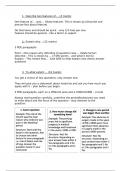
1. Describe two features of…. (4 marks)
One feature of…. was…. (State feature). This is shown by (Describe one
precise fact about feature)
Do that twice and should be quick – only 2/3 lines per one.
Feature should be general – like a factor or aspect.
2. Explain why….(12 marks)
3 PDE paragraphs
Point – One reason why (Wording of question) was…. (State factor)
Describe – This is shown by…. (3 SFD points – and what it led to)
Explain – This meant that…. (Use SIDE to help explain and clearly answer
question)
3. To what extent…. (16 marks)
You get a choice of two questions, only answer one.
They will give you a statement about medicine and ask you how much you
agree with it – plan before you begin.
3 PDE paragraphs, each on a different area and a CONCLUSION – crucial
Always read question carefully, underline the period/factor/area you need
to write about and the focus of the question – stay relevant to the
question.
, Structure: 2 yes and 1 no paragraphs
For the main one you agree with:
Point - The main reason why…. (Use wording of question and state point)
Describe – This is shown by…. (3 SFD and include WHAT IT LED TO)
Explain using wording of question – This was the main reason why
(Wording of question) as…. (Explain the impact it had on
causes/treatment/prevention and life expectancy)
For one you agree with but not main reason:
Point - Another reason why…. (Use wording of question and state point)
Describe – This is shown by…. (3 SFD and include WHAT IT LED TO)
Explain using wording of question – This is a big reason why….
(Wording of question) as…. (Explain the impact it had on
causes/treatment/prevention and life expectancy)
For the 1 paragraph you disagree with:
Point - Another reason why…. (Wording of Q) was….
Describe – This is shown by…. (3 SFD and what it led to)
Explain using wording of question – This was a big reason why
(wording of question) as…. (Explain the impact it had on
causes/treatment/prevention and life expectancy)
COUNTER – Nonetheless, the impact was limited/less important than
(Your answer) as…. (Explain limitations of this factor and why the other
factor is more important)
Example counter paragraph:
However, the advances in surgery between 1700-1900 were not as significant than advances made in 1900-
present day as they could perform transplants. In 1901, they discovered blood groups which allowed for blood
transfusions to occur. Additionally, they added sodium citrate to the blood during WWI so it would not clot so
it could be stored for long periods and transferred to other people. Due to them discovering specific blood
groups and antigens, they were able to perform the first heart transplant in 1967 in South Africa by Dr
Christian Bernard. They were also able to perform bone marrow transplants in 1982 and lung transplants in
1987. This shows that changes in 1900-present day were significant as they were effectively able to treat life
threatening illnesses that otherwise could cause death, and these illnesses could not be treated before.
Furthermore, doctors now have micro and key-hole surgery which make tint incisions to perform deep
surgeries with no scarring and small risk of damage to other tissues. This increased life expectancy as it helps
treat illnesses with otherwise high mortality rates like cancers. Nonetheless, the impact was less important
than the impact of anaesthesia and antiseptics because without them surgeries would not have developed.
Without anaesthesia, doctors could not perform heart transplants and without antiseptics patients would most
likely die from infections, for example 46% of amputees died before Lister. This means that transplants were
only able to flourish due to Simpson, Lister and Snow.
Example agree paragraph:


