
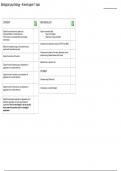
Biological psychology - A level paper 1 topic
CONTENT ✅ METHODOLOGY ✅
Explain the central nervous system and Explain correctional data
neurotransmitters in human behaviour - Types of correlation
The functions of neurotransmitters and synaptic - Weakness of using correlation
transmission
Describe and evaluate brain scans (CAT,PET and fMRI)
Effects of recreational drugs to the central nervous
system and transmission process
Describe and evaluate a Twin study (Brendgen) and an
Explain the structure of the brain adoption study (Deater-Deckard and Plomin)
Statistical test - spearman rho
Explain the brain functioning as an explanation of
aggression as a human behaviour
STUDIES
Explain the role of evolution as an explanation of
aggression as a human behaviour
Classical study (Raine et al)
Explain the role of hormones as an explanation of Contemporary study (Brendgen)
aggression as a human behaviour
Explain the biological explanation of aggression as an
alternative explanation to freud's psychodynamic
explanation Freud is not biological - do not use this
theory when the question asks for a biological
explanation
, The central nervous system (CNS)
Function Thalamus
It receives information from the sense and relays them
1. It collects,processes and responds to information in the to the cerebral cortex
environment
2. It coordinates the working of different organs and cells in Cerebellum
the body Coordinates posture,balance and movement. It
integrates information from the spinal cord and other
The CNS is made up of the spinal cord and the brain areas such as the motor cortex. It contains about 50%
of the brain’s neurons
Spinal cord
It links the CNS to the Peripheral nervous system (PNS). It’s Corpus callosum
responsible for reflex actions such as removing your hand from a It physically connects the two hemispheres below the
hot plate. cerebral cortex and allows communication between
them. Integrates activities of both sides of the body
Brain
It is the source of our conscious awareness and where decision
making occurs.There are two hemispheres connected by group of
structures like corpus callosum
Cerebral cortex
The outer layer of the brain. it’s highly developed and is what
distinguishes human mental functioning from other animals. It is
3mm thick and covered the inner part of the brain. It can be divided
in to cortical (belonging to the cortex) and subcortical (below the
cortex)
Subcortical structures
The limbic system
The limbic system plays a role in regulating emotional responses
(aggression) It is highly interconnected to the cortex
Hypothalamus
It controls motivational behaviour such as hunger,thirst and sex. It
has a key role in the body’s stress response through its control of
fight or flight .
It regulates the endocrine system and secrets some hormones too.
CONTENT ✅ METHODOLOGY ✅
Explain the central nervous system and Explain correctional data
neurotransmitters in human behaviour - Types of correlation
The functions of neurotransmitters and synaptic - Weakness of using correlation
transmission
Describe and evaluate brain scans (CAT,PET and fMRI)
Effects of recreational drugs to the central nervous
system and transmission process
Describe and evaluate a Twin study (Brendgen) and an
Explain the structure of the brain adoption study (Deater-Deckard and Plomin)
Statistical test - spearman rho
Explain the brain functioning as an explanation of
aggression as a human behaviour
STUDIES
Explain the role of evolution as an explanation of
aggression as a human behaviour
Classical study (Raine et al)
Explain the role of hormones as an explanation of Contemporary study (Brendgen)
aggression as a human behaviour
Explain the biological explanation of aggression as an
alternative explanation to freud's psychodynamic
explanation Freud is not biological - do not use this
theory when the question asks for a biological
explanation
, The central nervous system (CNS)
Function Thalamus
It receives information from the sense and relays them
1. It collects,processes and responds to information in the to the cerebral cortex
environment
2. It coordinates the working of different organs and cells in Cerebellum
the body Coordinates posture,balance and movement. It
integrates information from the spinal cord and other
The CNS is made up of the spinal cord and the brain areas such as the motor cortex. It contains about 50%
of the brain’s neurons
Spinal cord
It links the CNS to the Peripheral nervous system (PNS). It’s Corpus callosum
responsible for reflex actions such as removing your hand from a It physically connects the two hemispheres below the
hot plate. cerebral cortex and allows communication between
them. Integrates activities of both sides of the body
Brain
It is the source of our conscious awareness and where decision
making occurs.There are two hemispheres connected by group of
structures like corpus callosum
Cerebral cortex
The outer layer of the brain. it’s highly developed and is what
distinguishes human mental functioning from other animals. It is
3mm thick and covered the inner part of the brain. It can be divided
in to cortical (belonging to the cortex) and subcortical (below the
cortex)
Subcortical structures
The limbic system
The limbic system plays a role in regulating emotional responses
(aggression) It is highly interconnected to the cortex
Hypothalamus
It controls motivational behaviour such as hunger,thirst and sex. It
has a key role in the body’s stress response through its control of
fight or flight .
It regulates the endocrine system and secrets some hormones too.


