BTEC Level 3 Extended Diploma in Applied Science
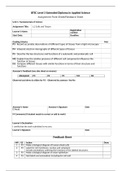
Assignment Front Sheet/Feedback Sheet
Unit 1: Fundamentals of Science
Assignment Title: 1.2 Cells and Tissues
Registration
Learner’s Name: number:
Start Date: Deadline:
Grading Criteria: Met
P3 Record accurately observations of different types of tissues from a light microscope
P4 Interpret electron micrographs of different types of tissues
P5 Describe the key structures and functions of a eukaryotic and prokaryotic cell
M2 Explain how the relative presence of different cell components influences the
function of tissues
D2 Compare different tissues with similar functions in terms of their structure and
functions
Assessor’s Feedback (see also sheet on reverse)
Attempted: P3 P4 P5 M2 D2
Observed and drew six slides for P3 – Observed by assessor: Yes/No
Assessor’s Name Assessor’s Signature Date
D.Wyat
IV Comments (if student needs to correct or add to work)
Learner’s Declaration:
I certify that the work submited is my own.
Learner’s Signature Date
Feedback Sheet
MP GC Action Done
1 P3 Make a biological diagram of human cheek cells
2 P3 Label the cell membrane, nucleus and cytoplasm.
Include annotations outlining the functions of the labeled structures.
3 P3 Make a biological diagram of onion epithelium
4 P3 Add labels and annotations including the cell wall
,5 P3 Draw up a table to compare the structure of typical plant and animal cells
P3 Using the prepared slides make labeled, biological diagrams of the main tissue
types:
6 P3 epithelium
7 P3 muscle
8 P3 connective
9 P3 nervous
P4 Interpretation of electron micrographs: identify and draw the following organelles
(including reference for each drawing):
10 P4 -Nucleus & Nucleolus
11 P4 -Cell surface membrane or plasma membrane
12 P4 -Cell wall
13 P4 -Mitochondria
14 P4 -Ribosome & Rough ER
15 P4 -Smooth ER
16 P4 -Golgi body
17 P4 -Lysosome
18 P4 -Vesicles
P5 Description of the structure and functions of the following cell components:
19 P5 -Nucleus
20 P5 -Nucleolus
21 P5 -Cell surface membrane or plasma membrane
22 P5 -Cell wall
23 P5 -Mitochondria
24 P5 -Ribosome &
25 P5 -Rough ER
26 P5 -Smooth ER
27 P5 -Golgi body
28 P5 -Lysosome
29 P5 -Vesicles
30 P5 Table comparing the structure of prokaryote and eukaryote cells
31 M2 Explanation of ‘differentiation’
32 M2 Explanation of the importance of differentiation in the formation of different types
of cells and tissues
M2 Detailed structure of the cells and intercellular material that make up the following
tissues is described:
33 M2 -Ciliated columnar epithelium
34 M2 -Hyaline cartilage
35 M2 -Brain tissue (multipolar neurones)
36 M2 -Skeletal muscle
M2 Explain how presence/absence/relative numbers of cell components influence the
functioning of the following tissues:
37 M2 -Ciliated columnar epithelium
38 M2 -Hyaline cartilage
39 M2 -Brain tissue (multipolar neurones)
40 M2 -Skeletal muscle
D2 Compare different tissues, in terms of their structure, that have similar functions
(skeletal & cardiac muscle)
41 D2 Write a clear description of the difference and similarities in structure of these two
tissues
42 D2 Describe the differences in function of these two tissues
, 43 D2 Link the differences in structure to the differences in function
1.2 Merit
Differentiation:
Differentiation describes the changes that occur in the cells of
multicellular organisms and how cells are focused to accomplish specific
purposes. In progressive biology, cellular differentiation is when
unspecialized cells become a specialized cell type. Differentiation
happens several times in the development of a multicellular organism as
the organism changes from a simple single-celled zygote to an intricate
arrangement of tissues and cells such as epithelium. Differentiation also
collective process in adults. Adult Stem Cells can split and create
completely differentiated offspring (daughter) cells during the
restoration of tissues as well as during a normal cell turnover.
Differentiation radically changes many things such as a cell size and
membrane potential shape and metabolic activity and lastly physical
features, these changes occur because of alterations in genes when they
are assorted randomly into offspring cells(daughter), cellular
differentiation almost never includes an alteration in the DNA structure. Cellular differentiation
almost never involves a change in DNA sequence itself. Therefore different cells can have very
physical characteristics despite having the same genome.in this way a zygote can become muscle,
connective, nervous or epithelium tissue
Ciliated epithelium:
Assignment Front Sheet/Feedback Sheet
Unit 1: Fundamentals of Science
Assignment Title: 1.2 Cells and Tissues
Registration
Learner’s Name: number:
Start Date: Deadline:
Grading Criteria: Met
P3 Record accurately observations of different types of tissues from a light microscope
P4 Interpret electron micrographs of different types of tissues
P5 Describe the key structures and functions of a eukaryotic and prokaryotic cell
M2 Explain how the relative presence of different cell components influences the
function of tissues
D2 Compare different tissues with similar functions in terms of their structure and
functions
Assessor’s Feedback (see also sheet on reverse)
Attempted: P3 P4 P5 M2 D2
Observed and drew six slides for P3 – Observed by assessor: Yes/No
Assessor’s Name Assessor’s Signature Date
D.Wyat
IV Comments (if student needs to correct or add to work)
Learner’s Declaration:
I certify that the work submited is my own.
Learner’s Signature Date
Feedback Sheet
MP GC Action Done
1 P3 Make a biological diagram of human cheek cells
2 P3 Label the cell membrane, nucleus and cytoplasm.
Include annotations outlining the functions of the labeled structures.
3 P3 Make a biological diagram of onion epithelium
4 P3 Add labels and annotations including the cell wall
,5 P3 Draw up a table to compare the structure of typical plant and animal cells
P3 Using the prepared slides make labeled, biological diagrams of the main tissue
types:
6 P3 epithelium
7 P3 muscle
8 P3 connective
9 P3 nervous
P4 Interpretation of electron micrographs: identify and draw the following organelles
(including reference for each drawing):
10 P4 -Nucleus & Nucleolus
11 P4 -Cell surface membrane or plasma membrane
12 P4 -Cell wall
13 P4 -Mitochondria
14 P4 -Ribosome & Rough ER
15 P4 -Smooth ER
16 P4 -Golgi body
17 P4 -Lysosome
18 P4 -Vesicles
P5 Description of the structure and functions of the following cell components:
19 P5 -Nucleus
20 P5 -Nucleolus
21 P5 -Cell surface membrane or plasma membrane
22 P5 -Cell wall
23 P5 -Mitochondria
24 P5 -Ribosome &
25 P5 -Rough ER
26 P5 -Smooth ER
27 P5 -Golgi body
28 P5 -Lysosome
29 P5 -Vesicles
30 P5 Table comparing the structure of prokaryote and eukaryote cells
31 M2 Explanation of ‘differentiation’
32 M2 Explanation of the importance of differentiation in the formation of different types
of cells and tissues
M2 Detailed structure of the cells and intercellular material that make up the following
tissues is described:
33 M2 -Ciliated columnar epithelium
34 M2 -Hyaline cartilage
35 M2 -Brain tissue (multipolar neurones)
36 M2 -Skeletal muscle
M2 Explain how presence/absence/relative numbers of cell components influence the
functioning of the following tissues:
37 M2 -Ciliated columnar epithelium
38 M2 -Hyaline cartilage
39 M2 -Brain tissue (multipolar neurones)
40 M2 -Skeletal muscle
D2 Compare different tissues, in terms of their structure, that have similar functions
(skeletal & cardiac muscle)
41 D2 Write a clear description of the difference and similarities in structure of these two
tissues
42 D2 Describe the differences in function of these two tissues
, 43 D2 Link the differences in structure to the differences in function
1.2 Merit
Differentiation:
Differentiation describes the changes that occur in the cells of
multicellular organisms and how cells are focused to accomplish specific
purposes. In progressive biology, cellular differentiation is when
unspecialized cells become a specialized cell type. Differentiation
happens several times in the development of a multicellular organism as
the organism changes from a simple single-celled zygote to an intricate
arrangement of tissues and cells such as epithelium. Differentiation also
collective process in adults. Adult Stem Cells can split and create
completely differentiated offspring (daughter) cells during the
restoration of tissues as well as during a normal cell turnover.
Differentiation radically changes many things such as a cell size and
membrane potential shape and metabolic activity and lastly physical
features, these changes occur because of alterations in genes when they
are assorted randomly into offspring cells(daughter), cellular
differentiation almost never includes an alteration in the DNA structure. Cellular differentiation
almost never involves a change in DNA sequence itself. Therefore different cells can have very
physical characteristics despite having the same genome.in this way a zygote can become muscle,
connective, nervous or epithelium tissue
Ciliated epithelium: