P5
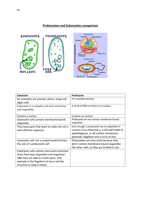
Prokaryotes and Eukaryotes camparison
Eukaryote Prokaryote
for examples are animals, plants, fungi and For example bacteria
algae cells
Eukaryote is a complex cell with structures A circle of DNA as there is no nucleus.
and organelles
Contains a nucleus Contains no nucleus
Eukaryotic cells contain membrane bound Prokaryote do not contain membrane bound
organelles organelles
They have parts that work to make the cell a Even though a prokaryote has no organelles it
self-sufficient organism contains it has ribosome’s, a cell wall made of
peptidoglycan, a cell surface membrane,
plasmids, flagellum and a circle of Dna
Eukaryotic cells are a couple hundred times Prokaryotes are very small because they
the size of a prokaryotic cell don't contain membrane bound organelles
like other cells, so they are limited in size
Eukaryotic cells contain extra parts attached.
Since they have organelles and organized
DNA they are able to create parts. One
example is the flagellum (it has a tail-like
structure to help it move).
Prokaryotes and Eukaryotes camparison
Eukaryote Prokaryote
for examples are animals, plants, fungi and For example bacteria
algae cells
Eukaryote is a complex cell with structures A circle of DNA as there is no nucleus.
and organelles
Contains a nucleus Contains no nucleus
Eukaryotic cells contain membrane bound Prokaryote do not contain membrane bound
organelles organelles
They have parts that work to make the cell a Even though a prokaryote has no organelles it
self-sufficient organism contains it has ribosome’s, a cell wall made of
peptidoglycan, a cell surface membrane,
plasmids, flagellum and a circle of Dna
Eukaryotic cells are a couple hundred times Prokaryotes are very small because they
the size of a prokaryotic cell don't contain membrane bound organelles
like other cells, so they are limited in size
Eukaryotic cells contain extra parts attached.
Since they have organelles and organized
DNA they are able to create parts. One
example is the flagellum (it has a tail-like
structure to help it move).