3.5.1 Photosynthesis – AQA A Level Biology Summary Notes
Plant and algal cells contain chloroplasts and carry out photosynthesis
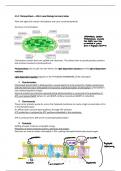
Structure of a chloroplast
Chloroplasts contain their own cpDNA and ribosomes. This allows them to quickly produce proteins
and enzymes involved in photosynthesis.
Photosynthesis can be split into two halves: the light dependent reactions and the light independent
reactions
Light-dependent reaction happens in the THYLAKOID MEMBRANE of the chloroplast
1) Photoionisation
Chlorophyll absorbs light in photosystems, causing electrons to be excited to a higher energy level
and two electrons leave chlorophyll in the process of photoionisation of chlorophyll – chlorophyll is
now oxidised (positive charge)
Some of energy from electrons released during photoionisation is conserved in the production of
ATP, and reduced NADP (where H+ and NADP combine to produce NADPH in reduction)
2) Chemiosmosis
These carrier proteins pump H+ across the thylakoid membrane to create a high concentration of H+
in the thylakoid space
H+ diffuse down concentration gradient, through ATP synthase
ATP production is catalysed by ATP synthase embedded in the membrane
ATP is produced from ADP and Pi via photophosphorylation
3) Photolysis
Spliting of water molecule using light energy
Photolysis of water produces protons, electrons and oxygen
Electrons are used to reduce chlorophyll in PSII, making chlorophyll electrically neutral again
Plant and algal cells contain chloroplasts and carry out photosynthesis
Structure of a chloroplast
Chloroplasts contain their own cpDNA and ribosomes. This allows them to quickly produce proteins
and enzymes involved in photosynthesis.
Photosynthesis can be split into two halves: the light dependent reactions and the light independent
reactions
Light-dependent reaction happens in the THYLAKOID MEMBRANE of the chloroplast
1) Photoionisation
Chlorophyll absorbs light in photosystems, causing electrons to be excited to a higher energy level
and two electrons leave chlorophyll in the process of photoionisation of chlorophyll – chlorophyll is
now oxidised (positive charge)
Some of energy from electrons released during photoionisation is conserved in the production of
ATP, and reduced NADP (where H+ and NADP combine to produce NADPH in reduction)
2) Chemiosmosis
These carrier proteins pump H+ across the thylakoid membrane to create a high concentration of H+
in the thylakoid space
H+ diffuse down concentration gradient, through ATP synthase
ATP production is catalysed by ATP synthase embedded in the membrane
ATP is produced from ADP and Pi via photophosphorylation
3) Photolysis
Spliting of water molecule using light energy
Photolysis of water produces protons, electrons and oxygen
Electrons are used to reduce chlorophyll in PSII, making chlorophyll electrically neutral again