3.1.5.2 DNA replication – AQA A Level Biology Summary Notes
The semi-conservative nature of DNA ensure genetic continuity between generations of cells
Before a cell divides by mitosis, it must replicate its DNA, causing chromosome to go from consisting
of one chromatid to two chromatids
- This is important because during mitosis chromatids are pulled away from each other,
therefore resulting in daughter cells receiving the same genetic information as the parent
cell
For genetic continuity, each sister chromatid must be identical to the other. This is ensured because
the DNA replicates semi-conservatively: one strand from a parent DNA molecule is always used a a
template from which a second new strand can be created
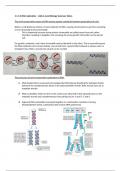
The processes of semi-conservative replication of DNA
1) DNA double helix is unwound and unzipped by DNA helicase breaking the hydrogen bonds
between the complementary bases in the polynucleotide strands. Both strands now act as
template strands
2) DNA nucleotides which are free in the nucleus are attracted to the exposed bases on the
template strands and complementary base pairing occurs: A and T, C and G
3) Adjacent DNA nucleotides are joined together in condensation reactions, forming
phosphodiester bonds, catalysed by the enzyme DNA polymerase
The semi-conservative nature of DNA ensure genetic continuity between generations of cells
Before a cell divides by mitosis, it must replicate its DNA, causing chromosome to go from consisting
of one chromatid to two chromatids
- This is important because during mitosis chromatids are pulled away from each other,
therefore resulting in daughter cells receiving the same genetic information as the parent
cell
For genetic continuity, each sister chromatid must be identical to the other. This is ensured because
the DNA replicates semi-conservatively: one strand from a parent DNA molecule is always used a a
template from which a second new strand can be created
The processes of semi-conservative replication of DNA
1) DNA double helix is unwound and unzipped by DNA helicase breaking the hydrogen bonds
between the complementary bases in the polynucleotide strands. Both strands now act as
template strands
2) DNA nucleotides which are free in the nucleus are attracted to the exposed bases on the
template strands and complementary base pairing occurs: A and T, C and G
3) Adjacent DNA nucleotides are joined together in condensation reactions, forming
phosphodiester bonds, catalysed by the enzyme DNA polymerase