
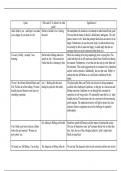
Quote Who said it? To whom? At what Significance?
point?
And I drink to you – and hope I can make Sheila to Gerald in Act 1 during He manipulates the situation in an attempt to make himself look good.
you as happy as you deserve to be. the meal The toast that he makes to Sheila is deliberately ambiguous. The verb
phrase ‘deserve to be’ hints that perhaps Sheila does not deserve to be
happy. Furthermore, he uses the noun ‘hope’ to indicate that he may
not actually be able to make her happy. It could imply that this is a
marriage based on social connection rather than love.
I’m sorry, Daddy. Actually I was Sheila before Birling makes his Sheila was looking at her ring enquiringly prior to saying this. This
listening. speech in Act 1. She assures her could infer that she is still suspicious about where Gerald went during
Father that she is listening to him. the summer. Furthermore, we see that she does not give her father her
full attention. This could suggest that she is not taken in by Capitalism
and his verbose speeches. Additionally, she uses the noun ‘Daddy’ to
indicate that she still behaves as a child and is influenced by her
father.
We can’t let all these Bernard Shaws and Act 1 - Birling after the meal The playwrights Shaw and Wells were known for being outspoken
H.G. Wellses do all the talking. We hard during his speech to the family. socialists who challenged Capitalism. As the play is a microcosm and
headed practical business men must say Birling represents Capitalism we see through this comment his
something sometime. opposition to left wing politics. We repeatedly learn that he is a ‘hard-
headed practical’ businessman who was concerned with maxismising
profit margins. The implication that he will fight to protect his class
interests whatever arguments are used to challenge his capitalist
philosophies.
Eric talking to Birling and Gerald Reinforces gender differences and the impact of patriarchal society.
You’d think a girl never had any clothes The uses of diminutive noun ‘girl’ demeans Sheila who is older than
before she gets married. Women are him. Also, the use of the colloquial adjective ‘potty’ implies that
potty about ‘em. Sheila is superficial.
No, thank you, Mr Birling. I’m on duty. The Inspector to Birling when he We see that The Inspector takes his job seriously and does not wish to
point?
And I drink to you – and hope I can make Sheila to Gerald in Act 1 during He manipulates the situation in an attempt to make himself look good.
you as happy as you deserve to be. the meal The toast that he makes to Sheila is deliberately ambiguous. The verb
phrase ‘deserve to be’ hints that perhaps Sheila does not deserve to be
happy. Furthermore, he uses the noun ‘hope’ to indicate that he may
not actually be able to make her happy. It could imply that this is a
marriage based on social connection rather than love.
I’m sorry, Daddy. Actually I was Sheila before Birling makes his Sheila was looking at her ring enquiringly prior to saying this. This
listening. speech in Act 1. She assures her could infer that she is still suspicious about where Gerald went during
Father that she is listening to him. the summer. Furthermore, we see that she does not give her father her
full attention. This could suggest that she is not taken in by Capitalism
and his verbose speeches. Additionally, she uses the noun ‘Daddy’ to
indicate that she still behaves as a child and is influenced by her
father.
We can’t let all these Bernard Shaws and Act 1 - Birling after the meal The playwrights Shaw and Wells were known for being outspoken
H.G. Wellses do all the talking. We hard during his speech to the family. socialists who challenged Capitalism. As the play is a microcosm and
headed practical business men must say Birling represents Capitalism we see through this comment his
something sometime. opposition to left wing politics. We repeatedly learn that he is a ‘hard-
headed practical’ businessman who was concerned with maxismising
profit margins. The implication that he will fight to protect his class
interests whatever arguments are used to challenge his capitalist
philosophies.
Eric talking to Birling and Gerald Reinforces gender differences and the impact of patriarchal society.
You’d think a girl never had any clothes The uses of diminutive noun ‘girl’ demeans Sheila who is older than
before she gets married. Women are him. Also, the use of the colloquial adjective ‘potty’ implies that
potty about ‘em. Sheila is superficial.
No, thank you, Mr Birling. I’m on duty. The Inspector to Birling when he We see that The Inspector takes his job seriously and does not wish to


