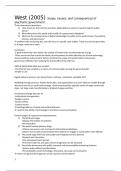
Behavioural Assumptions: born as a blank +eractical applications- SD used to
approach slate, humans learn behaviour is treat phobias by counter-
same way as animals, and only conditioning. Replacing learned fear
behaviour should be studied as it response using a relaxation
can be observed and measured response, taught relaxation
objectively. techniques, fe,a r hierarchy.
~':'. ~Classing conditioning- Pavlov + scientific- controlled lab
i '"'o\\).r,; ,,, using dogs and bell (stimulus). experiments. Skinner box-
,,. Operant
\J o,~ntc<>'
,-Y using ratsconditioni ng- Skinner
and skinner box
manipulated IV, food or shock and
DV number of times pressing lever.
Positive/negative reinforcement. +Animal research, problems with
Positive/negative punishment. extrapolation. Humans have free will
unlike animals so behaviour n~t
entirely due to
reinforcement/association.
-Deterministic-skinner says free will
is an illusion. Believe that behaviour
is determined by environment such
as reinforcement/punishment. So
environmentally deterministic.
Controversial, pessimistic view of
human nature.
Social Assumptions: behaviour is learnt +Practical applications- used as a
Learning through observing and imitating treatment for phobias. Model who is
theory others. Leaming occurs as a similar to patient interact with the
result of indirect experiences. phobic stimulus in a non-anxious
Meditational processes; attention, way. Patient observes and learns to
retention, reproduction and interact in non-anxious way
motivation. (vicarious reinforcement as pleasant
Models can be live or symbolic. conse11quence).
Imitation, identification. +Scientific- Bandura controlled lab
Vicarious reinforcement and experiments, standardised. IV
punishment. manipulated (which model they
Bandura-Bobo doll study. observed) and DV {aggression
measure). EV's controlled and ppt
variables eliminated.
+Less reductionist than other
approaches. Behaviou r not reduced
to a simplistic level. Consider s
environmental and cognitive factors.
Holistic explanation.
-Low internal validity. Demand
characteristics, bobo doll designed to
be hit so they may have done what
they thought was expected of them.
Cognitive Assumptipns: focus is on internal +Practical applicatio ns-CST for
approac h mental processes, mind is similar treating depression, replacing
to computer models, internal irrational thoughts with more rational
mental processes can be studied ones.
by observing human behaviou r +Sci~ntific- highly controlled lap exp.
and making inferences. Replicable, standard ised EV's
Schemas: minimised. Valid cause ~nd effect
✓ Useful as they provide a
made about IMP on behaviou r.
'mental shortcut' and fill in -Lack ecolooical validitv, memory
approach slate, humans learn behaviour is treat phobias by counter-
same way as animals, and only conditioning. Replacing learned fear
behaviour should be studied as it response using a relaxation
can be observed and measured response, taught relaxation
objectively. techniques, fe,a r hierarchy.
~':'. ~Classing conditioning- Pavlov + scientific- controlled lab
i '"'o\\).r,; ,,, using dogs and bell (stimulus). experiments. Skinner box-
,,. Operant
\J o,~ntc<>'
,-Y using ratsconditioni ng- Skinner
and skinner box
manipulated IV, food or shock and
DV number of times pressing lever.
Positive/negative reinforcement. +Animal research, problems with
Positive/negative punishment. extrapolation. Humans have free will
unlike animals so behaviour n~t
entirely due to
reinforcement/association.
-Deterministic-skinner says free will
is an illusion. Believe that behaviour
is determined by environment such
as reinforcement/punishment. So
environmentally deterministic.
Controversial, pessimistic view of
human nature.
Social Assumptions: behaviour is learnt +Practical applications- used as a
Learning through observing and imitating treatment for phobias. Model who is
theory others. Leaming occurs as a similar to patient interact with the
result of indirect experiences. phobic stimulus in a non-anxious
Meditational processes; attention, way. Patient observes and learns to
retention, reproduction and interact in non-anxious way
motivation. (vicarious reinforcement as pleasant
Models can be live or symbolic. conse11quence).
Imitation, identification. +Scientific- Bandura controlled lab
Vicarious reinforcement and experiments, standardised. IV
punishment. manipulated (which model they
Bandura-Bobo doll study. observed) and DV {aggression
measure). EV's controlled and ppt
variables eliminated.
+Less reductionist than other
approaches. Behaviou r not reduced
to a simplistic level. Consider s
environmental and cognitive factors.
Holistic explanation.
-Low internal validity. Demand
characteristics, bobo doll designed to
be hit so they may have done what
they thought was expected of them.
Cognitive Assumptipns: focus is on internal +Practical applicatio ns-CST for
approac h mental processes, mind is similar treating depression, replacing
to computer models, internal irrational thoughts with more rational
mental processes can be studied ones.
by observing human behaviou r +Sci~ntific- highly controlled lap exp.
and making inferences. Replicable, standard ised EV's
Schemas: minimised. Valid cause ~nd effect
✓ Useful as they provide a
made about IMP on behaviou r.
'mental shortcut' and fill in -Lack ecolooical validitv, memory