

Written by students who passed Immediately available after payment Read online or as PDF Wrong document? Swap it for free 4.6 TrustPilot
logo-home
Document preview thumbnail
Preview 4 out of 145 pages
Exam (elaborations)

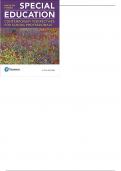
Special Education Contemporary Perspectives for School Professionals 5Th edition by Marilyn Friend - Test Bank

Document preview thumbnail
Preview 4 out of 145 pages

Special Education: Contemporary Perspectives, 5e (Friend) Chapter 3 Multicultural and Bilingual Perspectives 3.1 Multiple Choice Questions 1) A complex system of underlying beliefs and attitudes that shapes the thoughts and behaviors of a group of people is: A) Cultural dissonance. B) Culture. C) Macroculture. D) Microculture. Answer: B 2) Cultural elements held in great esteem or considered to be important by a society are: A) Values. B) Morals. C) Ethics. D) Belief systems. Answer: A 3) The term that refers to groups that have distinguishing characteristics with respect to cultural aspects such as language, values, and behaviors is/are: A) Macroculture. B) Microculture. C) Socioeconomic status. D) Behavior patterns. Answer: B 4) The way in which a particular framework is used to develop, approve, and disseminate new information is called: A) Cognitive knowledge. B) Metacognition. C) Cognitive style. D) Knowledge construction. Answer: D 5) Kazuko is a 14-year-old highly organized student who tends to be very analytical in processing information. She is demonstrating what kind of cognitive style? A) Field-dependent B) Field-independent C) Field-insensitive D) Field-sensitive Answer: B 6) Cognitive styles that reflect a holistic approach to processing information are referred to as: A) Field-dependent. B) Field-independent. C) Field-sensitive. D) Field-insensitive. Answer: C 7) Mr. Hernandez, who speaks English as a second language, is starting his new teaching position at Welbourn High School. The student population of Welbourn is middle-upper class Caucasian students. What may occur between Mr. Hernandez and his students? A) Multicultural education B) Field sensitivity C) Disproportionate representation D) Cultural dissonance Answer: D 8) Behavioral differences most frequently stem from each of the following EXCEPT: A) Cultural differences. B) Frustration. C) Feeling alienated. D) Race. Answer: D 9) The issue of disproportionate representation is particularly significant in respect to which population? A) Caucasian B) Asian C) African American D) Hispanic Answer: C 10) Poverty and systemic bias are factors that contribute to: A) Multicultural education. B) Equity pedagogy. C) Disproportionate representation. D) Dominant culture. Answer: C 11) Poverty has been associated with each of the following EXCEPT: A) Systemic bias. B) Childhood exposure to lead. C) Prenatal exposure to toxins. D) Poor nutrition. Answer: A 12) Systemic bias within an educational system can occur through each of the following EXCEPT: A) Curriculum and instruction. B) The special education referral process. C) Teacher attitude. D) Disproportionate representation. Answer: D 13) Showing favoritism toward a group that occurs at multiple levels within a society or institution is called: A) Cognitive style. B) Teacher attitude. C) Systemic bias. D) Knowledge construction. Answer: C 14) The special education referral process has been criticized for potential bias in which of the following areas? A) Possible contributions from classroom environment B) Elements of the child's home environment C) Support from principals and teachers D) The skill level of the school psychologist Answer: A 15) In the case of culturally diverse learners, several authors have suggested that during the traditional prereferral process or response to intervention (RTI) procedures, the team should carefully examine factors in the student's environment that: A) Contribute to delinquency. B) May influence learning. C) Are different from the dominant culture. D) Suggest poverty. Answer: B 16) An alternative to the current system for assessment of young children is: A) Portfolio and performance assessments. B) Standardized tests and medication. C) Universal screening. D) Parent education as participation. Answer: C 17) Which of the following is integral to teaching diverse students and includes strategies such as learning contracts and tiered lessons? A) Universal design for learning B) Differentiated instruction C) Multicultural education D) Knowledge construction Answer: B 18) Mr. Izquierdo is a seventh-grade social studies teacher. He asked his neighbors, Mr. and Mrs. Matsuda, to visit his class to discuss Japanese culture. He was utilizing: A) Prejudice reduction. B) Knowledge construction. C) Content integration. D) Equity pedagogy. Answer: C 19) The use of instructional strategies that embrace the learning characteristics of cognitive styles of diverse populations is: A) Multicultural education. B) Equity pedagogy. C) Bilingual education. D) Prejudice reduction. Answer: B 20) An empowering school culture focuses on eradicating systemic factors such as: A) Use of other languages. B) Negative effects of tracking practices. C) Prejudice reduction. D) Content integration. Answer: B 21) An approach that uses the student's dominant language along with English for instructional purposes is: A) Bilingual education. B) Sheltered English. C) Equity pedagogy. D) English as a Second Language. Answer: A 22) Cho, who speaks Mandarin, is immediately enrolled in a class where she will be taught English as a foreign language. This is called a/an: A) Bilingual education program. B) English as a second language program. C) Sheltered English program. D) Multicultural education program. Answer: B 23) An instructional approach for students who are NOT native English speakers that uses controlled vocabulary and sentence structure, along with prompting, to facilitate comprehension in English language learners is: A) Concrete English. B) Sheltered English. C) Bilingual education. D) Conceptual education. Answer: B 24) Which of the following is an example of factors beyond the direct influence of educators that can adversely affect interactions with culturally diverse families? A) Families from culturally diverse backgrounds are likely to have positive preconceived notions about school personnel. B) Parenting for families of children with special needs is easier than for other families. C) There is disproportionate representation of students of color in special education. D) Attitudes toward the school may be positively influenced by their own school experiences. Answer: A 25) Which phase of a process that involves asking parents to identify goals they have for collaborative relationships and activities that may be used productively to accomplish these goals helps to answer questions such as these: Are we following through with our plan? Is our plan doing a good job of addressing our needs? A) Intake and assessment B) Selection of goals C) Planning and implementing activities D) Evaluation of activities Answer: D 26) School professionals can positively influence interactions with family members who may find schools intimidating places by: A) Introducing them to the faculty. B) Developing a friendship. C) Meeting families in non-school settings. D) Offering to tutor them. Answer: C 27) Important equity issues for urban education include qualifications of school personnel, the physical condition of the school, and: A) Overcrowding. B) Transportation. C) Extracurricular activities. D) Number of teaching assistants. Answer: A 28) Each of the following is a condition of urban education EXCEPT: A) Equity issues. B) School choice programs. C) Disability access to service. D) Teachers and their preparation. Answer: C 29) Each of the following is a condition of rural education EXCEPT: A) Disability identification. B) School choice programs. C) Lower teacher pay. D) Isolation. Answer: B 30) Students who are lesbian, gay, bisexual, or transgender (LGBT) comprise approximately what percent of a school's population? A) 1% B) 5% C) .5% D) 10% Answer: D 3.2 Praxis Style Questions 1) Ms. Smith is an ESL teacher at Friendly Elementary School. When she taught her students the vocabulary for fruits and vegetables, she brought in examples for them to handle. Ms. Smith used which instructional approach? A) Concrete English B) Sheltered English C) Bilingual education D) Conceptual education Answer: B 2) This school year you have very culturally diverse students. To enhance your self-awareness of culture, you should specifically do all the following EXCEPT: A) Examine your cultural values. B) Talk to each student's parents. C) Become aware of your biases. D) Consider your expectations for your students. Answer: B 3) You notice in your culturally diverse classroom that there are some underlying prejudices among certain students. How can you reduce these prejudices to create a culturally accepting environment? A) When you notice prejudice, punish the student. B) Talk to the parents of the student who is exhibiting prejudice. C) Teach about the concept of race as a social construct. D) When you notice prejudice, send that student to the principal's office. Answer: C 3.3 Fill in the Blank Questions 1) ________ is a term often used to refer to an individual's educational and income levels, and it may define some microcultures (e.g., working class or middle class). Answer: Socioeconomic Status (SES) 2) ________ refers to a significant discrepancy between two or more cultural frames of reference. Answer: Cultural dissonance 3) When teachers attempt to "teach down" to students who have disability labels, it can lead to a ________, or the idea that students will do or become what is expected of them. Answer: self-fulfilling prophecy 4) At least part of the problem of disproportionate representation can be attributed to ________, or favoritism toward a particular group that occurs at multiple levels within a society or institution, making such favoritism an implicit part of it. Answer: systemic bias 5) ________ implies that the curriculum that students learn should include content about diverse populations and present information from diverse points of view. Instruction should include examples of key concepts and principles from a variety of cultures. Answer: Content integration 3.4 Short Answer Questions 1) Values and language are two elements of culture. Explain these concepts as they relate to culture, and provide an example of each. Answer: Values are those cultural elements held in great esteem or considered to be important by a society. For example, the dominant culture values individualism and independence. The importance of a concept to a culture often is reflected in how that concept is developed in language. For example, in the language of the Lakota, a Native American people who highly value peace and respect, no word exists to express the concept of war. 2) How does the representation of African American students in special education and gifted education compare? Answer: Fewer African American students than would be expected based on population distribution are identified as gifted versus many more than would be expected based on population distribution that are identified as having a disability. 3) What are the five major dimensions of multicultural education? Answer: The five major dimensions of multicultural education are content integration, knowledge construction, prejudice reduction, equity pedagogy, and an empowering school culture. 4) How can school professionals positively influence interactions with family members who may find school an intimidating place? Answer: Answers should include examples of approaches in which educators can personalize interactions with family members and cite the five phases of the collaborative relationships approach suggested by Shea and Bauer (1993) (intake and assessment, selection of goals, planning and implementing activities, evaluation of activities, and review of the collaborative relationship). 5) Describe the equity issues discussed regarding urban education. Answer: Student access to fully credentialed, experienced teachers is a chronic problem, and the physical condition of urban schools often compares unfavorably to that of suburban counterparts. 3.5 Essay Questions 1) What is culture? Compare and contrast the concepts of macro- and microculture. List at least 5 microcultures of which you consider yourself to belong. Answer: Culture is a complex system of underlying beliefs, attitudes, and actions that shapes the thoughts and behaviors of a group of people, distinguishing them from other groups. Culture is influenced by the environment and is learned, shared, and constantly changing. The overarching cultural aspects within a society are referred to as macroculture. Macroculture tends to unify the diverse members of a society and define them to others. Microcultures are groups that have distinguishing characteristics with respect to culture, such as language or dialect, values, behaviors, and worldviews. Examples of microcultures will vary. 2) What is disproportionate representation? Explain why this issue has been and continues to be such a hot topic within the field of special education. Answer: Discussion may include the prevalence rate of African American students in particular in the categories of intellectual disabilities and emotional and behavioral disabilities; placement of students of color in separate settings; and the stigma associated with labeling. African American students are nearly 3 times more likely than other students to be identified as having intellectual disabilities and twice as likely to be identified as having emotional or behavioral disabilities. 3) How does culture affect the learning process? In what ways has culture influenced your dealings with individuals of different cultures? Answer: Almost every aspect of the teaching and learning process is culturally influenced—from decisions about what is important to learn to decisions about how learning is best accomplished and assessed. Culture affects the content of instruction (what is taught, and who is portrayed); the cognitive styles used to teach (how students are taught); and the degree of cultural dissonance in the classroom (whether there is discrepancy between cultural frames of reference between teachers and students). Examples of how culture influences students' relationships with others will vary. 4) What can be done to improve fairness in the identification process of diverse learners? Answer: Before a referral for special education is officially made, the educators involved come together as a team to develop a deep understanding of the student's learning or behavior difficulties and to suggest strategies to address these difficulties. In the case of culturally diverse learners, the team should carefully examine factors in the student's environment that may influence learning during the traditional prereferral process or response to intervention (RTI) procedures, Garcia and Ortiz (1988) recommended systematic examination of classroom and teacher variables. Beyond enhanced intervention prior to referral, alternatives to traditional assessment procedures can be used. The eligibility determination process can be less dependent on standardized, norm-referenced assessment instruments because they tend to emphasize verbal skills, analytical thinking, and field-independent cognitive styles—elements that may lead to lower scores for many culturally diverse students. 5) Why is developing collaborative relationships with diverse families challenging? What factors contribute to this situation? Answer: Discussion should include an explanation of cultural dissonance (as cultural dissonance increases, so does the likelihood that roles designated by school personnel for family members will be deemed untenable or unproductive by them). Examples of factors may include preconceived notions about how a family values education (educators sometimes may believe, sometimes without being aware of their perceptions, that families from middle- or high-socioeconomic backgrounds are more concerned about their children's learning and more interested in being involved in their education than are families from low-socioeconomic backgrounds); a "one size fits all" approach to family involvement (educators unilaterally expect families to interact with them in a prescribed way); and unfamiliarity with how culturally influenced factors can affect home-school interactions (conceptions of disability vary according to group norms and expectations). School professionals test bank, Marilyn Friend test bank, School personnel perspectives, Educational assessment resources, School staff evaluation questions, Educational testing materials, Teacher preparation test bank, Special education assessment tools, School leadership exam questions, Education administration test bank, Inclusive education assessment, School management and leadership assessment, School psychology test questions, Educational resource evaluation, Classroom assessment strategies, Educational leadership test bank, School counselor evaluation questions, School administrator exam materials, Educational research methods test bank, Teacher evaluation and development, Student assessment in schools, Educational assessment and measurement, Education policy and practice evaluation, School improvement strategies, Educational change and reform assessment.

Content preview

,Special Education: Contemporary Perspectives, 5e (Friend)
Chapter 1 Understanding Special Education

1.1 Multiple Choice Questions

1) In 2012, the most recent year for which data are available, approximately how many children
and youth form birth to 21 years of age received special education services in U.S. schools?
A) 2.8 million
B) 5.5 million
C) 6.7 million
D) 10.2 million
Answer: C

2) Supports that are NOT directly related to a student's instruction but that are needed so that a
student can access instruction are:
A) General education.
B) Resource services.
C) Specialized curriculum.
D) Related services.
Answer: D

3) Preferential seating, computer access, and a one-on-one teaching assistant are examples of:
A) Special Education.
B) Free and Appropriate Education.
C) Related Services.
D) Supplemental Aids and Services.
Answer: D

4) Edouard Seguin is known for:
A) The idea that children with disabilities were not capable of learning.
B) Establishing the first public school class in 1875.
C) The idea that students with disabilities could learn if provided a structured learning
environment.
D) His work with 12-year-old Victor.
Answer: C

5) During the late 19th and early 20th centuries, many immigrants to the U.S. were judged to be
"feebleminded" because they did not know English or American customs. Because of this, some
became victims of laws supporting:
A) Eugenics.
B) Social conservatism.
C) Deportation.
D) Compulsory education.
Answer: A


1
Copyright © 2018 Pearson Education, Inc.

,6) The 1954 Brown v. Board of Education of Topeka, Kansas, decision resulted in which of the
following:
A) Separate can be equal.
B) Separate cannot be equal.
C) Separate classes are needed in extreme situations.
D) None of the above.
Answer: B

7) Mercer introduced the concept of:
A) Stigmatizing effects of labels.
B) "The six-hour retarded child."
C) Free appropriate education.
D) Inclusion.
Answer: B

8) Which is considered the "basis for all subsequent special education practice"?
A) P.L. 94-142 Education of the Handicapped Act
B) Larry P. v. Riles
C) P.L. 89-750 Elementary and Secondary Education Act
D) Diana v. State Board of Education of California
Answer: A

9) Mr. Edwards is a single dad whose son has recently been diagnosed with Tourette's syndrome.
He will begin kindergarten in the fall. Mr. Edwards knows that by law his son in entitled to
specialized instruction, related services, and supplemental aids and services. Mr. Edwards and
his son are guaranteed these rights by which provisions of IDEA?
A) Least Restrictive Environment
B) Zero Reject
C) Nondiscriminatory Evaluation
D) Free and Appropriate Education
Answer: B

10) Based on the section of IDEA concerning nondiscriminatory evaluation, which statement is
TRUE?
A) More than one test is used to assess the presence of a disability.
B) Any educational professionals can interpret assessment results.
C) Assessment occurs in only one academic area.
D) Tests are to be administered in English or Spanish.
Answer: A


2
Copyright © 2018 Pearson Education, Inc.

, 11) As Mrs. Vanstory read over the transcript of one of her new students, Audrey, she was
amazed. Audrey had a long and colorful history of medication difficulties and multiple
behavioral challenges. Mrs. Vanstory later called her close friend who was also a teacher (at
another school) and proceeded to tell her Audrey's history. How did she violate the rights of both
Audrey and her family?
A) Information about a student must be shared in person, not over the phone or email.
B) She didn't have permission from Audrey's parents to access Audrey's file.
C) Information regarding a student with a disability may not be shared with anyone who is not
directly working with the student.
D) Only the administrator and counselor can access students' records.
Answer: C

12) IDEA was most recently reauthorized in:
A) 1997.
B) 1999.
C) 2001.
D) 2004.
Answer: D

13) By far, the most comprehensive legislation protecting the rights of individuals with
disabilities, no matter their age, is:
A) Americans with Disabilities Act.
B) Individuals with Disabilities Education Act.
C) Section 504.
D) Adult with Disabilities Act.
Answer: A

14) Many young children with disabilities who receive services have milder needs related to:
A) Hearing impairments.
B) Specified learning disabilities.
C) Physical disabilities.
D) Language development or motor skill development.
Answer: D

15) Emily is 2 years old and is significantly behind her playmates in her gross motor skills. Her
mother wants her evaluated for disabilities. Which of the following statements is TRUE?
A) For children ages birth to 2 years old, special education is not always required by federal law.
B) IDEA mandates children birth to 5 years old to receive specialized education services.
C) Americans with Disabilities Act mandates children ages birth to 5 years old receive
specialized education services.
D) Section 504 specifies that children are not eligible for services until the age of three.
Answer: A


3
Copyright © 2018 Pearson Education, Inc.
Document information

Uploaded on
August 30, 2023
Number of pages
145
Written in
2022/2023
Type
Exam (elaborations)
Contains
Questions & answers
£18.99

Wrong document? Swap it for free Within 14 days of purchase and before downloading, you can choose a different document. You can simply spend the amount again.
Written by students who passed
Immediately available after payment
Read online or as PDF

Seller avatar
Reputation scores are based on the amount of documents a seller has sold for a fee and the reviews they have received for those documents. There are three levels: Bronze, Silver and Gold. The better the reputation, the more your can rely on the quality of the sellers work.
ExamsExpert
4.5
(90)
Sold
672
Followers
313
Items
2761
Last sold
5 days ago


Why students choose Stuvia

Created by fellow students, verified by reviews

Quality you can trust: written by students who passed their exams and reviewed by others who've used these revision notes.

Didn't get what you expected? Choose another document

No problem! You can straightaway pick a different document that better suits what you're after.

Pay as you like, start learning straight away

No subscription, no commitments. Pay the way you're used to via credit card and download your PDF document instantly.

Student with book image

“Bought, downloaded, and smashed it. It really can be that simple.”

Alisha Student

Working on your references?

Create accurate citations in APA, MLA and Harvard with our free citation generator.

Working on your references?

Frequently asked questions

