Explain 2 of the main conflicts affecting macroeconomic policy, and how a
government might trade off between achieving these objectives [10 Marks]
Governments around the world have many different objectives they wish to achieve, however,
economists argue that achieving all these objectives at the same time would be impossible due
to their mutually exclusive nature. Therefore, a trade off occurs between the policy objectives - if
one is achieved then another objective is sacrificed.
One common trade-off is between achieving full employment (and economic growth) and being
able to control inflation. If policymakers undertake job creation by way of increasing aggregate
demand (the total demand for final goods and services in the economy at a given time and price
level), through fiscal policy or monetary policy, there is a likelihood this will drive prices up.
Fiscal policy is the deliberate alteration of government spending or taxation whereas monetary
policy involves altering base interest rates or altering the quantity of money in the economy.
Both of these ways of alternating AD are likely to cause a rise in the rate of inflation- this
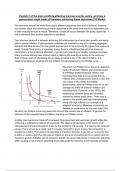
relationship between employment and inflation is best explained by the Phillips curve.
The short-run Phillips curve shows an apparent
trade-off between inflation and unemployment.
A.W.Phillips plotted historical inflation and
unemployment data and concluded that as
inflation falls, unemployment seems to rise, and
vice versa. In the 1950s and 1960s,
governments used the Phillips curve to try and
manage the trade-off between inflation and
unemployment. However, in the 1970s, the
relationship between these two variables
seemed to almost break down. There was a
period of low growth and high unemployment,
along with high inflation (an example of a
stagnant economy). Monetary economists put
forward an explanation for this and stated that
the short-run Phillips curve only takes into account the current rate of inflation - it ignores the
influence of the expected rate of inflation (the long-run Phillips curve).
Another macroeconomic trade-off is between full employment and economic growth while also
achieving a satisfactory balance of payments. The balance of payments is the record of all
international financial transactions made by the residents of a country - if a country has received
money, this is known as a credit, and if a country has paid or given money, the transaction is
counted as a debit. The balance of payments is important because it can tell us if a country has
a deficit or surplus, and thus this has an impact on the level of employment in a country and the
economic growth. A higher rate of economic growth will cause high levels of consumer spending
while causing a rise in import spending. It can also push the economy to full capacity and place
government might trade off between achieving these objectives [10 Marks]
Governments around the world have many different objectives they wish to achieve, however,
economists argue that achieving all these objectives at the same time would be impossible due
to their mutually exclusive nature. Therefore, a trade off occurs between the policy objectives - if
one is achieved then another objective is sacrificed.
One common trade-off is between achieving full employment (and economic growth) and being
able to control inflation. If policymakers undertake job creation by way of increasing aggregate
demand (the total demand for final goods and services in the economy at a given time and price
level), through fiscal policy or monetary policy, there is a likelihood this will drive prices up.
Fiscal policy is the deliberate alteration of government spending or taxation whereas monetary
policy involves altering base interest rates or altering the quantity of money in the economy.
Both of these ways of alternating AD are likely to cause a rise in the rate of inflation- this
relationship between employment and inflation is best explained by the Phillips curve.
The short-run Phillips curve shows an apparent
trade-off between inflation and unemployment.
A.W.Phillips plotted historical inflation and
unemployment data and concluded that as
inflation falls, unemployment seems to rise, and
vice versa. In the 1950s and 1960s,
governments used the Phillips curve to try and
manage the trade-off between inflation and
unemployment. However, in the 1970s, the
relationship between these two variables
seemed to almost break down. There was a
period of low growth and high unemployment,
along with high inflation (an example of a
stagnant economy). Monetary economists put
forward an explanation for this and stated that
the short-run Phillips curve only takes into account the current rate of inflation - it ignores the
influence of the expected rate of inflation (the long-run Phillips curve).
Another macroeconomic trade-off is between full employment and economic growth while also
achieving a satisfactory balance of payments. The balance of payments is the record of all
international financial transactions made by the residents of a country - if a country has received
money, this is known as a credit, and if a country has paid or given money, the transaction is
counted as a debit. The balance of payments is important because it can tell us if a country has
a deficit or surplus, and thus this has an impact on the level of employment in a country and the
economic growth. A higher rate of economic growth will cause high levels of consumer spending
while causing a rise in import spending. It can also push the economy to full capacity and place