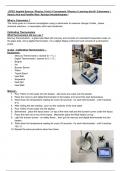
I BTEC Applied Science I Physics I Unit 2 I Coursework I Physics I Learning Aim B I Calorimetry I
Stearic Acid and Paraffin Wax I Apinaya Amuthalingham I
What is Calorimetry ?
The name given in a science investigation using a calorimeter to measure change of state , phase ,
chemical reactions - in association with heat transferred.
Calibrating Thermometers
What thermometers did you use ?
Mercury thermometers , a glass tube filled with mercury and consists of a standard temperature scale on
the glass tube. And a digital thermometer ,it is a digital display instrument and consists of a permanent
probe.
A plan : Calibrating Thermometers :-
Equipment:-
- Mercury Thermometer ( nearest to 1 o C )
- Digital Thermometer ( nearest to 0.1 o C )
- Beaker
- Ice
- Bunsen Burner
- Water
- Tripod Stand
- Heat Mat
- Stopwatch
- Heat Net
- Heat Matt
Method:-
1. Pour 150ml of cold water into the beaker , add some ice cubes into the beaker .
2. Place the mercury and digital thermometer in the beaker and record the start temperature .
3. Write down the temperature reading for every 30 seconds - for each thermometer , until it reaches
0o C.
4. After writing the last reading , pour out the contents of the iced water.
5. Pour 150ml of cold water into the beaker .
6. Beforehand , place the tripod stand on top of the heat matt and the bunsen burner under the tripod.
7. Place the heat net on top of the tripod , afterwards place the filled beaker on top .
8. Light the bunsen burner - on safety flame , then put the mercury and digital thermometer into the
beaker .
9. Write down the temperature reading for every 30 seconds - for each thermometer , until it reaches
100 o C.
10. Repeat the same procedure about two times .
1
,Results Table : Calibrating Thermometers :-
Thermo Temperature Of Iced Water Averag Temperature Of Boiling Water Average
meter ( o C) e (oC) Tempera
Temper ture
ature (oC)
1 2 3 ( o C) 1 2 3
Mercury 5.00 3.00 2.00 3.30 79.00 80.00 80.00 79.60
Thermo
meter
DigitalTh 2.30 2.40 2.30 2.30 79.00 79.20 78.90 79.03
ermomet
er
Mercury 3.00 1.00 1.00 1.60 86.00 92.00 104.00 94.00
Thermo
meter
Digital 3.00 1.90 1.60 2.10 94 98.1 100.60 97.50
Thermo
meter
How You Could Check If They Were Calibrated Or Not ? :-
Calibration is where you compare the measured values of your recorded results to know the accuracy and
precise standard measurements . You need to check that the thermometers are recording accurately - the
correct temperature ; it may be more important in some situations than others . It is best to practice that
and be aware of possible errors that may develop over time :-
- You can calibrate the thermometer at boiling point .
- You can calibrate the thermometer at freezing point .
- You can calibrate the thermometer at melting point .
Conclusion:-
In conclusion , the temperature increases and decreases , it stays constant when breaking all
intermolecular bonds ; even when we change the water’s temperature . This suggests that the state of
matter depends when calibrating thermometers , in any condition the temperature will stay the same .
Evaluation: How can it be improved ?
This method could be improved with a combination of different liquid states :-
- More Beakers with different temperatures of water , with thermometers in them .
- Different liquid matters .
- Different amounts of water in beakers .
- Do the experiment for a long period of time , until the temperature drops .
- A clamp for the thermometers to measure the temperature reading of the water .
Why does temperature remain constant during changes of state - in terms of intermolecular forces?
The temperature remains constant , as all intermolecular forces are formed to reach its boiling /melting
point ; to determine their physical state when heating , cooling or melting solids or liquids . Latent heat is
supplied to increase the temperature of the substance - to transform the state of matter . This suggests how
temperature remains constant when reverting to its original state .This is related to cooling as the
temperature stays constant when intermolecular forces start forming bonds to change its state of matter .
As the temperature decreases the paraffin wax reverts to its original physical state . This links to
intermolecular forces as particles of atoms break bonds as it’s easily reversible to change its state of
matter.
2
, Plan : Cooling Of Stearic Acid & Paraffin Wax :-
Aim:- To investigate the rate of cooling for stearic acid and paraffin wax to revert to its physical change of
state.
Equipment :-
- Test Tube Rack
- Stearic Acid
- Paraffin Wax
- Test Tube
- Mercury Thermometer ( nearest to 1 o C )
- Digital Thermometer ( nearest to 0.1 o C )
- Clamp Stand
- Heat Bath
- Stopwatch
Method :-
1. Pour a small amount of melted Stearic acid into a test tube . Place the test tube in a heat bath - up
to 80oC .
2. After boiling the Stearic acid , place the test tube in the test tube rack .
3. Fix the digital thermometer onto the clamp stand , and place the thermometer in the Stearic acid -
without touching the test tube’s bottom surface .
4. Record the start temperature .
5. Using a stopwatch read the temperature every 20 seconds - about 14 mins .
6. Record the last temperature reading .
7. Repeat the same method with a liquid thermometer - after melting the stearic acid in the hot bath.
8. Repeat this same procedure for paraffin wax .
1. Figure 1 - Stearic Acid Diagram ( REF )
3
Stearic Acid and Paraffin Wax I Apinaya Amuthalingham I
What is Calorimetry ?
The name given in a science investigation using a calorimeter to measure change of state , phase ,
chemical reactions - in association with heat transferred.
Calibrating Thermometers
What thermometers did you use ?
Mercury thermometers , a glass tube filled with mercury and consists of a standard temperature scale on
the glass tube. And a digital thermometer ,it is a digital display instrument and consists of a permanent
probe.
A plan : Calibrating Thermometers :-
Equipment:-
- Mercury Thermometer ( nearest to 1 o C )
- Digital Thermometer ( nearest to 0.1 o C )
- Beaker
- Ice
- Bunsen Burner
- Water
- Tripod Stand
- Heat Mat
- Stopwatch
- Heat Net
- Heat Matt
Method:-
1. Pour 150ml of cold water into the beaker , add some ice cubes into the beaker .
2. Place the mercury and digital thermometer in the beaker and record the start temperature .
3. Write down the temperature reading for every 30 seconds - for each thermometer , until it reaches
0o C.
4. After writing the last reading , pour out the contents of the iced water.
5. Pour 150ml of cold water into the beaker .
6. Beforehand , place the tripod stand on top of the heat matt and the bunsen burner under the tripod.
7. Place the heat net on top of the tripod , afterwards place the filled beaker on top .
8. Light the bunsen burner - on safety flame , then put the mercury and digital thermometer into the
beaker .
9. Write down the temperature reading for every 30 seconds - for each thermometer , until it reaches
100 o C.
10. Repeat the same procedure about two times .
1
,Results Table : Calibrating Thermometers :-
Thermo Temperature Of Iced Water Averag Temperature Of Boiling Water Average
meter ( o C) e (oC) Tempera
Temper ture
ature (oC)
1 2 3 ( o C) 1 2 3
Mercury 5.00 3.00 2.00 3.30 79.00 80.00 80.00 79.60
Thermo
meter
DigitalTh 2.30 2.40 2.30 2.30 79.00 79.20 78.90 79.03
ermomet
er
Mercury 3.00 1.00 1.00 1.60 86.00 92.00 104.00 94.00
Thermo
meter
Digital 3.00 1.90 1.60 2.10 94 98.1 100.60 97.50
Thermo
meter
How You Could Check If They Were Calibrated Or Not ? :-
Calibration is where you compare the measured values of your recorded results to know the accuracy and
precise standard measurements . You need to check that the thermometers are recording accurately - the
correct temperature ; it may be more important in some situations than others . It is best to practice that
and be aware of possible errors that may develop over time :-
- You can calibrate the thermometer at boiling point .
- You can calibrate the thermometer at freezing point .
- You can calibrate the thermometer at melting point .
Conclusion:-
In conclusion , the temperature increases and decreases , it stays constant when breaking all
intermolecular bonds ; even when we change the water’s temperature . This suggests that the state of
matter depends when calibrating thermometers , in any condition the temperature will stay the same .
Evaluation: How can it be improved ?
This method could be improved with a combination of different liquid states :-
- More Beakers with different temperatures of water , with thermometers in them .
- Different liquid matters .
- Different amounts of water in beakers .
- Do the experiment for a long period of time , until the temperature drops .
- A clamp for the thermometers to measure the temperature reading of the water .
Why does temperature remain constant during changes of state - in terms of intermolecular forces?
The temperature remains constant , as all intermolecular forces are formed to reach its boiling /melting
point ; to determine their physical state when heating , cooling or melting solids or liquids . Latent heat is
supplied to increase the temperature of the substance - to transform the state of matter . This suggests how
temperature remains constant when reverting to its original state .This is related to cooling as the
temperature stays constant when intermolecular forces start forming bonds to change its state of matter .
As the temperature decreases the paraffin wax reverts to its original physical state . This links to
intermolecular forces as particles of atoms break bonds as it’s easily reversible to change its state of
matter.
2
, Plan : Cooling Of Stearic Acid & Paraffin Wax :-
Aim:- To investigate the rate of cooling for stearic acid and paraffin wax to revert to its physical change of
state.
Equipment :-
- Test Tube Rack
- Stearic Acid
- Paraffin Wax
- Test Tube
- Mercury Thermometer ( nearest to 1 o C )
- Digital Thermometer ( nearest to 0.1 o C )
- Clamp Stand
- Heat Bath
- Stopwatch
Method :-
1. Pour a small amount of melted Stearic acid into a test tube . Place the test tube in a heat bath - up
to 80oC .
2. After boiling the Stearic acid , place the test tube in the test tube rack .
3. Fix the digital thermometer onto the clamp stand , and place the thermometer in the Stearic acid -
without touching the test tube’s bottom surface .
4. Record the start temperature .
5. Using a stopwatch read the temperature every 20 seconds - about 14 mins .
6. Record the last temperature reading .
7. Repeat the same method with a liquid thermometer - after melting the stearic acid in the hot bath.
8. Repeat this same procedure for paraffin wax .
1. Figure 1 - Stearic Acid Diagram ( REF )
3