

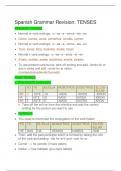
Spanish Grammar Revision: TENSES
PRESENT TENSES
• Normal er verb endings: -o –es –e –emos –eis –en
• Como, comes, come, comemos, coméis, comen
• Normal ar verb endings: -o –as –a –amos –ais –an
• Toco, tocas, toca, tocamos, tocáis, tocan
• Normal ir verb endings: -o –es –e –imos –is –en
• Existo, existes, existe, existimos, existís, existen
• To use present continuous: take off ending and add –iendo for er
and ir verbs and add –ando for ar verbs
(comiendo/existiendo/tocando)
PAST TENSES
• PRETERITE ENDINGS:
YO TU EL/ELLA NOSOTROS VOSOTROS ELLOS/
ELLAS
ER -Í -ISTE -ÍO -IMOS -ISTEIS -IERON
IR Í ISTE ÍO IMOS ISTEIS IERON
AR É ASTE Ó AMOS ASTEIS ARON
• Take off the er/ir/ar from the infinitive and add the correct
ending for the person you want to use
• PERFECT:
• You need to memorise the conjugation of the verb haber:
YO TU EL/ELLA NOSOTROS VOSOTROS ELLOS/
ELLAS
HE HAS HA HEMOS HABEIS HAN
• Then, add the past participle which is formed by taking the root
of the verb and adding –ido for er/ir and –ado for ar.
• Comer --> he comido (I have eaten)
• hablar--> has hablado (you have talked)
PRESENT TENSES
• Normal er verb endings: -o –es –e –emos –eis –en
• Como, comes, come, comemos, coméis, comen
• Normal ar verb endings: -o –as –a –amos –ais –an
• Toco, tocas, toca, tocamos, tocáis, tocan
• Normal ir verb endings: -o –es –e –imos –is –en
• Existo, existes, existe, existimos, existís, existen
• To use present continuous: take off ending and add –iendo for er
and ir verbs and add –ando for ar verbs
(comiendo/existiendo/tocando)
PAST TENSES
• PRETERITE ENDINGS:
YO TU EL/ELLA NOSOTROS VOSOTROS ELLOS/
ELLAS
ER -Í -ISTE -ÍO -IMOS -ISTEIS -IERON
IR Í ISTE ÍO IMOS ISTEIS IERON
AR É ASTE Ó AMOS ASTEIS ARON
• Take off the er/ir/ar from the infinitive and add the correct
ending for the person you want to use
• PERFECT:
• You need to memorise the conjugation of the verb haber:
YO TU EL/ELLA NOSOTROS VOSOTROS ELLOS/
ELLAS
HE HAS HA HEMOS HABEIS HAN
• Then, add the past participle which is formed by taking the root
of the verb and adding –ido for er/ir and –ado for ar.
• Comer --> he comido (I have eaten)
• hablar--> has hablado (you have talked)


