King Lear
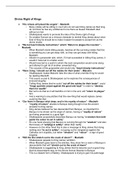
Act 1 Scene 1
Gloucester, Edmund and Kent
- The staging of King Lear contrasts with that of Burial at Thebes. King Lear does not adhere to
the three unities of tragedy: time, place and action. However, like in Burial, the opening
staging/ setting reflects the high birth of Lear, “A state room in King Lear’s palace.” (tragic
rules-status and stature)
- The play begins with the subplot, “Enter Kent, Gloucester and Edmund.” This deviates from
the tragic rules of unity of action. The postponing of the entrance of the central tragic figure
(Lear) has purposes of dramatic tension and also allows for the play to be contextualised.
Kent is one of Lea’s most loyal followers and is used to elevate Lear’s stature
- Although Lear is not present in the opening of the play, he is indirectly characterised by Kent
and Gloucester. Through the use of the verb “affected” Shakespeare alludes to one of Lear’s
central failures- his imbalanced affections and demonstration of favouritism. The skewed
familial values of Lear can be linked to the theme of power and family. (Context: James I
surrounded by flatterers and panderers)
- There is an immediate sense of the complex political issues and familial structures that will
dominate the play, “in the division of the Kingdom, it appears not which of the Dukes he
values most.” As in Burial at Thebes, the play examines the idea of the relationship between
public and private. The theme of kingship is one of the central themes of the play and the
play revolves around the question of abdication and the ability to give up responsibility in
favour of power sharing.
- Like Lear, Gloucester’s familial problems arise from an imbalance of affections, “blush’d to
acknowledge him.” Gloucester chooses to affect his legitimate son (Edgar) over Edmund, his
illegitimate son. In Jacobean society, illegitimacy was a social taboo and it was unacceptable
to have children out of wedlock. Due to the laws of primogeniture, Edmund’s illegitimacy
problematises his inheritance. Gloucester appears to treat Edmund almost as a salacious
joke, “though this knave came something saucily into the world” suggesting his
embarrassment over the origin of his son. This contextualises the bitterness and sense of
social inferiority of Edmund. For the audience, this would create some sense of sympathy for
Edmund, who is tarnished by the stigma of illegitimacy
First love test
- The status of Lear is evoked through the stage directions, “Enter one bearing a coronet;
then Lear; then the Dukes of Albany and Cornwall…” The primacy of Lear and his position in
the social order is emphasised through the fact that he enters first. There is a paradox
between the physical presence of the crown onstage and Lear’s desire to split this kingdom.
Lear’s fatal flaw is giving away what is assigned to him by the divine right. (Context: Power-
sharing was an issue in England at the time of Shakespeare. James I argued for the
Act 1 Scene 1
Gloucester, Edmund and Kent
- The staging of King Lear contrasts with that of Burial at Thebes. King Lear does not adhere to
the three unities of tragedy: time, place and action. However, like in Burial, the opening
staging/ setting reflects the high birth of Lear, “A state room in King Lear’s palace.” (tragic
rules-status and stature)
- The play begins with the subplot, “Enter Kent, Gloucester and Edmund.” This deviates from
the tragic rules of unity of action. The postponing of the entrance of the central tragic figure
(Lear) has purposes of dramatic tension and also allows for the play to be contextualised.
Kent is one of Lea’s most loyal followers and is used to elevate Lear’s stature
- Although Lear is not present in the opening of the play, he is indirectly characterised by Kent
and Gloucester. Through the use of the verb “affected” Shakespeare alludes to one of Lear’s
central failures- his imbalanced affections and demonstration of favouritism. The skewed
familial values of Lear can be linked to the theme of power and family. (Context: James I
surrounded by flatterers and panderers)
- There is an immediate sense of the complex political issues and familial structures that will
dominate the play, “in the division of the Kingdom, it appears not which of the Dukes he
values most.” As in Burial at Thebes, the play examines the idea of the relationship between
public and private. The theme of kingship is one of the central themes of the play and the
play revolves around the question of abdication and the ability to give up responsibility in
favour of power sharing.
- Like Lear, Gloucester’s familial problems arise from an imbalance of affections, “blush’d to
acknowledge him.” Gloucester chooses to affect his legitimate son (Edgar) over Edmund, his
illegitimate son. In Jacobean society, illegitimacy was a social taboo and it was unacceptable
to have children out of wedlock. Due to the laws of primogeniture, Edmund’s illegitimacy
problematises his inheritance. Gloucester appears to treat Edmund almost as a salacious
joke, “though this knave came something saucily into the world” suggesting his
embarrassment over the origin of his son. This contextualises the bitterness and sense of
social inferiority of Edmund. For the audience, this would create some sense of sympathy for
Edmund, who is tarnished by the stigma of illegitimacy
First love test
- The status of Lear is evoked through the stage directions, “Enter one bearing a coronet;
then Lear; then the Dukes of Albany and Cornwall…” The primacy of Lear and his position in
the social order is emphasised through the fact that he enters first. There is a paradox
between the physical presence of the crown onstage and Lear’s desire to split this kingdom.
Lear’s fatal flaw is giving away what is assigned to him by the divine right. (Context: Power-
sharing was an issue in England at the time of Shakespeare. James I argued for the