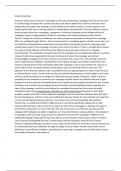
THE RELIC
- This is a love poem but it has religious associations and nuances
- The poem deals with similar themes to ‘The Canonization’ as it refers to the lovers become
saints of love
- A hypothetical dramatic scenario is created as the poet imagines forward to the future when
his grave is dug up and he and his lover are brought to the king to be canonized as saints of
love
FORM AND STRUCTURE
- The poem is made up of three stanzas
- It has an inventive, but regular, rhyme scheme- AABBCDDCEEE
- The rhythm is iambic tetrameter but lines 5 and 7 in each stanza are made of shorter
trimetres
- The rhyming triplet at the end of each stanza clinches the argument
- The regularity of the rhyme scheme and rhythm invites a degree of levity into the poem
- The verse form creates a tone of flippant levity
- There is a shift of tone from flippant levity to awestruck as he declares his current feelings
for his lover and defines the nature of their love
THEMES
- One of the central themes of the poem is the idea of love as a religion- although it is a
secular poem, it is infused with religious language
- The poem also deals with the relationship between love and time and love and death
(common metaphysical themes)
CONTEXT
- It was common in the 17th Century to make new graves on the site of old graves- the poet
exploits this practice to create a hypothetical, imagined scenario
- The fear of death is explored in the poem- this fear would have been omnipresent in 17th
Century because of low-life expectancy due to plague, infection and sudden illness
(omnipresent awareness of mortality)
LANGUAGE AND IMAGERY
Title
- The selling of relics was a big liturgical business in the 17th Century
- In medieval times, relics could be bought to offset sinfulness. This was one of the corrupt
practices of the Catholic Church that Luther protested against
- The practice of selling relics was one of the 39 articles in the Church of England doctrine
following the reformation, “Worshipping and adoration of relics is a fond thing vainly
invented and grounded upon no warranty of scripture but rather repugnant to the word of
God.”
- This is a love poem but it has religious associations and nuances
- The poem deals with similar themes to ‘The Canonization’ as it refers to the lovers become
saints of love
- A hypothetical dramatic scenario is created as the poet imagines forward to the future when
his grave is dug up and he and his lover are brought to the king to be canonized as saints of
love
FORM AND STRUCTURE
- The poem is made up of three stanzas
- It has an inventive, but regular, rhyme scheme- AABBCDDCEEE
- The rhythm is iambic tetrameter but lines 5 and 7 in each stanza are made of shorter
trimetres
- The rhyming triplet at the end of each stanza clinches the argument
- The regularity of the rhyme scheme and rhythm invites a degree of levity into the poem
- The verse form creates a tone of flippant levity
- There is a shift of tone from flippant levity to awestruck as he declares his current feelings
for his lover and defines the nature of their love
THEMES
- One of the central themes of the poem is the idea of love as a religion- although it is a
secular poem, it is infused with religious language
- The poem also deals with the relationship between love and time and love and death
(common metaphysical themes)
CONTEXT
- It was common in the 17th Century to make new graves on the site of old graves- the poet
exploits this practice to create a hypothetical, imagined scenario
- The fear of death is explored in the poem- this fear would have been omnipresent in 17th
Century because of low-life expectancy due to plague, infection and sudden illness
(omnipresent awareness of mortality)
LANGUAGE AND IMAGERY
Title
- The selling of relics was a big liturgical business in the 17th Century
- In medieval times, relics could be bought to offset sinfulness. This was one of the corrupt
practices of the Catholic Church that Luther protested against
- The practice of selling relics was one of the 39 articles in the Church of England doctrine
following the reformation, “Worshipping and adoration of relics is a fond thing vainly
invented and grounded upon no warranty of scripture but rather repugnant to the word of
God.”