
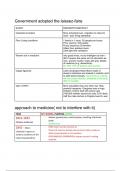
Government adopted the laissez-faire
EVENT DESCRIPTION/EFFECT
Industrial revolution More industrial town, migration to cities for
work - poor living standards
Poor Living conditions 1 family in 1 room. 50 people per house
Privy used by 100 people.
Pump shared by 30 families
Water from polluted rivers.
Little light and ventilation
Women not in medicine only good wives, not as intelligent as men -
didn’t receive the same sort of education as
men, women couldn’t cope with gory details
of medicine (e.g. dissections).
By 1931 10% of doctors were women.
Catgut ligatures Lister developed these fibers made of
sheep’s intestines and soaked in carbolic acid
to seek blood vessels. Came from an animal,
did not create infection, dissolved in the body
after 2-3 weeks.
start of WW1 More casualties than any other war. New,
powerful weapons. Gangrene was a huge
problem. Had to deal with poison gas
(186,000 soldiers injured but only 2.6% died).
Half the male doctors in England went to war.
approach to medicine( not to interfere with it)
YEAR KEY WORDS, PURPOSE, EFFECT
1831-1832 - cholera: general pain, muscle spasms, vomiting, diarrhoea,
death.
Cholera outbreak
- 20,000 dead
1842 - Edwin - Eiffel Tower has the cleanest air
- Theory of miasma: disease was carried in dirty, smelly air
Chadwick’s report on
which spread quicker in hot weather.
sanitary conditions of the
- SPONTANEOUS GENERATION: disease carried in rotting
Labouring population
material.
, - Microscopes weren’t strong- doctors weren’t as curious about
germs.
- Hospitals relied on charity, not government for funds- no
progression.
- Spend tax money on improving housing and living conditions
of the poor (clean water, removing rubbish and sewage).
-
1846 - used to amputate a leg
- Good for pain relief,
Robert Liston uses
- DISADVANTAGES WERE: vomiting, coughing, irritated lungs,
ether as anaesthetic
left patient asleep for hours or days, highly flammable gas
(theatre was lit by candles).
1847: Florence - Sidney Herbert - minister of war
- Dirty conditions: lice infested clothes, typhoid fever+cholera,
Nightingale goes to
difficult to get medical supplies(bandages/medicine) to the
military hospital in
hospital, low food supplies, rats
Scutari (38 nurses)
- Hospital was built over a cesspool.
- She cleaned the whole hospital (believed in miasma), opened
windows, and bought new linen.
- Times Newspaper fund
- Death rate of wounded fell (40% - 2%)
- She wrote ‘ Notes on Hospitals’ in 1963
James Simpson
discovered chloroform as
- Didn’t have the same side effects as Ether
anaesthetic
- Queen Victoria used it in childbirth in 1853
- Widely used as a result of royal approval and newspaper
publicity
- PROBLEMS WITH CHLOROFORM:
- Christian opposition - childbirth should be painful.
- Not known how chloroform would affect the baby.
- Difficult dosage (put them to sleep but not kill them).
- Some doctors thought a sleeping patient was more
likely to die than one kept awake by pain.
- Confidence for longer surgeries deeper in the body.
- Still infections: dirty linen, surgery tools, bandages - gangrene
and sepsis.
- Set up a General Board of Health
1848
- Town to employ medical officers - remove rubbish, sewer system.
Public Health Act - 3 commissioners of the Board of Health (one was Chadwick)
(Chadwick) - Terms were temporary (only 5 years)


