100% satisfaction guarantee Immediately available after payment Both online and in PDF No strings attached 4.2 TrustPilot
logo-home
Exam (elaborations)

Accounting Principles 7th Canadian Edition Volume 2 - Test Bank

Rating
-
Sold
-
Pages
1114
Grade
A+
Uploaded on
17-08-2023
Written in
2023/2024

CHAPTER 11 Financial Reporting Concepts ASSIGNMENT CLASSIFICATION TABLE Learning Objectives Questions Brief Exercises Exercises Problems Set A Problems Set B 1. Explain the importance of having a conceptual framework of accounting, and list the key components. 1 1 9 1 1 2. Explain the objective of financial reporting, and define the elements of the financial statements. 2, 3, 4, 20 2 1, 10 1, 2, 4, 7 1, 2, 4, 7 3. Apply the fundamental and enhancing qualitative characteristics of the conceptual framework to financial reporting. 5, 6, 7, 8, 9, 10, 11, 21 3 2, 3, 1, 2, 7 1, 2, 7 4. Apply the recognition and measurement criteria of the conceptual framework to financial reporting situations. 11, 12, 13, 14, 15, 16, 17, 18, 19, 4, 5, 6, 7, 8, 9, 10, 11 4, 5, 6, 7, 8, 10, 11, 12 1, 2, 3, 4, 5, 6, 7 1, 2, 3, 4, 5, 6, 7 5. Apply the foundational concepts, assumptions and constraints of the conceptual framework to financial reporting situations. 20, 21, 22, 23, 24 11, 12, 13, 14 6, 9, 10, 11, 12 1, 7, 8 1, 7, 8 ASSIGNMENT CHARACTERISTICS TABLE Problem Number Description Difficulty Level Time Allotted (min.) 1A Identify violations of the components of the conceptual framework. Complex 45-50 2A Identify objective of financial reporting, identifying elements, and revenue and expense recognition – earnings approach. Moderate 35-40 3A Identify contract components and prepare journal entries– revenue recognition contract based approach, multiple performance obligations. Moderate 20-25 4A Identify elements of the financial statements – contract-based approach revenue transactions. Moderate 15-20 5A Identify revenue recognition criteria and prepare journal entries–earnings approach. Moderate 20-25 6A Identify contract components and prepare journal entries – revenue recognition contract-based approach, right of return. Moderate 25-30 7A Identify concept or assumption violated and prepare entries. Moderate 30-35 8A Explain assumptions and concepts – going concern, full disclosure. Moderate 15-20 1B Identify violations of the components of the conceptual framework. Complex 45-50 2B Identify objective of financial reporting, identifying elements, and revenue and expense recognition. Moderate 35-40 3B Identify contract components and prepare journal entries– revenue recognition contract based approach, multiple performance obligations. Moderate 20-25 4B Identify elements of the financial statements – contract-based approach revenue transactions. Moderate 15-20 5B Identify revenue recognition criteria and prepare journal entries–earnings approach. Moderate 20-25 6B Identify contract components and prepare journal entries – revenue recognition contract-based approach, right of return. Moderate 25-30 7B Identify elements, assumptions, constraints and measurement criteria. Moderate 30-35 8B Comment on application of accounting assumptions and concepts. Moderate 15-20 BLOOM’S TAXONOMY TABLE Correlation Chart between Bloom’s Taxonomy, Learning Objectives and End-of-Chapter Material. Learning Objectives Knowledge Comprehension Application Analysis Synthesis Evaluation 1. Explain the importance of having a conceptual framework of accounting, and list the key components. BE11-1 Q11-1 E11-9 P11-1A P11-1B 2. Explain the objective of financial reporting, and define the elements of the financial statements. Q11-2 Q11-4 BE11-2 Q11-3 Q11-11 Q11-20 E11-1 E11-2 E11-4 E11-5 E11-10 P11-1A P11-2A P11-4A P11-1B P11-2B P11-4B P11-7A P11-7B 3. Apply the fundamental and enhancing qualitative characteristics of the conceptual framework to financial reporting. Q11-5 Q11-7 Q11-10 BE11-3 Q11-6 Q11-8 Q11-9 Q11-11 Q11-21 E11-2 E11-4 E11-3 P11-1A P11-2A P11-1B P11-2B P11-7A P11-7B 4. Apply the recognition and measurement criteria of the conceptual framework to financial reporting situations. Q11-13 Q11-14 Q11-17 E11-5 Q11-11 Q11-12 Q11-18 BE11-11 E11-7 E11-11 BE11-4 BE11-5 BE11-6 BE11-7 BE11-8 BE11-9 BE11-10 E11-4 E11-8 E11-10 E11-12 P11-1A P11-2A P11-3A P11-4A P11-5A P11-6A P11-1B P11-2B P11-3B P11-4B P11-5B P11-6B Q11-15 Q11-16 Q11-19 BE11-15 BE11-16 E11-6 P11-7A P11-7B 5. Apply the foundational concepts, assumptions and constraints of the conceptual framework to financial reporting situations. Q11-20 Q11-21 Q11-22 Q11-23 Q11-24 BE11-11 BE11-12 BE11-13 BE11-14 E11-9 E11-11 E11-10 E11-12 P11-1A P11-8A P11-1B P11-8B E11-6 P11-7A P11-7B Broadening Your Perspective BYP11-3 BYP11-4 BYP11-5 BYP11-1 BYP11-2 ANSWERS TO QUESTIONS 1. The conceptual framework is a coherent system of interrelated objectives and fundamentals that can lead to consistent standards and that prescribe the nature, function, and limits of financial accounting statements. It guides choices about what to present in financial statements, how to report economic events, and how to communicate such information. 2. (a) The main objective of financial reporting is to provide information that is useful for decision-making. More specifically, the conceptual framework states that the objective of general purpose financial reporting is to provide financial information that is useful to present and potential investors, lenders, and other creditors in making decisions about a business. (b) The objective identifies the specific users to ensure that a range of possible points of view are included in fulfilling the needs of users but cannot be all things to all users. 3. (a) Stewardship refers to the responsibility of management to acquire and use company resources in the best way possible. (b) The objective of financial reporting is to provide users with useful financial information. Users look for information in the financial statements about a company’s ability to earn a profit and generate future cash flows. Using the financial statements helps users assess stewardship. 4. Under IFRS the elements of assets, liabilities, equity, revenue, and expenses are included, as they are in ASPE. Under revenues, IFRS includes gains and under expenses, IFRS includes losses. Under ASPE, gains and losses are defined in separate categories from revenues and expenses, but have similar basic definitions to those under IFRS. 5. The two fundamental qualitative characteristics of financial information are: relevance and faithful representation. Accounting information has relevance if it makes a difference in a decision. Relevant information has predictive value or confirmatory value. Faithful representation shows the economic reality of events rather than just their legal form. Faithful representation is achieved if the information is complete, neutral, and free from material error. Complete information includes all information necessary to show the economic reality of the transaction. Questions (Continued) 5. (Continued) Accounting information is neutral if it is free from bias intended to attain a predetermined result or encourage a particular behaviour. Accounting estimates must also be based on the best available information and be reasonably accurate to be considered free from material error. 6. (a) The concept of materiality means that an item may be so small that failure to follow generally accepted accounting principles will not influence the decision of a reasonably careful investor or creditor. For example, the expensing of a $20 calculator would not technically be in accordance with GAAP since the calculator will probably have a useful life beyond one year. However, the cost is so insignificant that it will have no impact on users’ decisions and therefore, this GAAP deviation is not considered to be material. In addition, the cost constraint supports the expensing of the calculator. Materiality is also the criterion used in deciding whether or not an element deserves to be disclosed separately within the body of the financial statements or in the notes to the financial statements. (b) In order to be relevant to a financial statement user, a transaction or amount must make a difference to the user when making a decision. If an omission or misstatement does not influence a user, it is said to be immaterial or not material. Materiality is not only a matter of size, but also has to do with the nature of the omission or misstatement (for instance, illegal acts or contingent liabilities). 7. The four enhancing qualitative characteristics of financial information are: comparability, verifiability, timeliness and understandability. Accounting information about a company is most useful when it can be compared with accounting information about other companies. Comparability results when different companies use the same accounting principles. Comparability is also easier when accounting policies are used consistently by a business from one accounting period to the next. Information is verifiable if two knowledgeable and independent people would agree that it faithfully represents the economic reality. The usefulness of accounting information is enhanced when it is provided on a timely basis, when it is still highly useful for decision-making. Information in financial statements must be capable of being understood by users. Understandability is enhanced by classified, clear, and concise presentation. It is assumed that the average user has a reasonable understanding of accounting concepts and procedures, and general business and economic conditions. Questions (Continued) 8. Although the transactions amount might be considered immaterial to the rest of the financial statements of a business, it does not mean that the transaction should be omitted. In order for financial statements to be relevant the financial information presented should be complete. The concept of materiality means that an item may be so small that failure to follow GAAP will not influence the decision of a reasonably careful investor or creditor. When dealing with the omission of a transaction, the framework discusses the decision to omit the transaction’s detail in the disclosure of separate elements in the body of the financial statement or in their notes. 9. The qualitative characteristics differences of IFRS and ASPE can be highlighted in the following table: IFRS ASPE Qualitative Characteristics: Fundamental Relevance Faithful representation Enhancing Comparability Verifiability Timeliness Understandability Qualitative Characteristics: Understandability Relevance Reliability Comparability In ASPE, the reliability characteristic is similar in many ways to faithful representation in IFRS. ASPE includes conservatism as a component of reliability. Conservatism is similar to the prudence concept for IFRS. 10. The qualitative characteristic of relevance should be applied first because it will identify the specific information that would affect the decisions of investors and creditors and that should be included in the financial report. Once relevance is applied, faithful representation should be applied to ensure that the economic information faithfully represents the economic events being described. Taken together, relevance and faithful representation make financial reporting information decision useful. Then the enhancing qualitative characteristics—comparability, verifiability, timeliness, and understandability—are applied. They add to the decision usefulness of financial reporting information that is relevant and representationally faithful. They must be applied after the first two characteristics because they cannot, either individually or together, make information useful if it is irrelevant or not faithfully represented. Questions (Continued) 11. Fair value is defined as “the price that would be received to sell an asset or paid to transfer a liability in an orderly transaction between market participants.” For some elements of the financial statements, reporting balances at their fair values is judged by management to be the more appropriate choice as doing so better reflects their intentions and plans for the future. Fair values are thought to be more relevant in some financial reporting situations and will provide users with more relevant information to assess the impact of changes in value on the company’s liquidity and solvency. 12. The conceptual framework specifically addresses revenue recognition because of its importance in the measurement of the performance of any enterprise. There are a variety of methods that can be used to recognize revenue and judgement needs to be applied in the selection of a method that is most appropriate for the circumstances and transactions of the business. The activities that generate revenue have become more complex and innovative over the years, making the point where revenues meet the guidelines for recognition much harder to determine. The complex transactions include “swap” transactions, “bill and hold” sales arrangements, risk-sharing agreements, complex rights of return, price-protection guarantees, and post-sale maintenance contracts to name a few. From the perspective of a financial statement user, the revenue being recognized should be the best fit for the situation and must provide a relevant measure of financial performance. 13. The revenue recognition steps used in the contract-based approach include: a) Identify the contract with a customer b) Identify the performance obligations in the contract c) Determine the transaction price (overall contract price) d) Allocate the transaction price to the performance obligations in the contract e) Recognize revenue when the performance obligations are complete. Questions (Continued) 14. The revenue recognition criteria state that revenue is recognized when there is an increase in an asset or a decrease in a liability due to profit-generating activities. Under the earnings approach the following criteria must be met for revenue to be recognized: a) Performance is complete and the seller has transferred to the buyer the significant risks and rewards of ownership; b) The seller does not have control over the goods or continuing managerial involvement; c) The amount of revenue can be reliably measured; d) It is probable there will be an increase in economic resources (that is, cash will be collected); and e) Costs relating to the sale of the goods can be reliably measured. 15. Under the contract-based approach, the revenue from the sale should be recognized when the performance obligation has been satisfied. Since the sale is for a single product, with no apparent return privileges or collection risk, the performance obligation will be satisfied when the customer, Beowulf Industries takes possession of the furniture on June 10, 2017. 16. Under the earnings approach of revenue recognition, the $10,000 cash received on March 24, 2017 should be recorded as unearned revenue since no landscaping services have yet been performed. The unearned revenue should appear as a current liability on Greenthumb’s balance sheet at April 30, 2017. The revenue from providing landscaping services should be allocated to the month in which the services are performed. In this case, the amount of $10,000 will be allocated to the five-month period from May through September 2017 at the rate of $2,000 per month. 17. Under the contract-based approach to recognize revenue, the indications that control of the services has transferred to the customer over a period of time are: a) Customer receives and consumes the benefits provided by the business at the same time b) Business creates or enhances an asset that the customer controls c) Business is not creating or enhancing an asset that it could have an alternative use for d) Business has a right to payment for performance completed to date. Questions (Continued) 18. (a) Under the contract-based approach to revenue recognition, returns which can be measured reasonably will be treated as a separate performance obligation under the contract. Once that performance obligation has been completed at the end of 30 days that portion of revenue can be recognized. (b) If the potential returns cannot be estimated, the gross profit on the sale will be deferred and the sale recognized when all performance obligations have been completed. 19. I disagree. The payments for assets consumed in the same month as the month of payment and recorded as expenses do not violate the concept of a financial statement element. Those payments that benefit the organization for the current and future periods such as the annual insurance premium and the cost of the industrial oven should be broken down into the portion of the payment that is an expense for the month and the asset portion which will bring benefit to the business in future accounting periods. 20. Xiaoping has presented financial statements that are not useful because they include several business entities, some involved in the sale of goods and some involved in providing services. By violating the reporting entity principle, the information has become much less relevant in assessing the performance of each of the three businesses or her personal wealth. Comparisons of performance cannot be made with other businesses in the same industry, nor can trends be established and assessed by taking information from financial statements covering several fiscal years for each business. 21. Cost constraints are typically involved in the level of precision or detail of the financial information being provided. The value obtained for the level of precision on estimates for example or the finer detail of tracking all types of expenses might, due to materiality, exceed any benefit obtained from the additional effort that would be required. The concept of completeness is often tied to the disclosure principle. Completeness relates to the cost constraint in that disclosure may be limited due to the costs involved in getting the information ready for disclosure. Questions (Continued) 22. (a) It is assumed under the going concern assumption that the business will continue in its operations for the foreseeable future; that is, long enough to carry out its existing objectives and commitments. (b) As a consequence of the going concern assumption, the classification of assets and liabilities between current and non-current becomes relevant in the eyes of the financial statement user who may be assessing the business’ liquidity. The user may also be looking for some predictive value in the financial information that will determine expected future cash flows needed for replacing long-lived assets for example. In addition, the use of the historical cost basis of reporting some long-lived assets is justified by the expectation that the business will not need to liquidate these assets in the near future and management’s estimates and expectations for the use of the assets for the long-term can be achieved. 23. The cost constraint is a pervasive constraint that ensures the value of the information provided is greater than the cost of providing it. Cost constraints are typically involved in the level of precision, detail of the financial information being provided, or the details involved in the disclosure process. 24. The periodicity concept ties in with the timeliness concept which in turn enhances the main qualitative characteristic of relevance. The periodicity concept (also sometimes referred to as the time period concept) guides businesses in dividing up their economic activities into distinct time periods. The accrual basis of accounting is also closely tied to the periodicity concept. Together these concepts provide timely information to financial statement users who can make comparisons, and assess trends quickly in order to react appropriately to the financial information. SOLUTIONS TO BRIEF EXERCISES BRIEF EXERCISE 11-1 (a) F (b) T (c) F (d) T (e) T (f) T BRIEF EXERCISE 11-2 (a) 4. Revenues (b) 2. Liabilities (c) 1. Assets (d) 5. Expenses (e) 3. Equity (f) 1. Assets BRIEF EXERCISE 11-3 (a) 4 (b) 6 (c) 3 (d) 5 (e) 7 (f) 10 (g) 1 (h) 9 (i) 8 (j) 2 (k) 11 BRIEF EXERCISE 11-4 Revenue of $250,000; the value of the work completed in March. Salaries expense of $75,000. BRIEF EXERCISE 11-5 Using the contract–based approach, the company should recognize sales in the amount of 98% of the invoice amount of $450,000 or $441,000 in the month of September and the $9,000 should be recorded to Unearned Revenue. BRIEF EXERCISE 11-6 The critical event in the sales transaction is the legal possession of the merchandise, which occurs based on the shipping terms. In this case since the shipping terms are FOB shipping point, the sale occurs on November 29, 2017. Accounts Receivable 350,000 Sales 350,000 Cost of Goods Sold 200,000 Merchandise Inventory 200,000 The amount of gross profit recognized in November is $150,000 ($350,000 - $200,000) BRIEF EXERCISE 11-7 Although the customer, Ragnar Company has taken possession of the goods, Willow Appliance Company has not fulfilled all of the revenue recognition criteria. Willow is not able to reasonably estimate the probability of collection. Consequently, under the earnings approach, the gross profit on the sale is deferred until the collection is received. Accounts Receivable 25,000 Deferred Gross Profit 6,000 Merchandise Inventory 19,000 BRIEF EXERCISE 11-8 Step Description Criteria to be met and discussion 1 Is there a contract? Yes, a contract was signed April 3, 2017. 2 What is the performance obligation(s)? There are two performance obligations: 1) the delivery of the microprocessors to Thompson Industries and 2) the obligation to accept returns. 3 What is the transaction price? The transaction price is $35,000 (5,000 x $7) less the estimated refund liability of 5% ($1,750) for a net amount of $33,250. 4 Is there a need to allocate the transaction price? Sales will be in the amount of $33,250 and the refund liability will be $1,750 for expected returns. 5 Has the performance obligation(s) been satisfied? Yes, on June 3, 2017 Flin Flon will recognize sales of $33,250 when it delivers the goods to Thompson who takes control (possession and legal title has transferred) of the goods. BRIEF EXERCISE 11-9 Operating expenses from adjusted trial balance $55,000 Add: Loss on damaged inventory 4,000 Accrual of sales commissions expense 2,500 Total operating expenses $61,500 BRIEF EXERCISE 11-10 1. The measurement criterion for historical cost has been violated. The accountant should not have recorded the increase in the value from the original cost to the fair value as this is not allowed under ASPE. 2. There is a violation of revenue recognition criteria. Since the musical production for which the ticket sales were made has not yet taken place by the end of January, none of the revenue had been earned. Instead, Unearned Revenue should have been credited in the entry made by the accountant. BRIEF EXERCISE 11-11 (a) 3. Full disclosure (b) 5. Expense recognition (c) 1. Revenue recognition (d) 1. Revenue recognition (e) 4. Historical cost (f) 6. Realizable value (g) 2. Matching BRIEF EXERCISE 11-12 (a) Yes (b) Yes (c) No BRIEF EXERCISE 11-13 (a) Yes (b) Yes (c) Yes BRIEF EXERCISE 11-14 (a) 1. Going concern assumption (b) 2. Reporting entity concept (c) 3. Full disclosure (d) 4. Monetary unit (e) 6. Periodicity SOLUTIONS TO EXERCISES EXERCISE 11-1 1. Asset 2. No element exists as the benefit to the business is not measurable and is not the result of an exchange. 3. Liability 4. No element exists as the benefit to the business is not measurable and is not the result of an exchange. 5. Liability EXERCISE 11-2 (a) 3 (b) 4 (c) 6 (d) 6 (e) 2 (f) 7 (g) 1 (h) 5 EXERCISE 11-3 1. Feedback value 2. Free from material error 3. Complete 4. Predictive value EXERCISE 11-4 Step Question Answer 1. What kind of contract does Leo Legal Services have with the customer? One month of legal services by Leo Legal Services to J & J Home Inspections 2. What is Leo’s performance obligation? The performance obligation for Leo is to provide one month of legal services. 3. What is the transaction price? The transaction price is $5,000. 4. Should the transaction price be allocated? If so, how? Since there is only one performance obligation, there is no allocation needed. 5. When should Leo recognize revenue from this contract? The performance obligation will be satisfied by the end of the month at which time the revenue will have been earned from the contract. EXERCISE 11-5 1. Contract-based approach 2. Earnings approach 3. Contract-based approach 4. Contract-based approach 5. Contract-based approach 6. Earnings approach 7. Earnings approach 8. Contract-based approach EXERCISE 11-6 1. This is a violation of the cost measurement concept, because the inventory was recorded at its estimated fair value and not its cost. The correct journal entry is: Merchandise inventory 42,000 Cash 42,000 2. This is a violation of the reporting entity concept. The treatment of the transaction treats Evan Ellis and Ellis Company as one entity when they are two separate entities. No journal entry should have been made since Evan Ellis should have used personal assets to purchase the computer. If cash assets of the company were used, the debit entry could be to Accounts Receivable—E. Ellis, or to E. Ellis, Drawings and the credit entry to Cash. 3. There is no violation of generally accepted accounting principles. The merchandise inventory is properly reported at the lower of cost and net realizable value. 4. This is a question of matching, materiality, and cost constraint. In theory, the coffee machine should be depreciated to match the expense with revenue, since the coffee machine has an estimated useful life of 5 years. However, because the cost of the coffee machine is not material, the cost of accounting for it as a long-lived asset will exceed any benefits from doing so. Office Expense 50 Cash 50 5. This is a violation of the revenue recognition criteria. The revenue should be recognized when the service is provided in April. When the cash is received, it should be credited to an unearned revenue account until the revenue is earned. Cash 650 Unearned Revenue 650 EXERCISE 11-7 March sales = 350 × $760 = $266,000 for services performed from May-September (5 months) June sales = 300 × $800 = 240,000 for services performed from June-September (4 months) July sales = 100 × $800 = 80,000 for services performed from July-September (3 months) Total sales $586,000 No revenue would be recorded in March or April because no services were provided. Assuming the same amount of work is provided to the customers each month from May to September, revenue would be recognized as follows: March April May June July August Sept. $266,000 $53,200 $53,200 $53,200 $53,200 $53,200 $240,000 60,000 60,000 60,000 60,000 $ 80,000 0000 00 26,667 26,667 26,666 Total $53,200 $113,200 $139,867 $139,867 $139,866 EXERCISE 11-8 1. Byer’s Innovations Co. should record rent expense in 2017 in the amount of $6,000 for the months of November and December at the rate of $3,000 per month. 2. The full amount of $35,000 for research must be expensed immediately as there is no assurance of any future benefit to be derived from the research activity. 3. An estimate can be made of the amount of monthly power and water expenses that should be accrued for the month of December 2017 in the amount of $5,000 ($55,000 ÷ 11). Consequently the cost of power and water for the fiscal year will be in the amount of $60,000 ($55,000 + $5,000). 4. No depreciation expense should be recognized in the 2017 fiscal year as the packaging equipment was not yet available for use. EXERCISE 11-9 (a) It is advisable for Susan to prepare monthly financial statements, particularly because the business is new. It is not unusual for new business owners to experience difficulty when starting a new business, for example in areas such as product pricing and expense management. Monthly financial statements will provide Susan the necessary frequent feedback she needs concerning the results of operations. Timely information will allow Susan to react quickly and make any necessary business decisions to ensure her business’ success. (b) Since Susan’s business is quite small it is not cost effective for her to adopt IFRS. Only very large operations can justify the time, effort, and cost of implementing IFRS. Consequently, Susan should follow ASPE. EXERCISE 11-10 (a) Financial statements help the bank assess the financial position, profitability, and liquidity of their customers. With accurate and complete financial information, the bank can determine the impact the expansion plans might have on Marc’s profitability and ability to repay any current and additional loans obtained. Financial statements will allow the bank to conduct some analysis and make comparisons of Marc’s business with other similar retail operations. (b) The bank manager wants reliable, comparable, and relevant information to determine the amount of risk the bank is taking if it is to extend a loan to Marc for his inventory expansion. GAAP requires qualitative characteristics to be embedded in accounting information. (c) Unless there is contractual relationship between the two companies, such as a guarantee for an existing loan, the two companies do not have a business relationship. The two companies should not be combined for purposes of preparing financial statements. Doing so would violate the reporting entity concept of GAAP. (d) Although the rented store space is shared space with another business, there is likely other property, plant, and equipment owned by the business that is necessary to operate the store. These assets would be depreciated and would be reported on the balance sheet at their carrying amount (i.e., cost less accumulated depreciation). As for the inventory, the measurement of this current asset should be at the lower of cost and net realizable value. EXERCISE 11-11 (a) 2. Reporting entity concept (b) 5. Cost constraint (c) 3. Completeness (d) 1. Going concern assumption (e) 6. Materiality (f) 4. Cost constraint EXERCISE 11-12 1. Revenue recognition criteria 2. Completeness 3. Expense recognition criteria 4. Going concern assumption; Completeness 5. No violation (lower of cost and net realizable value) 6. Timeliness characteristic 7. Historical cost 8. Reporting entity concept 9. Cost constraint SOLUTIONS TO PROBLEMS PROBLEM 11-1A (a) The financial statements that have been provided are not useful to the bank manager as they have not been prepared in accordance with GAAP. The banker will also want to see a Statement of Owner’s Equity and a Statement of Cash Flows. Along with properly prepared financial statements, the bank manager will also want to see the notes to the financial statements which will assist him in gathering the necessary information, required under the disclosure principle, needed to interpret the elements reported on the financial statements. (b) The reporting of assets, liabilities, revenue, and expenses is not appropriate as several GAAP have been violated in their preparation. Assets are misstated because: 1. Cash should be reported at $5,000 and the remaining amount should be reported as a long-term investment of $495,000 (or a short-term investment if the intention is to resell the shares in the near future). 2. A vehicle should be reported as property, plant, and equipment, on the balance sheet and should have depreciation expense recorded in the period. It should not have been expensed completely on the statement of income. 3. The different categories of property, plant, and equipment should be disclosed, as well as the accounting policy used for depreciation. 4. The property, plant, and equipment is misstated as the estimate of the useful life far exceeds the number of years used in the calculation of the depreciation expense. PROBLEM 11-1A (Continued) (b) (Continued) 5. Depreciation expense in the amount of $75,000 has been listed as an asset on the balance sheet instead of as an expense on the income statement. 6. Inventory includes cost of goods sold which should be reported on the income statement as an expense 7. Inventory has been reported at an amount that has not been adjusted to its net realizable value and is therefore overstated. Liabilities are misstated because: 1. The liabilities on the balance sheet should be classified between current and non-current liabilities. 2. The bank loan reported on the balance sheet should be relabelled as a mortgage payable and the current and non-current portions should be split on the balance sheet. 3. The security for the mortgage payable, along with its rate of interest and terms of repayment need to be disclosed in the notes to the financial statements. 4. Customer deposits appearing on the income statement as revenues need to be reported as unearned revenue on the balance sheet. Revenues are misstated because: 1. Some of the revenues from a separate entity and business, Sumsong Appliance Store, have been incorrectly included in the sales reported on the income statement. 2. Customer deposits appearing on the income statement as revenues need to be reported as unearned revenue on the balance sheet. 3. The amount of $18,000 reported as sales for orders to be filled is not a transaction and should not be included in revenue or elsewhere on the financial statements. PROBLEM 11-1A (Continued) (b) (Continued) 4. There are likely performance obligations outstanding relating to the return policy. Expenses are misstated because: 1. The income statement is missing cost of goods sold expense which has been shown as inventory on the balance sheet. 2. G. Sumsong’s personal transactions are incorrectly included as expenses of the business. 3. G. Sumsong’s drawings should not appear on the income statement as an expense but should instead be reported in the statement of owner’s equity. 4. The vehicle expense is a capital asset and should appear on the balance sheet. Depreciation expense should be recorded on the vehicle for the current year. 5. There is no interest expense reported on the mortgage payable. 6. Depreciation expense in the amount of $75,000 has been listed as an asset on the balance sheet instead of an expense on the income statement. (c) Sumsong has not followed the guidance for relevance and faithful representation. As mentioned in the details of part (b) the violations include: 1. Reporting entity 2. Revenue recognition 3. Periodicity 4. Full disclosure 5. Measurement (lower of cost and NRV for inventory and depreciation expense omission for the vehicle) 6. Historical cost (for the omission of the vehicle that was expensed) PROBLEM 11-1A (Continued) (d) As mentioned in the details of part (b) there have been revenues included in the income statement that have not been realized or not based on transactions. As well there may be performance obligations outstanding on the returns of merchandise which will reduce total sales reported. The measurement problems exist for the reporting of inventory at the lower of cost and net realizable value. A write down of the inventory by $4,000 should be recorded. There was also an issue of the measurement of depreciation expense caused by not applying the appropriate useful life of some capital assets. (e) Because transactions of another business have been included in the records of the business, the reporting entity principle has been violated. Not all financial statements have been prepared. No notes to the financial statements have been provided. These are violations of the full disclosure principle. Taking It Further: When looking at the financial statements provided, it would be very difficult to interpret the performance and financial position of Sumsong. It would also be difficult to have confidence in Gillian’s ability to determine the success or failure of the business due to the extremely poor treatment of the financial records. Consequently, I would doubt Gillian’s abilities as an owner manager. PROBLEM 11-2A (a) Financial statements help the bank assess the financial position, profitability, and liquidity of their customers. With accurate and complete financial information, the bank can determine the impact the expansion plans might have on Kamloops’s profitability and ability to repay any current and additional loans obtained. (b) In order to ensure that the financial information provided by Kamloops is reliable, the bank has requested that the financial statements be reviewed by an independent accountant. (c) Current assets $120,000 Add: Cost of goods in transit (1) 15,000 Less: Sale has not occurred (2) (8,400) Accrued sales returns (3) (1,300)* Eliminate prepaid advertising (4) (3,500) Revised current assets $121,800 *($26,000 × 5%) Current liabilities $ 80,000 Add: Invoice for goods in transit (1) 15,000 Revised current liabilities $ 95,000 Sales 560,000 Less: Accrued sales returns (3) (1,300) Sale has not occurred, no transfer of ownership (2) (8,400) Revised sales $550,300 Total operating expenses $106,000 Add: Advertising expense (4) 3,500 Revised total operating expenses $109,500 PROBLEM 11-2A (Continued) (c) (Continued) 1. Goods in transit must be included in inventory and accounts payable as the terms of shipment indicate that Kamloops owned the inventory as of December 31, 2017. 2. No sale has occurred. The sales amount must be removed from the accounts receivable and sales accounts. The cost of goods sold is not affected because the amount ($4,300) was still included in merchandise inventory. 3. Sales returns for the last 15 days of the fiscal year need to be accrued as a reduction of sales and a reduction of accounts receivable. The amount accrued is 5% of $26,000 or $1,300. 4. The promotional expense recorded as a prepaid expense must be expensed as there is no measurable future benefit realized as of December 31, 2017. Taking It Further: (a) Current ratio = $ 120,000 = 1.50:1 $ 80,000 (b) Current ratio = $ 121,800 = 1.28:1 $ 95,000 As a result of the required adjustments, Kamloops’s current ratio is considerably worse as it has reduced by from the initial 1.5 to 1.28. Since the adjustments that were required are in the same direction (reducing profit, decreasing current assets, and increasing current liabilities), there appears to be bias in the errors made by Kamloops. On the other hand, without knowing the level of training and expertise of Alphonzo, the company’s manager, who is the preparer of the financial statements, it is inappropriate to conclude if the errors were intentional. PROBLEM 11-3A (a) Step Question Answer 1. Is there a contract? If so, describe the contract. Delivery of one fir tree and the removal of one fir tree. 2. What is Santa Holiday Farm’s performance obligation(s)? 1) Deliver one fir tree. 2) Remove one fir tree. 3. What is the transaction price? The transaction price for both performance obligations is a combined price of $60 allocated on a basis of their pre-holiday package individual selling prices. 4. Is there a need to allocate the transaction price? Yes. For the fir tree $42.86 ($50 ÷ $70 x $60) and the disposal service $17.14 ($20 ÷ $70 x $60) 5. Has the performance obligation(s) been satisfied? If so, when? The performance obligation to deliver fir trees has been satisfied by December 31, 2017 and the removal of the fir trees will be satisfied on January 3, 2018. (b) Cash (200 x $60) 12,000 Sales (200 x $42.86) 8,572 Unearned Revenue (200 x $17.14) 3,428 (upon delivery of the fir trees) Unearned Revenue 3,428 Revenue 3,428 (upon removal of fir trees) Taking It Further: Accounting standards need to change to address the needs of the financial statement users. As new types of transactions occur, for example from technological advances, standards need to be developed and applied to these new transactions or situations to maintain representational faithfulness. PROBLEM 11-4A Dec. 4 Asset (Cash and Building) Liability (Bank Loan) Dec. 10 No elements as there has been no exchange and there is no transaction. Dec. 15 Asset (Cash and Merchandise Inventory) Revenue (Sales) Expenses (Cost of Goods Sold) Dec. 18 No elements as there has been no exchange and there is no transaction. Dec. 20 Asset (Accounts Receivable and Merchandise Inventory) Revenue (Sales) Expenses (Cost of Goods Sold) Dec. 24 Asset (Cash) Expenses (Salaries Expense) Dec. 31 Liability (Accounts Payable) Expenses (Utilities Expense) Dec. 31 Asset (Accumulated Depreciation – Equipment) Expenses (Depreciation Expense) Taking It Further: Precisely defined elements for the financial statements enhance the representational faithfulness of what is being reported. It avoids confusion on the part of the financial statement reader, particularly when making comparisons with other businesses. PROBLEM 11-5A (a) 1. Port’s performance will be complete when the tires reach the destination of Kelsee Electrocar Company. This is the point where the risks and rewards of ownership will pass to Kelsee and when Kelsee has legal title of the goods. 2. Port has no control over the goods or continuing involvement as there are no returns expected and the warranty on the goods is provided by the manufacturer of the tires. 3. The transaction can be measured reliably at the selling price of the tires since no sales discount is offered for early payment. 4. There is a risk that collection will not be achieved. Port cannot determine that it is probable that collection will be received. Consequently, the probability that there will be an increase in the economic resources to Port cannot be established. 5. The cost of the goods sold of $6,000 is known but the bad debt expense is not known. 6. The critical event in this case that will trigger the revenue will be the collection of the account from Kelsee. PROBLEM 11-5A (Continued) (b) Sept. 18, 2017 Accounts Receivable (300 x $40) 12,000 Deferred Gross Profit 6,000 Merchandise Inventory (300 x $20) 6,000 Nov. 4, 2017 Cash 12,000 Accounts Receivable 12,000 Cost of Goods Sold 6,000 Deferred Gross Profit 6,000 Sales 12,000 Taking It Further: Additional costs that could be incurred after the sale include the cost of sales returns and allowances, sales discounts, freight on sales returns, and bad debt expenses. PROBLEM 11-6A (a) The contract is to deliver to the customer 300 accounting textbooks at a price of $110 per book, to be paid September 25, 2017. (b) Nicolet’s performance obligation is to ship 300 accounting textbooks to Hinton University. (c) The transaction price is $33,000 (300 x $110). (d) The revenue from the sale of the books should be recognized on August 25, 2017. (e) August 25, 2017 Accounts Receivable 33,000 Refund Liability ($33,000 X 10%) 3,300 Sales 29,700 Inventory Returns (300 X 10% x $80) 2,400 Cost of Goods Sold 21,600 Merchandise Inventory (300 X $80) 24,000 Sept. 15, 2017 Refund Liability (10 x $110) 1,100 Accounts Receivable (10 X $110) 1,100 Merchandise Inventory (10 x $ 80) 800 Inventory Returns 800 Sept. 25, 2017 Cash ($33,000 - $1,100) 31,900 Accounts Receivable 31,900 Sept. 30, 2017 Refund Liability (20 x $ 110) 2,200 Cash (20 X $110) 2,200 PROBLEM 11-6A (Continued) (e) (Continued) Merchandise Inventory (20 x $ 80) 1,600 Inventory Returns 1,600 Taking It Further: Because Nicolet would have offered Hinton a cash discount for early payment, the transaction price is subject to a variable consideration and so the amount of the accounts receivable recorded on August 25, 2017 should be reduced by the sales discount if it is probable that Hinton will take advantage of the discount offered by Nicolet. PROBLEM 11-7A (a) and (b) 1. Expense recognition criteria (matching concept). The cost of equipment should not be expensed immediately. Only costs that have no probable future benefits are recognized immediately as expenses. Therefore, the following entries are necessary: Equipment 80,000 Cash 80,000 Depreciation Expense [$80,000 × (100%  5 × 2)] 32,000 Accumulated Depreciation—Equipment 32,000 2. Expense recognition criteria (matching concept). The cost of property, plant, and equipment should be allocated over its useful life in a rational and systematic manner. Deferring depreciation is not rational and systematic. Therefore, the following entry is necessary: Depreciation Expense 43,000 Accumulated Depreciation 43,000 3. Measurement criteria (historical cost basis). Recording the transaction at its estimated fair value would not be proper because estimated fair value in this case does not represent an exchange price (the company has not adopted the revaluation model for accounting for its property, plant, and equipment). The purchase should be recorded at cost, not at a fair value that someone believes the equipment is worth. The correct entry is: Equipment 36,000 Cash 36,000 PROBLEM 11-7A (Continued) (a) and (b) (Continued) 4. Going concern assumption. Liquidation value is not appropriate because it assumes that the enterprise will not continue. No entry is necessary. Only when liquidation appears imminent is the going concern assumption inapplicable. Otherwise, the cost measurement basis applies. 5. Expense recognition criteria (matching concept). Expensing the cost of the rent immediately does not allow a proper matching of the expense with the revenue that will be earned over the next 6 months. The correct entry is: Prepaid Rent 18,000 Cash 18,000 An adjusting entry is made at December 31 to record the proper rent expense. Rent Expense 12,000 Prepaid Rent 12,000 Alternatively, the entry debiting Rent Expense can be recorded, but the adjusting entry at December 31 would then be as follows: Prepaid Rent 6,000 Rent Expense 6,000 If financial statements are prepared only once at the end of the fiscal year, it really doesn’t matter what entry is made originally (although debiting an asset account such as Prepaid Rent tends to result in better internal control), as long as the correct allocation is made at year end between the asset and the expense account. PROBLEM 11-7A (Continued) (a) and (b) (Continued) 6. Measurement criteria (historical cost basis). Appreciation in value does not justify recognizing a gain on the land, until the land is sold (since Kwick Kopy has not adopted the revaluation model for accounting for its property, plant, and equipment). Appreciation does not involve an exchange transaction. No entry is necessary. Taking It Further: A liquidation basis may be appropriate for property, plant, and equipment if the company can no longer apply the going concern assumption. In such a case, the company’s demise would be imminent and liquidation is likely. PROBLEM 11-8A (a) If a company files for bankruptcy, it may not satisfy the going concern assumption. The going concern assumption is a basic assumption underlying the preparation and presentation of financial statements. When this assumption is not satisfied, the balance sheet would not be classified, since all assets and liabilities would be current. The basis of measurement of assets would be liquidation or net realizable value, rather than their carrying amounts. (b) Companies that are under bankruptcy protection would disclose in the notes to their financial statements, their plan for restructuring their operations. Since many factors may remain outside of their control, depending on the circumstances, it is possible that some of the companies will not be able to continue and cannot be viewed as a going concern. Individual companies can be expected to survive bankruptcy protection and can continue to apply the going concern assumption, but the remarks in the notes to the financial statements will be strongly worded and send a clear message of warning to users. Usually, a company has to be virtually certain that it will not continue operations in the near future in order to not apply the going concern assumption. Taking It Further: In disclosing that a company may not be able to continue as a going concern, a company’s management faces the dilemma of a “self-fulfilling” prophecy. If a company prepares financial statements without applying the going concern assumption, this is a clear signal to users that the company’s management does not believe the company will survive beyond the coming year. This sends a clear signal to users to think in terms of liquidation; it encourages creditors to demand repayment of outstanding debt and discourages potential investors from investing in the company. PROBLEM 11-1B (a) The financial statements that have been provided are not useful to the investor as they have not been prepared in accordance with GAAP. The investor will also want to see a Statement of Owner’s Equity and a Statement of Cash Flows. Along with properly prepared financial statements, the investor will also want to see the notes to the financial statements which will assist him in gathering the necessary information, required under the disclosure principle, needed to interpret the elements reported on the financial statements. (b) The reporting of assets, liabilities, revenue, and expenses is not appropriate as several GAAP have been violated in their preparation. Assets are misstated because: 1. Accounts receivable are overstated. Accounts receivable should be reported at the gross amount of $35,000 and the remaining amount of $315,000 should be reported as a long-term investment (or a short-term investment if the intention is to resell the shares in the near future). In addition, an allowance for doubtful accounts should be set up to reduce the accounts receivable to their net realizable value. 2. A building addition should be reported as property, plant, and equipment, on the balance sheet and should have depreciation expense recorded in the period. It should not have been expensed completely on the statement of income. 3. The different categories of property, plant, and equipment should be disclosed, as well as the accounting policy used for depreciation. 4. The property, plant, and equipment is misstated as the estimate of the useful life far exceeds the number of years used in the calculation of the depreciation expense. PROBLEM 11-1B (Continued) (b) (Continued) Assets are misstated because: (Continued) 5. Depreciation expense in the amount of $85,000 has been listed as an asset on the balance sheet instead of an expense on the income statement. 6. Inventory includes cost of goods sold which should be reported on the income statement as an expense. Liabilities are misstated because: 1. The liabilities on the balance sheet should be classified between current and non-current liabilities. 2. The accounts payable reported on the balance sheet should be reduced by an amount reported separately as a bank loan and the current and non-current portions should be split on the balance sheet. 3. The security for the bank loan (if any), the rate of interest, and the terms of repayment need to be disclosed in the notes to the financial statements. 4. Customer deposits appearing on the income statement as revenues need to be reported as unearned revenue on the balance sheet. Revenues are misstated because: 1. Some of the revenues from a separate entity and business, a music store, have been incorrectly included in the sales reported on the income statement. 2. Customer deposits appearing on the income statement as revenues need to be reported as unearned revenue on the balance sheet. 3. The amount of $35,000 reported as sales for orders to be filled is not a transaction and should not be included in revenue or elsewhere on the financial statements. PROBLEM 11-1B (Continued) (b) (Continued) Expenses are misstated because: 1. The income statement is missing cost of goods sold expense which has been shown as inventory on the balance sheet. 2. D. Zytel’s personal transactions are incorrectly included as expenses of the business. 3. D. Zytel’s drawings should not appear on the income statement as an expense but should instead be reported in the statement of owner’s equity. 4. The building expense is a capital asset and should appear on the balance sheet. Depreciation expense should be recorded on the building addition for the current year. 5. There is no interest expense reported on the bank loan. 6. Depreciation expense in the amount of $85,000 has been listed as an asset on the balance sheet instead of an expense on the income statement. (c) Zytel has not followed the guidance for relevance and faithful representation. As mentioned in the details of part (b) the violations include: 1. Reporting entity 2. Revenue recognition 3. Periodicity 4. Full disclosure 5. Measurement (allowance for doubtful accounts for accounts receivable) and depreciation expense for the building that was expensed 6. Historical cost (for the omission of the building). PROBLEM 11-1B (Continued) (d) As mentioned in the details of part (b) there have been revenues included in the income statement that have not been realized or not based on transactions. The measurement problems exist for the reporting of accounts receivable at realizable value. An allowance for doubtful accounts should be created in the amount of 5% of the accounts receivable balance and a bad debt expense reported on the income statement. There was also an issue of the measurement of depreciation expense caused by not applying the appropriate useful life of some capital assets. (e) Because transactions of another business have been included in the records of the business the reporting entity principle has been violated. Not all financial statements have been prepared. No notes to the financial statements have been provided. These are violations of the full disclosure principle. Taking It Further: Using the revaluation model, public companies following IFRS can choose to report property, plant, and equipment at their fair value, as long as a fair value can be reliably measured. Certain industries, such as investment or real estate companies, where fair values are more relevant than cost find this a logical alternative. The revaluation model is not allowed under ASPE. From the perspective of a current or potential investor more up-to-date information is available to assess the value of businesses they have or are considering investing in. PROBLEM 11-2B (a) Financial statements help me as a potential partner in the business in my assessment of the business’s financial position, profitability, and ability meet its financial obligations. With accurate and complete financial information, I can assess the impact the expansion plans will have on the financial performance of the business and determine if my investment can provide me with a return that is satisfactory based on the risks associated with making my investment. (b) Current assets $90,000 Less: Inventory already sold (3) (35,000) Eliminate prepaid advertising (4) (4,800) Revised current assets $50,200 Current liabilities $65,000 Add: Unearned revenue from contract (1) 22,000 Unearned warranty sales (2) 10,000 Revised current liabilities $97,000 Net sales and consulting revenue $650,000 Less: Reduce for unearned warranty sales (2) (10,000)* Less: Unearned Revenue (1) (22,000) Revised net sales and consulting revenue $618,000 Total operating expenses $106,000 Add: Advertising expense (4) 4,800 Revised total operating expenses $110,800 * ($500 × 20) 1. The service contract extends for a twelve-month period and so 11 months or $22,000 remains unearned at December 31, 2017 ($24,000 × 11 ÷ 12). PROBLEM 11-2B (Continued) (b) (Continued) 2. The cash obtained from the sale of extended warranties should not be included in revenue as no warranty services have yet been delivered to earn this revenue ($500 × 20). 3. Eugene has double counted the inventory items in accounts receivable and in inventory. The merchandise inventory was sold and so the recording of the sale and corresponding cost of goods sold is correctly recorded. The amount of the cost of the items sold must be removed from the inventory count and balance. There is no impact on cost of goods sold. 4. The promotional expense recorded as a prepaid expense must be expensed as there is no measurable future benefit realized as of December 31, 2017. Taking It Further: My review of the required revisions to Eugene Company’s financial statements leads to the recalculation of the current ratio below: Before adjustment Current ratio = $ 90,000 = 1.38:1 $ 65,000 After adjustment Current ratio = $ 50,200 = 0.52: 1 $ 97,000 As a result of the required adjustments, Eugene’s current ratio is considerably worse as it has declined from the initial 1.38 to 0.52. Since the adjustments that were required are in the same direction (reducing profit, decreasing current assets, and increasing current liabilities), there appears to be bias in the errors made by Eugene. Whether the errors are intentional or not, I have concluded that the liquidity and profitability of Eugene Company does not warrant my investment. I would look into how Eugene has arrived at the pricing of the new extended warranty program, for any possible errors in the estimates. PROBLEM 11-3B (a) Step Question Answer 1. Is there a contract? If so, describe the contract. Provide one box of lights and one hour of service to hang the lights. 2. What is Brilliance’s performance obligation(s)? 1) Deliver one box of lights. 2) Provide one hour of service to hang the lights. 3. What is the transaction price? The transaction price for both performance obligations is a combined price of $110 allocated on a basis of their pre-holiday package individual selling prices. 4. Is there a need to allocate the transaction price? Yes. For the lights $28.52 ($35 ÷ $135 x $110) and the one hour of service to hang the lights $81.48 ($100 ÷ $135 x $110) 5. Has the performance obligation(s) been satisfied? If so, when? The performance obligation to provide one box of lights has been satisfied on November 15, 2017 and the service of hanging the lights will be satisfied on December 5, 2017. (b) Cash (40 x $110) 4,400 Sales (40 x $28.52) 1,141 Unearned Revenue (40 x $81.48) 3,259 (upon delivery of the box of lights and the collection) Unearned Revenue 3,259 Revenue 3,259 (upon completion of the installation of lights) PROBLEM 11-3B (Continued) Taking It Further: If Brilliance adds a 30-day warranty on the lights offered in their holiday package, it will need to establish the costs that are likely to be incurred for this assurance type warranty. The warranty revenue would be recognized as a separate performance obligation under the contract. In part (b) an additional liability would be recognized for the warranty liability when the cash is collected which would be adjusted to revenue 30 days later. PROBLEM 11-4B Oct. 4 Asset (Cash and Building) Liability (Bank Loan) Oct. 10 No elements as there has been no exchange and there is no transaction for the business. Oct. 15 Asset (Cash and Merchandise Inventory) Revenue (Sales) Expenses (Cost of Goods Sold) Oct. 18 No elements as there has been no exchange and there is no transaction. Oct. 20 Asset (Accounts Receivable and Merchandise Inventory) Revenue (Sales) Expenses (Cost of Goods Sold) Oct. 24 Asset (Cash) Expenses (Salaries Expense) Oct. 31 Liability (Accounts Payable) Expenses (Telephone Expense) Oct. 31 Asset (Accumulated Depreciation – Equipment) Expenses (Depreciation Expense) PROBLEM 11-4B (Continued) Taking It Further: When estimating returns, accountants use information of past returns’ history or research the level of returns that are expected for their particular industry. Since returns can occur in an accounting period following the accounting period in which the sale was recognized, arriving at an accurate estimate of returns will become even more important. An understatement of the liability for the return obligation will result in an overstatement of profit in the year of the sale and an understatement of profit in the year when the return occurs. PROBLEM 11-5B (a) 1. Crittenden’s performance will be complete when the phones reach the destination of Joe’s Country Corner Store. This is the point where the risks and rewards of ownership will pass to Joe’s and when Joe’s has legal title of the goods. 2. Crittenden has no control over the goods or continuing involvement as there are no returns expected and the warranty on the goods is provided by the manufacturer of the phones. 3. The transaction can be measured reliably at the selling price of the phones since no sales discount is offered for early payment. The potential revenue is $450 (10 x $45). 4. There is a risk that collection will not be achieved. Crittenden cannot determine that it is probable that collection will be received. Consequently, the probability that there will be an increase in the economic resources to Crittenden cannot be established. 5. The cost of the goods sold ($300) is known but the bad debt expense is not known. 6. The critical event in this case that will trigger the revenue will be the collection of the account from Joe’s. PROBLEM 11-5B (Continued) (b) March 15, 2017 Accounts Receivable (10 x $45) 450 Deferred Gross Profit 150 Merchandise Inventory (10 x $30) 300 April 30, 2017 Cash 450 Accounts Receivable 450 Cost of Goods Sold 300 Deferred Gross Profit 150 Sales 450 Taking It Further: Additional costs that could be incurred after the sale include the cost of sales returns and allowances, sales discounts, freight on sales returns, and bad debt expenses. PROBLEM 11-6B (a) Dusky’s performance obligation is completed when the 50 bracelets are in the possession of Tara’s Boutique. (b) The transaction can be reliably measured at the contract price of $4,250 (50 x $85). (c) It is probable that there will be an increase in the economic resources to Dusky from the sale. (d) The costs associated with the sale are the cost of goods sold of $1,250 (50 x $25) less 10% for estimated returns for a net of $1,125. (e) The critical event that triggers revenue recognition is the passage of the title to Tara’s when delivery of the bracelets is made. (f) June 1, 2017 Accounts Receivable 4,250 Refund Liability ($4,250 X 10%) 425 Sales 3,825 Inventory Returns (50 X 10% x $25) 125 Cost of Goods Sold 1,125 Merchandise Inventory (50 X $25) 1,250 June 20, 2017 Refund Liability (5 x $85) 425 Accounts Receivable 425 Merchandise Inventory (5 x $ 25) 125 Inventory Returns 125 PROBLEM 11-6B (Continued) (f) (Continued) June 30, 2017 Cash ($4,250 - $425) 3,825 Accounts Receivable 3,825 Taking It Further: If the returns could not have been estimated, all costs relating to the sale of the goods could not be reliably measured and so not all of the revenue recognition criteria would have been met.

Show more Read less


Whoops! We can’t load your doc right now. Try again or contact support.

Document information

Uploaded on
August 17, 2023
Number of pages
1114
Written in
2023/2024
Type
Exam (elaborations)
Contains
Questions & answers

Subjects

Content preview

Weygandt, Kieso, Kimmel, Trenholm, Warren, Novak Accounting Principles, Seventh Canadian Edition


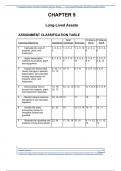
CHAPTER 9

Long-Lived Assets

ASSIGNMENT CLASSIFICATION TABLE
Brief Problems Problems
Learning Objectives Questions Exercises Exercises Set A Set B

1. Calculate the cost of 1, 2, 3, 4, 1, 2, 3, 4 1, 2, 3, 12 1, 2, 3, 4, 1, 2, 3, 4,
property, plant, and 5 6 6
equipment.

2. Apply depreciation 6, 7, 8, 9, 5, 6, 7, 8, 2, 3, 4, 5, 2, 3, 6, 7, 2, 3, 6, 7,
methods to property, plant, 9 12 8, 9 8, 9, 12
and equipment.

3. Explain the factors that 9, 10, 11, 10, 11 6, 7, 8 4, 5, 6, 12 4, 5, 6
cause changes in periodic 12, 13,
depreciation and calculate
revised depreciation for
property, plant, and
equipment.

4. Demonstrate how to 14, 15, 12, 13, 14 9, 10 6, 7, 8, 9 6, 7, 8, 9
account for property, plant, 16, 17,
and equipment disposals.

5. Record natural resource 18, 19, 20 15 11 12 12
transactions and calculate
depletion.

6. Identify the basic 21, 22 16 12, 13, 14 10, 11 10, 11
accounting issues for
intangible assets and
goodwill.

7. Illustrate the reporting and 23, 24 17, 18, 19 15, 16 9, 11, 12, 9, 11, 12,
analysis of long-lived assets. 13 13


Solutions Manual 9-1
Chapter 9
© 2016 John Wiley & Sons Canada, Ltd. Unauthorized copying, distribution, or transmission of this page is prohibited.

,Weygandt, Kieso, Kimmel, Trenholm, Warren, Novak Accounting Principles, Seventh Canadian Edition


ASSIGNMENT CHARACTERISTICS TABLE
Problem Difficulty Time
Number Description Level Allotted (min.)

1A Record property transactions. Simple 20-30

2A Allocate cost and calculate partial period depreciation. Moderate 20-30

3A Determine cost; calculate and compare depreciation under Moderate 30-40
different methods.

4A Account for operating and capital expenditures and asset Moderate 20-30
impairments.

5A Record impairment and calculate revised depreciation. Moderate 20-30

6A Record acquisition, depreciation, impairment and disposal of Moderate 25-35
land and building.

7A Calculate and compare depreciation and gain or loss on Moderate 30-40
disposal under three methods of depreciation.

8A Record acquisition, depreciation and disposal of equipment. Moderate 30-40

9A Record property, plant and equipment transactions; prepare Complex 40-50
partial financial statements.

10A Correct errors in recording intangible asset transactions. Complex 15-20

11A Record intangible asset transactions; prepare partial balance Moderate 30-40
sheet.

12A Record natural resource transactions; prepare partial financial Moderate 25-30
statements.

13A Calculate ratios and comment. Moderate 15-25

1B Record property transactions. Simple 20-30

2B Allocate cost and calculate partial period depreciation. Moderate 20-30

3B Determine cost; calculate and compare depreciation under Moderate 30-40
different methods.

4B Account for operating and capital expenditures and asset Moderate 20-30
impairments.

5B Record impairment and calculate revised depreciation. Moderate 20-30

6B Record acquisition, depreciation, impairment and disposal of Moderate 25-35
land and buildings.


Solutions Manual 9-2
Chapter 9
© 2016 John Wiley & Sons Canada, Ltd. Unauthorized copying, distribution, or transmission of this page is prohibited.

,Weygandt, Kieso, Kimmel, Trenholm, Warren, Novak Accounting Principles, Seventh Canadian Edition


ASSIGNMENT CHARACTERISTICS TABLE (Continued)

Problem Difficulty Time
Number Description Level Allotted (min.)

7B Calculate and compare depreciation and gain or loss on Moderate 30-40
disposal under three methods of depreciation.

8B Record acquisition, depreciation and disposal of furniture. Moderate 30-40

9B Record property, plant and equipment transactions; prepare Complex 40-50
partial financial statements.

10B Correct errors in recording intangible asset transactions. Complex 15-20

11B Record intangible asset transactions; prepare partial balance Moderate 30-40
sheet.

12B Record equipment, note payable, and natural resource Moderate 25-30
transactions; prepare partial financial statements.

13B Calculate ratios and comment. Moderate 15-25


Solutions Manual 9-3
Chapter 9
© 2016 John Wiley & Sons Canada, Ltd. Unauthorized copying, distribution, or transmission of this page is prohibited.

, Weygandt, Kieso, Kimmel, Trenholm, Warren, Novak Accounting Principles, Seventh Canadian Edition


BLOOM’S TAXONOMY TABLE
Correlation Chart between Bloom's Taxonomy, Study Objectives and End-of-
Chapter Exercises and Problems
Learning Objective Knowledge Comprehension Application Analysis Synthesis Evaluation
1. Calculate the cost of Q9-1 Q9-3 BE9-1 P9-2A
property, plant, and Q9-2 Q9-4 BE9-2 P9-3A
equipment. BE9-3 Q9-5 BE9-4 P9-4A
E9-3 E9-1 P9-6A
E9-2 P9-1B
E9-12 P9-2B
P9-1A P9-3B
P9-4B
P9-6B
2. Apply depreciation Q9-7 Q9-6 BE9-5 P9-3A
methods to property, Q9-9 Q9-8 BE9-6 P9-6A
plant, and equipment. Q9-10 BE9-7 P9-7A
Q9-11 BE9-8 P9-8A
E9-3 BE9-9 P9-9A
E9-2 P9-2B
E9-4 P9-3B
E9-5 P9-6B
E9-12 P9-7B
P9-2A P9-8B
P9-9B
P9-12B
3. Explain the factors Q9-9 Q9-10 BE9-10 P9-5A
that cause changes in Q9-12 Q9-11 BE9-11 P9-6A
periodic depreciation Q9-13 E9-6 P9-12A
and calculate revised E9-7 P9-4B
depreciation for E9-8 P9-5B
property, plant, and P9-4A P9-6B
equipment.

4. Demonstrate how to Q9-16 Q9-14 BE9-12 P9-8A
account for property, Q9-15 BE9-13 P9-9A
plant, and equipment Q9-17 BE9-14 P9-6B
disposals. E9-9 P9-7B
E9-10 P9-8B
P9-6A P9-9B
P9-7A
5. Record natural Q9-18 Q9-19 BE9-15 P9-12A
resource transactions Q9-20 E9-11 P9-12B
and calculate
depletion.
6. Identify the basic Q9-21 BE9-16 P9-10A
accounting issues for Q9-22 E9-12 P9-11A
intangible assets and E9-13 P9-10B
goodwill. E9-14 P9-11B
7. Illustrate the reporting Q9-23 Q9-24 BE9-18 P9-11A E9-16
and analysis of long- BE9-17 BE9-19 P9-12A P9-13A
lived assets. E9-15 P9-9B P9-13B
P9-9A P9-11B
P9-12B


Solutions Manual 9-4
Chapter 9
© 2016 John Wiley & Sons Canada, Ltd. Unauthorized copying, distribution, or transmission of this page is prohibited.

Get to know the seller

Seller avatar
Reputation scores are based on the amount of documents a seller has sold for a fee and the reviews they have received for those documents. There are three levels: Bronze, Silver and Gold. The better the reputation, the more your can rely on the quality of the sellers work.
ExamsExpert (self)
View profile
Follow You need to be logged in order to follow users or courses
Sold
613
Member since
2 year
Number of followers
313
Documents
2838
Last sold
10 hours ago
ExamsExpert

We as a team provide best and Latest Test Banks that helps students to get A Grade we have vast range of test banks you can order us any test bank that you need

4.5

85 reviews

5
58
4
15
3
9
2
1
1
2

Recently viewed by you

Why students choose Stuvia

Created by fellow students, verified by reviews

Quality you can trust: written by students who passed their exams and reviewed by others who've used these revision notes.

Didn't get what you expected? Choose another document

No problem! You can straightaway pick a different document that better suits what you're after.

Pay as you like, start learning straight away

No subscription, no commitments. Pay the way you're used to via credit card and download your PDF document instantly.

Student with book image

“Bought, downloaded, and smashed it. It really can be that simple.”

Alisha Student

Frequently asked questions