

Written by students who passed Immediately available after payment Read online or as PDF Wrong document? Swap it for free 4.6 TrustPilot
logo-home
Document preview thumbnail
Preview 3 out of 22 pages
Exam (elaborations)

A History of Modern Psychology 11th Edition - Final Exam

Document preview thumbnail
Preview 3 out of 22 pages

True / False 1. A course in the history of psychology is a typical requirement for only 10% of undergraduate degree programs in psychology. a. True b. False ANSWER: False REFERENCES: Why Study the History of Psychology? QUESTION TYPE: True / False 2. Virtually every modern science includes a course on its history as a part of its curriculum. a. True b. False ANSWER: False REFERENCES: Why Study the History of Psychology? QUESTION TYPE: True / False 3. The authors of your textbook argue that the formal study of the history of psychology is the most systematic way to integrate the areas and issues that constitute modern psychology. a. True b. False ANSWER: True REFERENCES: Why Study the History of Psychology? QUESTION TYPE: True / False NOTES: WWW 4. Psychology is one of the oldest and one of the newest scholarly disciplines. a. True b. False ANSWER: True REFERENCES: The Development of Modern Psychology QUESTION TYPE: True / False 5. It can be argued that psychology today studies and debates some of the same questions as those that concerned the philosophers of ancient Greece. a. True b. False ANSWER: True REFERENCES: The Development of Modern Psychology QUESTION TYPE: True / False NOTES: WWW 6. The earliest possible starting point for psychology is approximately 1,000 years ago. a. True b. False ANSWER: False REFERENCES: The Development of Modern Psychology QUESTION TYPE: True / False 7. The distinction between modern psychology and its roots has more to do with the kinds of questions asked than with the methods used. a. True b. False ANSWER: False REFERENCES: The Development of Modern Psychology QUESTION TYPE: True / False 8. Reconstruction refers to the principles, methods, and philosophical issues of historical research. a. True b. False ANSWER: False REFERENCES: The Data of History: Reconstructing Psychology's Past QUESTION TYPE: True / False 9. The data of history are much like the data of science. a. True b. False ANSWER: False REFERENCES: The Data of History: Reconstructing Psychology's Past QUESTION TYPE: True / False 10. Although difficult to do, the data of history can be reconstructed or replicated. a. True b. False ANSWER: False REFERENCES: The Data of History: Reconstructing Psychology's Past QUESTION TYPE: True / False 11. The papers and diaries of Ebbinghaus and Fechner were found more than 70 years after their deaths. a. True b. False ANSWER: True REFERENCES: The Data of History: Reconstructing Psychology's Past QUESTION TYPE: True / False 12. The written record of Darwin's life and work is now complete. a. True b. False ANSWER: False REFERENCES: The Data of History: Reconstructing Psychology's Past QUESTION TYPE: True / False 13. Jung wrote his autobiography a. True b. False ANSWER: False REFERENCES: The Data of History: Reconstructing Psychology's Past QUESTION TYPE: True / False 14. The terms id, ego, and superego were improperly translated from German. a. True b. False ANSWER: True REFERENCES: The Data of History: Reconstructing Psychology's Past QUESTION TYPE: True / False NOTES: WWW 15. Freud's original term for free association was Einfall, which means an intrusion or an invasion. a. True b. False ANSWER: True REFERENCES: The Data of History: Reconstructing Psychology's Past QUESTION TYPE: True / False 16. In his autobiography, Skinner recounts that his graduate days at Harvard were filled with endless work. a. True b. False ANSWER: True REFERENCES: The Data of History: Reconstructing Psychology's Past QUESTION TYPE: True / False 17. Current evidence demonstrates that Freud's works were ignored or even renounced by intellectuals during his lifetime. a. True b. False ANSWER: False REFERENCES: Contextual Forces in Psychology QUESTION TYPE: True / False 18. The term Zeitgeist refers to the spirit of the times. a. True b. False ANSWER: True REFERENCES: Contextual Forces in Psychology QUESTION TYPE: True / False 19. Three examples of contextual forces in psychology are economic opportunity, war, and prejudice. a. True b. False ANSWER: True REFERENCES: Contextual Forces in Psychology QUESTION TYPE: True / False 20. By 1960, the prejudice against women entering prestigious graduate schools of psychology had ended. a. True b. False ANSWER: False REFERENCES: Contextual Forces in Psychology QUESTION TYPE: True / False 21. The first African American to earn a doctoral degree in psychology was Kenneth Clark. a. True b. False ANSWER: False REFERENCES: Contextual Forces in Psychology QUESTION TYPE: True / False 22. Instances of simultaneous discoveries of theory support the naturalistic concept of scientific history. a. True b. False ANSWER: True REFERENCES: Conceptions of Scientific History QUESTION TYPE: True / False NOTES: WWW 23. The Zeitgeist is most influential in the naturalistic theory of history. a. True b. False ANSWER: True REFERENCES: Conceptions of Scientific History QUESTION TYPE: True / False 24. The effects of the Zeitgeist in inhibiting or delaying the dissemination and/or acceptance of a discovery operate at a cultural level but also within a science itself. a. True b. False ANSWER: True REFERENCES: Conceptions of Scientific History QUESTION TYPE: True / False 25. In Kuhn's (1970) view, psychology is at the paradigm stage because it has several models from which one might choose. a. True b. False ANSWER: False REFERENCES: Schools of Thought in the Evolution of Modern Psychology QUESTION TYPE: True / False 26. A new school of thought may overcome its opposition not because the opposing points of view become convinced to accept the new thinking, but because adherents of the old school of thought die off. a. True b. False ANSWER: True REFERENCES: Schools of Thought in the Evolution of Modern Psychology QUESTION TYPE: True / False NOTES: WWW Multiple Choice 27. Psychology is unique among the sciences in its requirement that its students ____ a. have a minor in the natural sciences b. learn the experimental method c. use carefully controlled observations in its procedures d. study the history of psychology e. have a liberal arts background in the humanities ANSWER: d REFERENCES: Why Study the History of Psychology? QUESTION TYPE: Multiple Choice 28. What conclusions can be drawn from the study of the Invisible Gorilla? a. All psychology students can multitask when presented with multiple stimuli at one time b. Extraordinary events can induce extreme stress when presented to unsuspecting people c. It is difficult for people to pay attention to more than one stimulus at a time d. Doing homework and watching television at the same time are as efficient as if the two are done separately e. Counting can be a difficult task when one is being watched ANSWER: c REFERENCES: The Invisible Gorilla QUESTION TYPE: Multiple Choice NOTES: WWW 29. Division ____ of the American Psychological Association is concerned with the study of the discipline's history. a. 1 b. 2 c. 26 d. 32 e. 42 ANSWER: c REFERENCES: Why Study the History of Psychology? QUESTION TYPE: Multiple Choice 30. In what year was the American Psychological Association founded? a. 1892 b. 1932 c. 1952 d. 1969 e. 1979 ANSWER: a REFERENCES: Why Study the History of Psychology? QUESTION TYPE: Multiple Choice 31. Psychology is marked by diversity and divisiveness. The one aspect of the discipline that provides cohesiveness and a common ground for discourse is its ____. a. reliance on the experimental method in all its research b. focus on the study of overt behavior c. use of the hypothetico-deductive method d. national organizations (APA and APS) e. history ANSWER: e REFERENCES: Why Study the History of Psychology? QUESTION TYPE: Multiple Choice NOTES: WWW 32. Perhaps the most valuable outcome of the study of the history of psychology is that one will learn the ____. a. relationships among psychology's ideas, theories, and research strategies b. contributions of the classic Greek philosophers c. origins of the experimental methods d. evolution of the scientist-practitioner model of clinical psychology e. issues at the root of the pure versus applied research conflict in psychology ANSWER: a REFERENCES: Why Study the History of Psychology? QUESTION TYPE: Multiple Choice 33. According to Schultz & Schultz, a course in the history of psychology is useful because ____. a. it helps us to understand why modern psychology has so many different movements b. it helps to integrate the areas and issues that constitute modern psychology c. it provides a fascinating story on its own d. All of the choices are correct e. None of the choices are correct ANSWER: d REFERENCES: Why Study the History of Psychology? QUESTION TYPE: Multiple Choice 34. As a scientific discipline, psychology is ____. a. one of the newest b. one of the oldest c. the only one to have started in the United States d. one of the newest and one of the oldest e. None of the choices are correct ANSWER: d REFERENCES: The Development of Modern Psychology QUESTION TYPE: Multiple Choice 35. Greek philosophers studied issues involving ____. a. motivation b. abnormal behavior c. learning d. thought e. All of the choices are correct ANSWER: e REFERENCES: The Development of Modern Psychology QUESTION TYPE: Multiple Choice 36. Modern psychology emerged from philosophy approximately ____ years ago. a. 100 b. 150 c. 200 d. 250 e. 300 ANSWER: c REFERENCES: The Development of Modern Psychology QUESTION TYPE: Multiple Choice 37. The feature of modern psychology that distinguishes it from its antecedents is its ____. a. methodology b. focus on learning c. focus on motivation d. focus on abnormal behavior e. use of deductive logic ANSWER: a REFERENCES: The Development of Modern Psychology QUESTION TYPE: Multiple Choice 38. Until the last quarter of the 19th century, philosophers studied human nature using which of the following methods? a. speculation b. intuition c. generalizations d. All of the choices are correct. e. None of the choices are correct. ANSWER: d REFERENCES: The Development of Modern Psychology QUESTION TYPE: Multiple Choice 39. Modern psychology shares which of the following characteristics with ancient Greek philosophy? a. An interest in the same kinds of questions about human nature b. The development of common methods of research to answer questions about human nature c. A reliance upon biology to help in the understanding of human nature d. The denial that humans are composed of a physical body and a spiritual soul e. None of the choices are correct ANSWER: a REFERENCES: The Development of Modern Psychology QUESTION TYPE: Multiple Choice 40. The new discipline of psychology was the product of the union of ____. a. philosophy and ethics b. philosophy and physics c. physics and biology d. physics and physiology e. philosophy and physiology ANSWER: e REFERENCES: Development of Modern Psychology QUESTION TYPE: Multiple Choice 41. The hallmark of psychology's separation from philosophy was its reliance on ____. a. physics b. biology c. experimentation d. deduction e. psychophysics ANSWER: c REFERENCES: The Development of Modern Psychology QUESTION TYPE: Multiple Choice NOTES: WWW 42. Modern psychology differs from philosophy in which of the following ways? a. Modern psychology is concerned with the study of mental processes such as learning, memory, and perception. Philosophy is concerned with the study of human nature. b. Modern psychology uses objective methods to study questions. Philosophy depends upon speculation and intuition in order to answer questions. c. Modern psychology studies only the brain. Philosophy studies only the mind. d. Modern psychology is based upon the use of inductive reasoning. Philosophy is based upon the use of deductive reasoning. e. None of the choices are correct. ANSWER: b REFERENCES: The Development of Modern Psychology QUESTION TYPE: Multiple Choice 43. Psychology became an independent discipline during the ____. a. Renaissance b. last quarter of the eighteenth century c. last quarter of the nineteenth century d. first decade of the nineteenth century e. first decade of the twentieth century ANSWER: c REFERENCES: The Development of Modern Psychology QUESTION TYPE: Multiple Choice 44. The term historiography refers to ____. a. historical biography b. methods used in psychological autopsy c. the techniques, principles, and issues involved in historical research d. the scientific study of history e. the study of the history of psychology ANSWER: c REFERENCES: The Data of History: Reconstructing Psychology's Past QUESTION TYPE: Multiple Choice 45. In contrast to the events that are studied in science, historical events cannot be ____. a. used to predict future outcomes b. repeated c. discovered d. analyzed and explained e. understood ANSWER: b REFERENCES: The Data of History: Reconstructing Psychology's Past QUESTION TYPE: Multiple Choice 46. The data of history are most accurately depicted or described as ____. a. public records b. private records c. eyewitness testimony d. recollections e. data fragments ANSWER: e REFERENCES: The Data of History: Reconstructing Psychology's Past QUESTION TYPE: Multiple Choice 47. The approach of the historian of psychology is similar to the approach taken by ____ in the study of their field. a. physicists b. archaeologists c. chemists d. economists e. None of the choices are correct. ANSWER: b REFERENCES: The Data of History: Reconstructing Psychology's Past QUESTION TYPE: Multiple Choice 48. Which psychologist burned his/her own letters, manuscripts, and research notes before s/he died? a. B. F. Skinner b. John Watson c. Karen Horney d. Sigmund Freud e. Margaret Washburn ANSWER: b REFERENCES: The Data of History: Reconstructing Psychology's Past QUESTION TYPE: Multiple Choice 49. At least one of Freud's biographers downplayed the extent of Freud's cocaine use. This is an example of ____. a. suppressed data b. data distorted by translation c. lost data d. errors of eyewitnesses e. a misrepresentation intended to protect Freud's reputation ANSWER: e REFERENCES: The Data of History: Reconstructing Psychology's Past QUESTION TYPE: Multiple Choice 50. An "autobiography" of Jung was evidently written not by Jung but by an assistant who ____. a. slandered him personally b. altered and/or deleted some of Jung's writings to present him in a manner suiting his family and followers c. exaggerated the degree of the break between Freud and Jung d. expanded Jung's theories and attributed the expansion to Jung e. None of the choices are correct. ANSWER: b REFERENCES: The Data of History: Reconstructing Psychology's Past QUESTION TYPE: Multiple Choice NOTES: WWW 51. Important personal papers by ____ have been misplaced for decades or more. a. Ebbinghaus b. Fechner c. Darwin d. All of the choices are correct. e. None of the choices are correct. ANSWER: d REFERENCES: The Data of History: Reconstructing Psychology's Past QUESTION TYPE: Multiple Choice 52. The historical treatment of Freud's impact upon psychology is still incomplete because ____. a. he changed his ideas so many times b. many of his most important works have not been translated into English c. many of his papers and letters will not be publicly available until later in the 21st century d. All of the choices are correct. e. None of the choices are correct. ANSWER: c REFERENCES: The Data of History: Reconstructing Psychology's Past QUESTION TYPE: Multiple Choice 53. The terms ego and id, which do not precisely represent Freud's ideas, are examples of ____. a. suppressed data b. data distorted by translation c. eyewitness errors d. lost data e. distortions intended to protect Freud's reputation ANSWER: b REFERENCES: The Data of History: Reconstructing Psychology's Past QUESTION TYPE: Multiple Choice 54. Freud's idea "Einfall" was translated to English into the term ____ which means something other than what Freud implied in the original German. a. rationalization b. free association c. penis envy d. dream analysis e. fixation ANSWER: b REFERENCES: The Data of History: Reconstructing Psychology's Past QUESTION TYPE: Multiple Choice NOTES: WWW 55. Skinner's self-discipline as a student and Freud's being ignored and rejected early in his career indicated that ____. a. biographers disregard the real events in favor of fantasy b. data of history are true in their original versions c. participants may themselves produce biased accounts d. translations errors account for most misinterpretations e. All of the choices are correct ANSWER: c REFERENCES: The Data of History: Reconstructing Psychology's Past QUESTION TYPE: Multiple Choice 56. To guard against self-serving data and to assess the truth of a person's recollections and reports of events in the history of psychology, the historian should, whenever possible, ____. a. collect data from other observers b. learn the language in which the person wrote c. read newspaper accounts of the events d. read others' research publications of that era e. reconstruct the event ANSWER: a REFERENCES: The Data of History: Reconstructing Psychology's Past QUESTION TYPE: Multiple Choice 57. Regardless of how objective a science and its practitioners are alleged to be, that science will be influenced by the ____. a. scientists' political beliefs b. scientists' religious beliefs c. policies of the government that funds that science's research d. contextual forces of the time e. amount of funding it receives ANSWER: d REFERENCES: Contextual Forces in Psychology QUESTION TYPE: Multiple Choice 58. The term "Zeitgeist" refers to ____. a. the intellectual and cultural climate of the times b. a German dessert c. the moment of discovery d. the moment of change in scientific revolutions e. a blizzard of activity ANSWER: a REFERENCES: Contextual Forces in Psychology QUESTION TYPE: Multiple Choice 59. The contextual forces in psychology deal with the ____. a. paradigms that exist in modern psychology. b. social, economic, and political factors that influenced the field. c. great individuals who have developed psychology. d. attempt of psychology to separate itself from other disciplines such as physiology. e. None of the choices are correct. ANSWER: b REFERENCES: Contextual Forces in Psychology QUESTION TYPE: Multiple Choice 60. The three contextual forces in the history of psychology were ____. a. economic opportunities, wars, and discrimination b. famine, pestilence, and death c. theory, research, and application d. cognition, motivation, and effect e. social, political, and economic ANSWER: a REFERENCES: Contextual Forces in Psychology QUESTION TYPE: Multiple Choice 61. A surge in the practice of applied psychology occurred in response to the lack of jobs in academic settings for PhDs. Thus, the development of applied psychology was a direct consequence of the ____. a. great number of psychologists Wundt trained b. political context of Europe c. economic context of the United States d. fact that the first generation of American psychologists learned all their courses in German and thus could not practice Wundt's psychology e. political context of the United States ANSWER: c REFERENCES: Contextual Forces in Psychology QUESTION TYPE: Multiple Choice 62. A wave of employment possibilities in applied psychology in the first two decades of the 20th century was partly due to ____. a. 700% increases in public school enrollment b. more money being spent on defense than on education c. the rise of the Veteran's administration Hospital system d. less money being spent on education than on defense and welfare combined e. All of the choices are correct ANSWER: a REFERENCES: Contextual Forces in Psychology QUESTION TYPE: Multiple Choice 63. Which contextual influence on psychology lead to the growth of psychology in the areas of personnel selection, psychological testing, and engineering psychology? a. Demands generated by the world wars b. Emigration from Germany of the top psychologists when Hitler took power c. Prosperity of the 1920s and 1930s in the United States d. Psychological needs of combat pilots e. Need to provide education for an unexpected surge in the U.S. population ANSWER: a REFERENCES: Contextual Forces in Psychology QUESTION TYPE: Multiple Choice 64. On the basis of the destruction associated with World War I, Freud proposed that ____. a. humans have the ability to survive any catastrophe b. the defense mechanisms are used by humans to distort reality c. humans have an instinct for aggression d. the id is stronger than the ego in controlling behavior e. None of the choices are correct ANSWER: c REFERENCES: Contextual Forces in Psychology QUESTION TYPE: Multiple Choice 65. According to the textbook, psychology as a discipline has ____. a. engaged in the discriminatory practices that mark American culture as a whole b. been substantially more discriminatory against women than have other sciences c. been substantially more discriminatory against minorities than have other sciences d. focused on the reduction of discrimination since its beginnings e. None of the choices are correct ANSWER: a REFERENCES: Contextual Forces in Psychology QUESTION TYPE: Multiple Choice 66. Even when some women were admitted to graduate programs in psychology, they still encountered many barriers to their success, such as ____. a. being barred from some laboratory facilities b. being prevented from using graduate library facilities c. being unable to eat in graduate cafeterias d. not being allowed to participate in some seminar topics e. All of the choices are correct ANSWER: e REFERENCES: Contextual Forces in Psychology QUESTION TYPE: Multiple Choice NOTES: WWW 67. As recently as the 1960s, why were some universities reluctant to admit women to their graduate programs in psychology? a. Their graduate admission scores were not as high as those of male applicants. b. Their personal lives, in terms of marriage and becoming pregnant, were viewed as obstacles that reduced the likelihood of completion of graduate school. c. In the opinion of some influential psychologists, some women would never amount to anything. d. There were too many female applicants. e. Their personal lives, in terms of marriage and becoming pregnant, were viewed as obstacles that reduced the likelihood of completion of graduate school and, in the opinion of some influential psychologists, some women would never amount to anything. ANSWER: e REFERENCES: Contextual Forces in Psychology QUESTION TYPE: Multiple Choice 68. Julian Rotter, a leading personality theorist was told that "____ simply could not get academic jobs, regardless of their credentials." a. African-Americans b. women c. graduates above the age of 50 d. Jews e. All of the choices are correct. ANSWER: d REFERENCES: Contextual Forces in Psychology QUESTION TYPE: Multiple Choice 69. According to your text, it was so difficult for Jewish psychologists to get a job that some resorted to ____. a. only applying to traditionally Jewish colleges and universities b. changing their religion c. lying about their religion d. changing their name to something that didn't seem Jewish e. changing their name to something that didn't seem Jewish ANSWER: d REFERENCES: Contextual Forces in Psychology QUESTION TYPE: Multiple Choice 70. When ____ enrolled as a graduate student at Clark University, the administration arranged a separate dining table for her/him. a. Francis Sumner b. Margaret Floy Washburn c. Kenneth Clark d. Mamie Clark e. Maslow ANSWER: a REFERENCES: Contextual Forces in Psychology QUESTION TYPE: Multiple Choice 71. Kenneth Clark was rejected by the graduate program in psychology at Cornell because the university ____. a. could not tolerate Blacks working closely with Whites b. had no dormitory facilities for Blacks c. had no dining facilities for Blacks d. could not have Black males working with White female graduate students e. would not confer the PhD on a Black person even if he or she completed the requisite coursework ANSWER: a REFERENCES: Contextual Forces in Psychology QUESTION TYPE: Multiple Choice 72. The first African American president of the APA was ____. a. Frances Cecil Sumner b. Charles Henry Turner c. Kenneth Clark d. Mamie Phipps Clark e. None of the choices are correct ANSWER: c REFERENCES: Contextual Forces in Psychology QUESTION TYPE: Multiple Choice NOTES: WWW 73. Who conducted a research program on racial identity and self-concept issues for Black children that was cited in the 1954 Supreme Court decision to end racial segregation in public schools? a. Francis Sumner b. James Bayton c. Inez Prosser d. Kenneth and Mamie Clark e. none of the choices are correct ANSWER: d REFERENCES: Contextual Forces in Psychology QUESTION TYPE: Multiple Choice 74. History ignores the work of the majority of ____. a. women b. African-Americans c. Jews d. white me e. all psychologists ANSWER: e REFERENCES: Contextual Forces in Psychology QUESTION TYPE: Multiple Choice 75. The _____ theory would support the claim: “Freud was instrumental in discovering psychoanalysis. If not for Freud, no other psychologist would have been able to undercover the human psyche.” a. Zeitgeist b. personalistic c. naturalistic d. ortgeist e. evolution ANSWER: b REFERENCES: Conceptions of Scientific History QUESTION TYPE: Multiple Choice NOTES: WWW 76. "The man makes the times," reflects which view of history? a. panpsychic b. personalistic c. naturalistic d. nativist e. regressive ANSWER: b REFERENCES: Conceptions of Scientific History QUESTION TYPE: Multiple Choice 77. Which theory suggests that “the times make the person”? a. naturalistic b. personalistic c. nativist d. particularistic e. panpsychic ANSWER: a REFERENCES: Conceptions of Scientific History QUESTION TYPE: Multiple Choice 78. Simultaneous discovery favors which view of history? a. dynamic b. personalistic c. naturalistic d. recurrent e. syncopated ANSWER: c REFERENCES: Conceptions of Scientific History QUESTION TYPE: Multiple Choice 79. Darwin and Wallace developed similar theories of evolution independently; Newton and Leibnitz developed the calculus independently; Twitmyer discovered "Pavlovian" conditioning before Pavlov did. Such independent discoveries are attributed to which theory? a. syncopated b. personalistic c. naturalistic d. Ortgeist e. evolution ANSWER: c REFERENCES: Conceptions of Scientific History QUESTION TYPE: Multiple Choice 80. In the 1970s, the publication of the research of John Garcia was significantly delayed because ____. a. his work challenged the cognitive psychology school of thought b. his work was regarded as poorly done c. his findings challenged the prevailing view in stimulus-response (S-R) learning theory d. journal editors tend to accept findings that contradict or oppose current thinking e. All of the choices are correct ANSWER: c REFERENCES: Conceptions of Scientific History QUESTION TYPE: Multiple Choice NOTES: WWW 81. The editors and editorial boards of journals in psychology are composed of people eminent in their specialty areas and likely to subscribe to tradition and their own viewpoints. Thus, new knowledge may not be published if it is revolutionary. This situation illustrates which theory? a. Zeitgeist b. personalistic c. naturalistic d. Ortgeist e. evolution ANSWER: c REFERENCES: Conceptions of Scientific History QUESTION TYPE: Multiple Choice 82. In the first years of psychology's emergence as a new discipline, which man determined its direction? a. James McKeen Cattell b. Edward Bradford Titchener c. The Unknown Soldier d. Wilhelm Wundt e. Thomas Kuhn ANSWER: d REFERENCES: Schools of Thought in the Evolution of Modern Psychology QUESTION TYPE: Multiple Choice 83. A school of thought emerges whenever ____. a. a group shares a theoretical orientation and investigates similar problems b. some person organizes and markets several compatible themes or practices, as did Wundt and Watson c. a group at a particular college or university focuses on a particular problem, such as the "Würzburg school" d. a college or university adopts a particular orientation, such as behaviorism at Harvard or the "Chicago school" of functionalism e. a college or university adopts a single methodology, such as the experimental psychology program at the University of Illinois ANSWER: a REFERENCES: Schools of Thought in the Evolution of Modern Psychology QUESTION TYPE: Multiple Choice 84. The stage in the development of a science when it is still divided into schools of thought is called ____. a. paradigmatic b. preparadigmatic c. revolutionary d. a scientific revolution e. messy ANSWER: b REFERENCES: Schools of Thought in the Evolution of Modern Psychology QUESTION TYPE: Multiple Choice 85. Which eminent historian called the process of replacing one paradigm with another a scientific revolution? a. E.G. Boring b. Gordon Allport c. Duane Schultz d. Thomas Kuhn e. John Garcia ANSWER: d REFERENCES: Schools of Thought in the Evolution of Modern Psychology QUESTION TYPE: Multiple Choice 86. Kuhn (1970) defines a paradigm as ____. a. an instance of agreement on theory and methodology by the science's practitioners. b. a model that describes a scientific phenomenon. c. a model that explains a scientific phenomenon. d. the reconciliation of disparate views on the proper subject matter of the field. e. the ultimate goal of any science but which is an ideal and will never be realized. ANSWER: a REFERENCES: Schools of Thought in the Evolution of Modern Psychology QUESTION TYPE: Multiple Choice 87. In Kuhn's philosophy of science, when Einstein's theory of relativity replaced Galilean-Newtonian physics, a(n) ____ occurred. a. Zeitgeist b. Ortgeist c. paradigm d. scientific revolution e. school of thought ANSWER: d REFERENCES: Schools of Thought in the Evolution of Modern Psychology QUESTION TYPE: Multiple Choice NOTES: WWW 88. Currently, psychology ____. a. has reached the paradigmatic stage b. has been described as a sequence of failed paradigms c. may be more fragmented than at any time in its history d. has been described as a sequence of failed paradigms and may be more fragmented than at any time in its history e. None of the choices are correct ANSWER: d REFERENCES: Schools of Thought in the Evolution of Modern Psychology QUESTION TYPE: Multiple Choice 89. The various schools of thought in psychology have served well as systems to be opposed. In each case, ____ was the consequence. a. a new paradigm b. a new school of thought c. absorption into the mainstream d. a new and unique methodology e. a new definition of "mind" ANSWER: b REFERENCES: Schools of Thought in the Evolution of Modern Psychology QUESTION TYPE: Multiple Choice 90. The school of thought that deals with conscious experience as it is dependent on the experiencing person is the ____ school. a. structuralist b. functionalist c. Gestalt d. humanistic e. cognitive ANSWER: a REFERENCES: Plan of the Book QUESTION TYPE: Multiple Choice 91. The school of thought that deals with how the conscious mind enables and facilitates one's adaptation to one's environment is the ____ school. a. structuralist b. functionalist c. Gestalt d. humanistic e. cognitive ANSWER: b REFERENCES: Plan of the Book QUESTION TYPE: Multiple Choice 92. The school of thought that focuses on the processes of knowing and thus represents a return to the study of conscious processes is the ____ school. a. structuralist b. functionalist c. Gestalt d. cognitive e. humanistic ANSWER: d REFERENCES: Plan of the Book QUESTION TYPE: Multiple Choice 93. The school of thought that is distinct in its focus on the role of the unconscious in determining behavior is the ____ school. a. functionalist b. psychoanalytic c. behaviorist d. Gestalt e. cognitive ANSWER: b REFERENCES: Plan of the Book QUESTION TYPE: Multiple Choice 94. The school of thought that focuses on learning and perception and emphasizes the combination of elements to produce new patterns is the ____ school. a. structuralist b. behaviorist c. Gestalt d. cognitive e. Würzburg ANSWER: c REFERENCES: Plan of the Book QUESTION TYPE: Multiple Choice 95. The school of thought that deals solely with observable behaviors that can be described in objective terms is the ____ school. a. structuralist b. behaviorist c. Gestalt d. cognitive e. humanistic ANSWER: b REFERENCES: Plan of the Book QUESTION TYPE: Multiple Choice 96. The school of thought that emphasizes the study of conscious experience and the wholeness of human nature is the ____ school. a. structuralist b. behaviorist c. Gestalt d. cognitive e. humanistic ANSWER: e REFERENCES: Plan of the Book QUESTION TYPE: Multiple Choice Essay 97. Why is it important for psychology students to study the development of psychology? ANSWER: Answer not provided. QUESTION TYPE: Essay 98. Argue that Psychology's roots began 2000 years ago. Now argue that they began 200 years ago. What fields came together to form Psychology? ANSWER: Answer not provided. QUESTION TYPE: Essay NOTES: WWW 99. Define historiography. How do the data of history differ from the data of science? Name and describe the three major difficulties involved in recalling and presenting the data of history. ANSWER: Answer not provided QUESTION TYPE: Essay 100. Discuss and give one example of each of the contextual forces that influenced the development of psychology. ANSWER: Answer not provided. QUESTION TYPE: Essay 101. Describe, compare, and contrast the personalistic and naturalistic theories as conceptions of scientific history. How could the contributions of Darwin be used to illustrate both? ANSWER: Answer not provided. QUESTION TYPE: Essay NOTES: WWW 102. Define "school of thought" and discuss it in terms of Thomas Kuhn's concept of paradigms in scientific evolution. ANSWER: Answer not provided. QUESTION TYPE: Essay 1. Describe the circumstances under which Bessel discovered the importance of the human observer. To what two conclusions did his findings lead? What were the consequences of his work in terms of subsequent developments in early physiology? ANSWER: Answer not provided. POINTS: 1 NOTES: WWW 2. Describe Müller's doctrine of the specific energies of nerves. Why was it so important to the early years of modern psychology? ANSWER: Answer not provided. POINTS: 1 3. Identify the early physiologists who made substantial contributions to the mapping of brain functions and describe the methods and findings of each. ANSWER: Answer not provided. POINTS: 1 4. Why did experimental psychology begin in Germany rather than in other European countries? ANSWER: Answer not provided. POINTS: 1 NOTES: WWW 5. What contributions led to the description of Helmholtz as "one of the greatest scientists of the 19th century"? ANSWER: Answer not provided. POINTS: 1 6. Describe the research and findings of Ernst Weber. What was the importance of his work on later physiologists? What was its importance to the new psychology? ANSWER: Answer not provided. POINTS: 1 7. Discuss why Fechner's work may have been the necessary precondition for the founding of psychology as a separate discipline. ANSWER: Answer not provided. POINTS: 1 8. Why was David Kinnebrook fired? a. He dated, but did not marry, the daughter of his boss. b. His observations differed from the observations of his boss. c. He was incompetent. d. He was never able to learn to use the equipment correctly. e. None of the choices are correct. ANSWER: b POINTS: 1 REFERENCES: David K. Makes a Mistake: The Importance of the Human Observer 9. Bessel began the study of individual differences in perception by noting that ____. a. humans differ in the speed with which they react to a loud sound b. animals, such as dogs, have a wider range for hearing sounds than do humans c. time space must be measured in relative units d. astronomers differed in their time estimates in measuring the transit of a star e. None of the choices are correct. ANSWER: d POINTS: 1 REFERENCES: David K. Makes a Mistake: The Importance of the Human Observer 10. Whose research would support the argument that there is no such thing as objective observation? a. Maskelyne's b. Bessel's c. Locke's d. Muller's e. Wundt's ANSWER: b POINTS: 1 REFERENCES: David K. Makes a Mistake: The Importance of the Human Observer 11. Bessel’s discovery had an impact on which of the following sciences? a. Psychology b. Physiology c. Biology d. Astronomy e. All of the above ANSWER: e POINTS: 1 REFERENCES: David K. Makes a Mistake: The Importance of the Human Observer 12. Until the work of ____, experimentation was not the preferred method in physiology. a. Galileo b. Newton c. J. Müller d. Broca e. Wundt ANSWER: c POINTS: 1 REFERENCES: Developments in Early Physiology NOTES: WWW 13. Johannes Müller found that nerves only give information characteristic of the sense associated with it. This means that when an auditory nerve is stimulated, it will result in someone hearing a sound, even when no noise is present. Müller called this ____. a. the doctrine of the specific energies of nerves b. specificity c. neuronal tubule clarity d. the postmortem method e. the experimental method in physiology ANSWER: a POINTS: 1 REFERENCES: Developments in Early Physiology 14. Johannes Müller's most influential publications was ____. a. The Nervous system of Animals b. The Senses c. The Handbook of the Physiology of Mankind d. Experimental Methods e. Interpretation of Dreams ANSWER: c POINTS: 1 REFERENCES: Developments in Early Physiology 15. The practice of psychosurgery such as prefrontal lobotomies, has its roots in the ____. a. implementation of the experimental method in physiology b. doctrine of the specific energies of nerves c. electrical stimulation method d. postmortem method e. extirpation method ANSWER: e POINTS: 1 REFERENCES: Developments in Early Physiology 16. ____ was a pioneer in research on reflex behavior showing that reflexes could occur in the absence of brain involvement. a. Hall b. Broca c. Flourens d. Galvani e. Gall ANSWER: a POINTS: 1 REFERENCES: Developments in Early Physiology 17. In his research, Flourens localized specific functions to how many brain areas? a. 2 b. 3 c. 4 d. 5 e. 6 ANSWER: c POINTS: 1 REFERENCES: Developments in Early Physiology NOTES: WWW 18. "Acts like a chicken with its head cut off" is a description of behavior that has its roots in ____ research. a. Hall's b. Flouren's c. Broca's d. Fritsch's e. Helmholtz's ANSWER: a POINTS: 1 REFERENCES: Developments in Early Physiology 19. In modern medicine, the cause of a person's dementia typically cannot be determined until autopsy. Thus, ____ clinical research method continues to be of significance in medicine and psychology. a. Marshall's b. Flouren's c. Broca's d. Fritsch's e. Helmhotz's ANSWER: c POINTS: 1 REFERENCES: Developments in Early Physiology 20. The ____ method is described as a type of posthumous extirpation. a. experimental b. clinical c. scientific d. electrical stimulation e. introspection ANSWER: b POINTS: 1 REFERENCES: Developments in Early Physiology 21. Electrical stimulation as a method of mapping the cerebral cortex was introduced by ____. a. Galvani and Aldini b. Flourens and Hall c. Gall and Spurzheim d. Broca and Kinnebrook e. Fritsch and Hitzig ANSWER: e POINTS: 1 REFERENCES: Developments in Early Physiology 22. ____ produced the theory of cranioscopy. a. Flourens b. Broca c. Spurzheim d. Gall e. Hall ANSWER: d POINTS: 1 REFERENCES: Developments in Early Physiology NOTES: WWW 23. ____ discovered, among other things, that the brain had both white and gray matter, and that fiber connect the two halves of the brain. a. Gall b. Spurzheim c. Broca d. Hall e. Flourens ANSWER: a POINTS: 1 REFERENCES: Developments in Early Physiology 24. ____ created phrenology, which proposed that the topography of a person's skull revealed his or her intellectual and emotional characteristics. a. Flourens b. Gall c. Spurzheim d. Broca e. Hall ANSWER: b POINTS: 1 REFERENCES: Developments in Early Physiology 25. Although he did not develop the theory called phrenology, ____ served as its popularizer. a. Gall b. Spurzheim c. Galvani d. Fritsch e. Hall ANSWER: b POINTS: 1 REFERENCES: Developments in Early Physiology 26. In the Unites States, the ____ brothers had a profitable and extensive business selling phrenology readings. a. Ringling b. Fowler c. Barnum d. Smithson e. James ANSWER: b POINTS: 1 REFERENCES: Developments in Early Physiology 27. The most effective criticisms of phrenology came from whom? a. Broca b. Hall c. Spurzheim d. Fechner e. Flourens ANSWER: e POINTS: 1 REFERENCES: Developments in Early Physiology 28. ____ systematically destroyed parts of the brain using extirpation. a. Broca b. Gall c. Spurzheim d. Flourens e. Fowler ANSWER: d POINTS: 1 REFERENCES: Developments in Early Physiology 29. The researcher credited with the finding or conclusion that nerve impulses are electrical within the neuron is ____. a. Flourens b. Galvani c. Helmholtz d. Müller e. Sherrington ANSWER: b POINTS: 1 REFERENCES: Developments in Early Physiology NOTES: WWW 30. The representation of the nervous system as a complex switching system reveals the 19th-century reliance on ____. a. mechanism b. determinism c. experimentation d. materialism e. mentalism ANSWER: a POINTS: 1 REFERENCES: Developments in Early Physiology 31. Who discovered the direction of travel of nerve impulses in the brain and spinal cord? a. Flourens b. Fechner c. Helmholtz d. Cajal e. Gall ANSWER: d POINTS: 1 REFERENCES: Developments in Early Physiology 32. The method of logic that characterizes psychology and that was favored in Germany of the 19th century was ____. a. the deductive method b. the inductive method c. the experimental method d. the hypothetico-deductive method e. structural equation modeling ANSWER: b POINTS: 1 REFERENCES: The Beginnings of Experimental Psychology 33. In the 19th century, the British and French defined science as including ____. a. only physics b. physiology and medicine only c. physics and chemistry only d. all fields that used the experimental method e. all areas that took a positivistic approach ANSWER: c POINTS: 1 REFERENCES: The Beginnings of Experimental Psychology 34. German universities were especially fertile ground for scientific advances because ____. a. there were only two of them, so each received only the most talented faculty and students b. there was academic freedom for students and faculty alike c. the British and the French were using unscientific methods to research the mind d. anyone with independent income could be a gentleman-scientist e. None of the answers are correct. ANSWER: b POINTS: 1 REFERENCES: The Beginnings of Experimental Psychology 35. The "publish or perish" ethic, which is a hallmark of the most prestigious U.S. research universities and colleges, is a direct descendant of the 19th-century ____ universities. a. British b. French c. German d. Austrian e. Russian ANSWER: c POINTS: 1 REFERENCES: The Beginnings of Experimental Psychology 36. Helmholtz emphasized a(n) ____ approach. a. materialistic and mechanistic b. deterministic and mentalistic c. experimental and mentalistic d. mechanistic and deterministic e. materialistic and experimental ANSWER: d POINTS: 1 REFERENCES: Hermann von Helmholtz () 37. Who invented the ophthalmoscope? a. Weber b. Fechner c. Helmholtz d. Cajal e. Wundt ANSWER: c POINTS: 1 REFERENCES: Hermann von Helmholtz () 38. Which of the following was NOT one of the research areas of Helmholtz? a. theory of color vision b. perception of combination and individual tones c. resonance theory of hearing d. speed of neural impulse e. All of the choices were research areas of Helmholtz. ANSWER: e POINTS: 1 REFERENCES: Hermann von Helmholtz () 39. One of Helmholtz's particular contributions to psychology was his work on ____. a. vision b. the skin senses c. the conservation of energy d. geometric axioms e. mental telegraphy ANSWER: a POINTS: 1 REFERENCES: Hermann von Helmholtz () 40. Why did Helmholtz abandon his research into human reaction times? a. He found differences from one individual to the next. b. He found differences in the same individual. c. He never did any such research on human subjects. d. He did not abandon this research. e. He found differences from one individual to the next and he found differences in the same individual. ANSWER: e POINTS: 1 REFERENCES: Hermann von Helmholtz () 41. Who devised a theory of color vision as well as conducted research on audition? a. Cajal b. Fechner c. Wundt d. Helmholtz e. Weber ANSWER: d POINTS: 1 REFERENCES: Hermann von Helmholtz () NOTES: WWW 42. With regard to the speed of the nerve impulse, perhaps the most important conclusion of Helmholtz's research for psychology was the determination ____. a. that the nerve impulse's speed is 900 feet/second b. that thought and movement are not simultaneous c. of the specific energies of nerves d. of the nature of harmony e. of the problem of resonance ANSWER: b POINTS: 1 REFERENCES: Hermann von Helmholtz () 43. The modern notion of subliminal perception rests on the idea that the threshold of perception or consciousness can be determined. The first experimental illustration of psychological threshold was demonstrated by ____. a. Helmholtz b. Weber c. Fechner d. Wundt e. Freud ANSWER: b POINTS: 1 REFERENCES: Ernst Weber () 44. Weber's Law, the formulation of how much change in a stimulus is required for a subject to detect it, rests on the measurement of the ____. a. threshold of consciousness b. just noticeable difference c. cognizant awareness d. limen of consciousness e. method of average error ANSWER: b POINTS: 1 REFERENCES: Ernst Weber () 45. Who developed both the two-point threshold and the concept of the just noticeable difference? a. Weber b. Helmholtz c. Fechner d. Wundt e. Cajal ANSWER: a POINTS: 1 REFERENCES: Ernst Weber () NOTES: WWW 46. Whose major contributions to the new psychology involved the two-point threshold and the just noticeable difference? a. Hermann von Helmholtz b. Gustav Fechner c. Friedrich Bessel d. Wilhelm Wundt e. Ernst Weber ANSWER: e POINTS: 1 REFERENCES: Ernst Weber () 47. What is the smallest detectable difference between two stimuli? a. absolute threshold b. doctrine of specific nerve energies c. decision threshold d. just noticeable difference e. threshold of consciousness ANSWER: d POINTS: 1 REFERENCES: Ernst Weber () 48. What was the ratio of a weight to its just noticeable difference weight when they were lifted? What was the ratio of a weight to its just noticeable difference weight when the weights were placed in the subject's hands? a. 1:40; 1:30 b. 1:30; 1:40 c. 1:40; 1:25 d. 1:25; 1:50 e. None of the choices are correct. ANSWER: a POINTS: 1 REFERENCES: Ernst Weber () 49. Weber suggested that discrimination among sensations depended on ____. a. audition b. vision c. a constant ratio that would be consistent for all of the senses d. the absolute difference between two weights e. the relative difference or ratio between two weights ANSWER: e POINTS: 1 REFERENCES: Ernst Weber () 50. Weber's experiments led to two important contributions: (a) further research and (b) the focus of attention of later physiologists and the new psychology on the development of ____. a. experimental methods for studying mind-body relationships b. the method of introspection c. the application of experimentation to physiological events d. the field he called "psychophysics" e. cranioscopy ANSWER: a POINTS: 1 REFERENCES: Ernst Weber () 51. Which of the following is true of Fechner? a. He taught at Leipzig. b. He developed the notion of the pleasure principle. c. He seriously damaged his eyes by looking at the sun through colored glasses. d. He was "cured" of some symptoms by eating spiced raw ham soaked in Rhine wine and lemon juice. e. All of the choices are correct. ANSWER: e POINTS: 1 REFERENCES: Gustav Theodor Fechner () 52. Fechner wrote satirical essays ridiculing medicine and science under the pen name ____. a. Dr. Weber b. Dr. Mises c. Mr. Misfortune d. Dr. Kopf e. Dr. Misfortune ANSWER: b POINTS: 1 REFERENCES: Gustav Theodor Fechner () 53. After Fechner obtained the very important appointment of professor at the University of Leipzig, he ____. a. became depressed b. married his fiancé c. became angry d. was "cured" of depression e. celebrated in an inappropriate manner ANSWER: a POINTS: 1 REFERENCES: Gustav Theodor Fechner () 54. As a form of occupational therapy, Fechner ____. a. chopped carrots and turnips b. made strings and bandages c. grinded a sugarloaf into powdered sugar d. dipped candles e. All of the choices are correct. ANSWER: e POINTS: 1 REFERENCES: Gustav Theodor Fechner () 55. While euphoric and suffering from delusions of grandeur, Fechner ____. a. had to be hospitalized b. developed the idea of the pleasure principle c. stumbled on the notion of free association d. ate ham soaked in Rhine wine e. declared he was Napoleon ANSWER: b POINTS: 1 REFERENCES: Gustav Theodor Fechner () NOTES: WWW 56. Fechner's flash of insight about the mind-body connection was that there is a(n) ____ relationship between a mental sensation and a material stimulus. a. null b. quantitative c. one-to-one d. qualitative e. unobservable ANSWER: b POINTS: 1 REFERENCES: Gustav Theodor Fechner () 57. According to Fechner, the effects of stimulus intensities are not ____ but are ____ to the amount of sensation that already exists. a. equal; related b. relative; absolute c. noticeable; relevant d. related; equal e. absolute; relative ANSWER: e POINTS: 1 REFERENCES: Gustav Theodor Fechner () 58. Fechner's most important contribution to psychology was the ____. a. quantification of the mind-body relationship b. determination that the effect of a stimulus intensity change is relative to the intensity that already exists c. determination of the pleasure principle d. qualitative relationship between a physical stimulus and the mental sensation of it e. study of the differential threshold ANSWER: a POINTS: 1 REFERENCES: Gustav Theodor Fechner () 59. Fechner proposed two ways to measure the lowest level of a sensation. One was the point of stimulus intensity below which no sensation is reported and above which subjects do experience a sensation; the other was ____. a. whether or not a stimulus is present or absent, sensed or not sensed b. the point of sensitivity at which the least change in a stimulus results in a change of sensation c. the level at which two points of stimulation can be distinguished d. the smallest difference that can be detected between two physical stimuli e. None of the choices are correct. ANSWER: a POINTS: 1 REFERENCES: Gustav Theodor Fechner () NOTES: WWW 60. The point of sensitivity at which the least amount of change in a stimulus gives rise to a change in a sensation is a definition of ____. a. the just noticeable difference b. the absolute threshold c. Weber's Law d. the differential threshold e. the stimulus change threshold ANSWER: d POINTS: 1 REFERENCES: Gustav Theodor Fechner () 61. The point of sensitivity below which no sensation can be detected and above which sensation can be experienced is a definition of the ____. a. just noticeable difference b. absolute just noticeable difference c. differential threshold d. differential just noticeable difference e. absolute threshold ANSWER: e POINTS: 1 REFERENCES: Gustav Theodor Fechner () 62. ____ discovered the law, S = K log R. a. Müller b. Weber c. Helmholtz d. Fechner e. Wundt ANSWER: d POINTS: 1 REFERENCES: Gustav Theodor Fechner () 63. The scientific study of the relations between mental and physical processes is a definition of ____. a. psychophysics b. Wundt's psychology c. Weber's Law d. Fechner's Law e. cranioscopy ANSWER: a POINTS: 1 REFERENCES: Gustav Theodor Fechner () 64. In Fechner's Law as one variable increases arithmetically, the other variable increases ____. a. arithmetically b. geometrically c. metaphysically d. mathematically e. psychophysically ANSWER: b POINTS: 1 REFERENCES: Gustav Theodor Fechner () NOTES: WWW 65. In Fechner's law, S is the ____. a. magnitude of the stimulus b. duration of the stimulus c. intensity of the stimulus d. magnitude of the sensation e. duration of the sensation ANSWER: d POINTS: 1 REFERENCES: Gustav Theodor Fechner () 66. Late in his career, Fechner noted that the idea for describing the mind-body relationship ____. a. came in a vision b. was essentially what Weber's work had shown c. had not been suggested to him by Weber's work d. was inspired by Helmholtz e. would not have come to him if he hadn't eaten wine-soaked ham ANSWER: c POINTS: 1 REFERENCES: Gustav Theodor Fechner () 67. The calculation of the mean of a group of scores is the same as Fechner's ____. a. method of limits b. differential threshold c. method of constant stimuli d. method of average error e. differential average ANSWER: d POINTS: 1 REFERENCES: Gustav Theodor Fechner () 68. The original source material on Fechner reproduced in your textbook was taken from the book ____. a. Physics and Medicine b. The Connection between Mind and Body c. Dealing with Depression d. Physics, Physiology, and Psychophysics e. Elements of Psychophysics ANSWER: e POINTS: 1 REFERENCES: Gustav Theodor Fechner () 69. According to Fechner in the original source material, "Psychophysics should be understood as an exact theory of the functionally dependent relations of..." ____ and ____. a. soul; body b. physical world; psychological world c. the material; the mental d. All of the choices are correct. e. None of the choices are correct. ANSWER: d POINTS: 1 REFERENCES: Gustav Theodor Fechner () 70. In the original source material from one of his books, Fechner states that, "____ depends on ____". a. an outer part; an inner part b. an inner part; an outer part c. empirical; metaphysical d. stimulation; sensation e. sensation; stimulation ANSWER: e POINTS: 1 REFERENCES: Gustav Theodor Fechner () NOTES: WWW 71. How did the British empiricists (BritE) and the German physiologists (GerP) differ in their approach to the study of the senses? a. The BritE developed more precise experiments than the GerP to study the senses. b. The BritE applied mathematics to the study of the senses whereas the Germans did not. c. The BritE concentrated on the study of vision and the GerP studied hearing. d. The BritE studied the senses from the viewpoint of philosophy. The GerP used scientific methods to study the senses. e. They did not differ. ANSWER: d POINTS: 1 REFERENCES: The Formal Founding of Psychology 72. Fechner's work had proved Immanuel Kant wrong when Kant said that ____. a. nothing good ever comes out of Leipzig b. psychology could never be a science c. the brain would never be mapped d. mental phenomena do not exist e. sensations reliably reflect the object in the material world ANSWER: b POINTS: 1 REFERENCES: Gustav Theodor Fechner () 73. Psychology was founded by ____. a. Helmholtz b. Weber c. Fechner d. Wundt e. James ANSWER: d POINTS: 1 REFERENCES: The Formal Founding of Psychology 74. The royal astronomer of England, Nevil Maskelyne, discovered the phenomenon that is known as the personal equation. a. True b. False ANSWER: False POINTS: 1 REFERENCES: David K. Makes a Mistake: The Importance of the Human Observer NOTES: WWW 75. The personal equation is a formula that describes the precise role that each of a person's voluntary behaviors contributes to his or her personality (behavioral style). a. True b. False ANSWER: False POINTS: 1 REFERENCES: David K. Makes a Mistake: The Importance of the Human Observer 76. Physiology did not adopt the experimental method until the 1830s. a. True b. False ANSWER: True POINTS: 1 REFERENCES: Developments in Early Physiology 77. The theory of the specific energies of nerves was the work of Johannes Müller. a. True b. False ANSWER: True POINTS: 1 REFERENCES: Developments in Early Physiology NOTES: WWW 78. Flourens is known for the systematic nature of his extirpation research. a. True b. False ANSWER: True POINTS: 1 REFERENCES: Developments in Early Physiology 79. Both Hall and Flourens studied localization of function using the method of electrical stimulation. a. True b. False ANSWER: False POINTS: 1 REFERENCES: Developments in Early Physiology 80. Broca's area was discovered using the extirpation method. a. True b. False ANSWER: False POINTS: 1 REFERENCES: Developments in Early Physiology 81. Today, a differential diagnosis of Alzheimer's or Pick's disease can be made only by autopsy. Thus, the extirpation method continues to be invaluable to research in psychology. a. True b. False ANSWER: False POINTS: 1 REFERENCES: Developments in Early Physiology 82. Hall and Flourens found that stimulating particular cortical areas in animals caused motor responses. a. True b. False ANSWER: False POINTS: 1 REFERENCES: Developments in Early Physiology 83. Gall's work on phrenology has been strongly supported by subsequent research. a. True b. False ANSWER: False POINTS: 1 REFERENCES: Developments in Early Physiology 84. Gall's ideas reinforced the growing belief among scientists that it was possible to localize specific brain functions. a. True b. False ANSWER: True POINTS: 1 REFERENCES: Developments in Early Physiology NOTES: WWW 85. The electrical nature of the nerve impulse was one of the most important discoveries in physiology concurrent with the founding of psychology in the late 1800s. a. True b. False ANSWER: True POINTS: 1 REFERENCES: Developments in Early Physiology 86. The major principle of the Berlin Physical Society was that all phenomena could be accounted for by the principles of physics. a. True b. False ANSWER: True POINTS: 1 REFERENCES: Developments in Early Physiology 87. The work of Helmholtz along with that of Fechner and Wundt was instrumental in starting the new discipline of psychology. a. True b. False ANSWER: True POINTS: 1 REFERENCES: The Beginnings of Experimental Psychology 88. Biology was very rapidly accepted as a science in England and France. a. True b.

Content preview

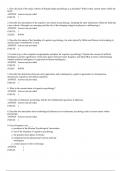
1. How did each of the major schools of thought shape psychology as a discipline? What is their current status within the
field?
ANSWER: Answer not provided.
POINTS: 1

2. Describe the antecedents of the cognitive movement in psychology, including the early indications within the field that
a new school of thought was emerging and the role of the changing zeitgeist in physics in influencing it.
ANSWER: Answer not provided.
POINTS: 1
NOTES: WWW

3. Describe the nature of the founding of cognitive psychology, the roles played by Miller and Neisser in developing it,
and the major contributions of each.
ANSWER: Answer not provided.
POINTS: 1

4. In what ways is the computer an appropriate metaphor for cognitive psychology? Explain the concept of artificial
intelligence and the significance of the chess games between Garry Kasparov and Deep Blue in terms of determining
whether artificial intelligence is equivalent to human intelligence.
ANSWER: Answer not provided.
POINTS: 1
NOTES: WWW

5. Describe the distinctions between early approaches and contemporary cognitive approaches to introspection,
unconscious cognition, and animal cognition.
ANSWER: Answer not provided.
POINTS: 1

6. What is the current status of cognitive psychology?
ANSWER: Answer not provided.
POINTS: 1

7. Describe evolutionary psychology and the four fundamental questions it addresses.
ANSWER: Answer not provided.
POINTS: 1

8. Describe the antecedent and sociobiological influences on evolutionary psychology and its current status within
psychology.
ANSWER: Answer not provided.
POINTS: 1

9. Garry Kasparov was ____.
a. president of the Russian Psychological Association
b. one of the founders of cognitive psychology
c. the greatest chess player in history
d. celebrated for his phenomenal work in artificial
intelligence
e. a minor player on the world stage
ANSWER: c
POINTS: 1

,REFERENCES: Chess Champion Capitulates to Cunning Computer

10. In his match against the “cunning opponent,” why did Kasparov exhibits signs of fear and confusion?
a. Because he was playing against a computer that could challenge him
intellectually.
b. Because he couldn’t help thinking about the rapid fall of the Soviet Union.
c. Because he was trying to trick his opponent into thinking he had won.
d. Because, after winning five straight games, he was tired.
e. Because he saw a basic flaw in the reasoning of his opponent.
ANSWER: a
POINTS: 1
REFERENCES: Chess Champion Capitulates to Cunning Computer

11. Which of the following schools made substantial contributions to psychology's evolution?
a. Gestalt psychology
b. structuralism
c. functionalism
d. behaviorism
e. All of the choices are
correct.
ANSWER: e
POINTS: 1
REFERENCES: Schools of Thought in
Perspective

12. There are no structural psychologists left in the United States. However, structural psychology was a success because
it ____.
a. discovered metal elements that compose consciousness
b. helped to establish psychology as an independent science
c. was able to perfect the method of introspection as a means to explore the nature of consciousness
d. discovered the phi phenomenon which shows that mentality has the job of trying to interpret reality from
sensory inputs
e. None of the choices are correct.
ANSWER: b
POINTS: 1
REFERENCES: Schools of Thought in
Perspective
NOTES: WWW

13. Of all the schools of psychology initiated by 1930, only behaviorism and psychoanalysis ____.
a. have maintained their identities
b. have been absorbed into the mainstream
c. have been phased out of contemporary psychology
d. maintained a focus on the pseudo-problem of consciousness
e. are the primary schools of thought in contemporary
psychology
ANSWER: a
POINTS: 1

, REFERENCES: Schools of Thought in
Perspective

14. The imperative that "psychology must discard all references to consciousness" was the command of ____.
a. Dewey
b. Angell
c. Watson
d. Skinner
e. Seligman
ANSWER: c
POINTS: 1
REFERENCES: The Cognitive Movement in
Psychology
NOTES: WWW

15. In McKeachie's opinion, the return of consciousness to psychology signaled a change in favor of ____ psychology.
a. operational
b. mechanistic
c. humanistic
d. cognitive
e. behavioral
ANSWER: d
POINTS: 1
REFERENCES: The Cognitive Movement in
Psychology

16. Cognitive psychology is concerned with ____.
a. reducing mental processes to the activity of the brain
b. the study of all mental processes such as perception, learning, memory, and problem
solving
c. the analysis of behavior into stimulus-response associations
d. the explanation of behavior using external stimuli as causes
e. human cognition only
ANSWER: b
POINTS: 1
REFERENCES: The Cognitive Movement in
Psychology

17. In terms of its antecedent influences, cognitive psychology represents a return to ____.
a. the early attempts at a science of the mind and consciousness
b. the type of speculations engaged in by philosophers
c. introspection
d. the active role of the perceiver
e. All of the choices are correct.
ANSWER: e
POINTS: 1
REFERENCES: The Cognitive Movement in
Psychology


Document information

Uploaded on
August 14, 2023
Number of pages
22
Written in
2023/2024
Type
Exam (elaborations)
Contains
Questions & answers
£15.99

Wrong document? Swap it for free Within 14 days of purchase and before downloading, you can choose a different document. You can simply spend the amount again.
Written by students who passed
Immediately available after payment
Read online or as PDF

Seller avatar
Reputation scores are based on the amount of documents a seller has sold for a fee and the reviews they have received for those documents. There are three levels: Bronze, Silver and Gold. The better the reputation, the more your can rely on the quality of the sellers work.
ExamsExpert
4.5
(90)
Sold
672
Followers
313
Items
2761
Last sold
6 days ago


Why students choose Stuvia

Created by fellow students, verified by reviews

Quality you can trust: written by students who passed their exams and reviewed by others who've used these revision notes.

Didn't get what you expected? Choose another document

No problem! You can straightaway pick a different document that better suits what you're after.

Pay as you like, start learning straight away

No subscription, no commitments. Pay the way you're used to via credit card and download your PDF document instantly.

Student with book image

“Bought, downloaded, and smashed it. It really can be that simple.”

Alisha Student

Working on your references?

Create accurate citations in APA, MLA and Harvard with our free citation generator.

Working on your references?

Frequently asked questions
