Treatment & Management -
Insomnia Neuropharmacology
Insomnia:
What is it?
Inadequate quantity or quality of sleep. It is a sleep disorder/pathology which
causes an individual to either have trouble falling asleep or staying asleep for
example waking up multiple times during the night. It disrupts the different stages of
sleep and the sleep cycles.
It is diagnosed when this sleep disturbance has affected the normal healthy
functioning of an individual - basically impairing daytime function and causing an
unpleasant effect on an individual’s daily routine. It is also only diagnosed when the
sleep disturbance is persistent and lasts for at least a month.
Neurotransmitters that regulate wakefulness & REM (Rapid Eye Movement):
Monoamines
GABA
Acetylcholine
Orexin
Neurotransmitters that regulate wakefulness & NREM (Non-Rapid Eye
Movement):
Adenosine
GABA
Neuroanatomical regions involving GABA:
Pontine Reticular Formation (PRF)
Ventrolateral Pre-optic Nucleus (VLPO)
Basal Forebrain
Neuroanatomical regions involving Acetylcholine (ACh):
Treatment & Management - Insomnia Neuropharmacology 1
, Thalamus
Latero-dorsal Tegmental / Pedunculopontine Tegmental (LDT/PPT)
Basal Forebrain
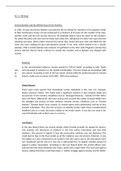
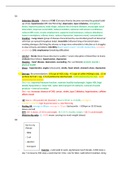
Schematic Drawing of Rodent Brain:
This diagram shows the neurotransmitters involved with the different brain regions.
Sleep Neurobiology:
What is it?
Neuroscience that studies the neurone phenotype and does so on the basis of the
discharge patterns, projection pathways, chemical identity, transmitter release and
receptor expression of neurones.
Diagram showing the level at which each neurotransmitter is released and
expressed during the different stages of sleep.
The dots show how much neurotransmitter is expressed.
Treatment & Management - Insomnia Neuropharmacology 2
Insomnia Neuropharmacology
Insomnia:
What is it?
Inadequate quantity or quality of sleep. It is a sleep disorder/pathology which
causes an individual to either have trouble falling asleep or staying asleep for
example waking up multiple times during the night. It disrupts the different stages of
sleep and the sleep cycles.
It is diagnosed when this sleep disturbance has affected the normal healthy
functioning of an individual - basically impairing daytime function and causing an
unpleasant effect on an individual’s daily routine. It is also only diagnosed when the
sleep disturbance is persistent and lasts for at least a month.
Neurotransmitters that regulate wakefulness & REM (Rapid Eye Movement):
Monoamines
GABA
Acetylcholine
Orexin
Neurotransmitters that regulate wakefulness & NREM (Non-Rapid Eye
Movement):
Adenosine
GABA
Neuroanatomical regions involving GABA:
Pontine Reticular Formation (PRF)
Ventrolateral Pre-optic Nucleus (VLPO)
Basal Forebrain
Neuroanatomical regions involving Acetylcholine (ACh):
Treatment & Management - Insomnia Neuropharmacology 1
, Thalamus
Latero-dorsal Tegmental / Pedunculopontine Tegmental (LDT/PPT)
Basal Forebrain
Schematic Drawing of Rodent Brain:
This diagram shows the neurotransmitters involved with the different brain regions.
Sleep Neurobiology:
What is it?
Neuroscience that studies the neurone phenotype and does so on the basis of the
discharge patterns, projection pathways, chemical identity, transmitter release and
receptor expression of neurones.
Diagram showing the level at which each neurotransmitter is released and
expressed during the different stages of sleep.
The dots show how much neurotransmitter is expressed.
Treatment & Management - Insomnia Neuropharmacology 2