Rate
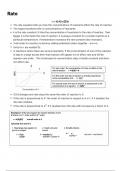
r = k[A]m[B]n
The rate equation tells you how the concentrations of reactants affect the rate of reaction.
The square brackets refer to concentrations of reactants.
k is the rate constant. It links the concentration of reactants to the rate of reaction. Then
bigger k is the faster the rate of reaction. It is always constant for a certain reaction at a
particular temperature. If temperature increases the rate constant also increases.
Total order for reaction is done by adding individual orders together - m+n=x.
Units for r are mol/dm3/s.
In reactions where there are several reactants, if the concentration of one of the reactant
is kept in a large excess then that reactant will appear not to affect rate and will be
pseudo-zero order . This is because its concentration stays virtually constant and does
not affect rate.
If [A] changes and rate stays the same the order of reaction is 0.
If the rate is proportional to A1 the order of reaction in respect to A is 1. If A doubles the
rate also doubles.
If the rate is proportional to A2. If A doubles then the rate with increase by a factor of 2.
r = k[A]m[B]n
The rate equation tells you how the concentrations of reactants affect the rate of reaction.
The square brackets refer to concentrations of reactants.
k is the rate constant. It links the concentration of reactants to the rate of reaction. Then
bigger k is the faster the rate of reaction. It is always constant for a certain reaction at a
particular temperature. If temperature increases the rate constant also increases.
Total order for reaction is done by adding individual orders together - m+n=x.
Units for r are mol/dm3/s.
In reactions where there are several reactants, if the concentration of one of the reactant
is kept in a large excess then that reactant will appear not to affect rate and will be
pseudo-zero order . This is because its concentration stays virtually constant and does
not affect rate.
If [A] changes and rate stays the same the order of reaction is 0.
If the rate is proportional to A1 the order of reaction in respect to A is 1. If A doubles the
rate also doubles.
If the rate is proportional to A2. If A doubles then the rate with increase by a factor of 2.