Introduction: Monomers and Polymerisation
Polymers are long chained molecules - long repeating units - made when many small molecules
called monomers join together.
Addition Polymers
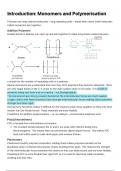
Double bonds in alkenes can open up and join together to make long chains called polymers.
n stands for the number of repeating units in a polymer
Alkene monomers are unsaturated and once they form polymers they become saturated. There
are only single bonds in the C-C chain so the main carbon chain is non polar. This results in
polymers being very inert and un-reactive - not biodegradable.
The monomers have strong covalent bonds but the intermolecular forces are much weaker.
Longer chains with fewer branches have stronger intermolecular forces making these polymers
stronger and more rigid.
Having many branches makes it difficult for the chains to pack close together so they only form
weaker Van Der Waals forces. These materials are more flexible.
Conditions for addition polymerisation - H+ as catalyst - concentrated sulphuric acid.
Poly(chloroethene)
PVC is formed from chloroethene monomers.
The covalent bonds between the Cl and C are polar with chlorine being more
electronegative. This means there are permanent dipole-dipole forces. This makes PVC
hard and brittle used to make drain pipes and window frames.
Plasticisers
Plasticisers modify polymers properties. Adding them makes polymers bendier as the
plasticiser gets in between the polymer chains pushing them apart. This reduces the strength
of the intermolecular forces between the chains so they can slide around and are more flexible.
Plasticised PVC is more flexible than rigid PVC so it is used for electrical cable insulation,
clothing and floor tiles.
Polymers are long chained molecules - long repeating units - made when many small molecules
called monomers join together.
Addition Polymers
Double bonds in alkenes can open up and join together to make long chains called polymers.
n stands for the number of repeating units in a polymer
Alkene monomers are unsaturated and once they form polymers they become saturated. There
are only single bonds in the C-C chain so the main carbon chain is non polar. This results in
polymers being very inert and un-reactive - not biodegradable.
The monomers have strong covalent bonds but the intermolecular forces are much weaker.
Longer chains with fewer branches have stronger intermolecular forces making these polymers
stronger and more rigid.
Having many branches makes it difficult for the chains to pack close together so they only form
weaker Van Der Waals forces. These materials are more flexible.
Conditions for addition polymerisation - H+ as catalyst - concentrated sulphuric acid.
Poly(chloroethene)
PVC is formed from chloroethene monomers.
The covalent bonds between the Cl and C are polar with chlorine being more
electronegative. This means there are permanent dipole-dipole forces. This makes PVC
hard and brittle used to make drain pipes and window frames.
Plasticisers
Plasticisers modify polymers properties. Adding them makes polymers bendier as the
plasticiser gets in between the polymer chains pushing them apart. This reduces the strength
of the intermolecular forces between the chains so they can slide around and are more flexible.
Plasticised PVC is more flexible than rigid PVC so it is used for electrical cable insulation,
clothing and floor tiles.