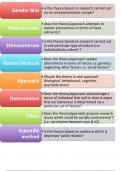
• is the theory based on research carried out
Gender bias on an unrepresentative sample?
• does the theory/approach attempts to
Reductionism explain phenomena in terms of basic
elements?
• is the theory based on research carried out
Ethnocentrism in one particular type of culture (i.e.
Individualistic culture) ?
• Does the theory/approach explain
Nature/Nurture phenomena in terms of nature i.e. genetics
neglecting other factors i.e. social factors?
• Situate the theory in one approach
Approach (biological, behavioural, cognitive,
psychodynamic)
• Does the theory/approach acknowledge a
Determinism sense of individual free-will or does it argue
that our behaviour is determined by a
particular set of factors?
• Does the theory/approach propose research
Ethics issues which could be socially controversial ?
(i.e. correlation between race & IQ)
Scientific • Is the theory based on evidence which is
method objective/ valid/ reliable?
, GENDER BIAS:
★ Universality = any underlying characteristic of human beings that’s capable of being
applied to all, despite differences of upbringing. Gender & culture bias threaten
universality of findings
★ Gender bias = bias is tendency to treat one individual/group in different way from others.
Gender bias = psychological research may offer a view that doesn’t justifiably represent
the experience & behaviour of men or women [usually women]
★ Androcentrism = male-centered. ‘Normal’ behaviour judged according to male standard
[female behaviour is judged to be ‘abnormal’]
★ Alpha bias = psychological theories that suggest there are real differences between men
& women - may enhance or undervalue member of either sex [undervalue women]
★ Beta bias = theories that ignore/minimise differences between sexes
● Bias undermines psychology’s claim to universality - that conclusions drawn can be
applied to everyone, anywhere, regardless of time or culture
● E.g of alpha bias = sociobiological theory of relationship formation which explains human
sexual through princple of ‘survival efficiency’. It’s in male’s interest to try to impregnate as
many women as possible to increase chances of his genes being passed to the next gen.
For female, best chance of preserving her genes is to ensure healthy survival of few
offspring = sexual promiscuity in males is genetically determines whilst females who
engage in the same behaviour is regarded as going against their nature. This is also an e.g
of essentialist argument
● Beta bias often occurs when female participants aren’t included as part of the research
process & then assumed that findings apply equally to both sexes
● E.g beta bias = fight or flight response - early research into fight or flight was based on
male animals & was assumed to be a universal response. Taylor et al suggest that female
biology has evolved to inhibit fight or flight response, shifting attention towards caring for
offspring [tending] & forming defensive networks with other females [befriending]
● Consequence of beta bias is androcentrism. If our understanding of what counts as normal
behaviour is drawn from a research involving only male sample then any behaviour that
deviates from this standard is likely to be judges as ‘abnormal’. This leads to female
behaviour being misunderstood & pathologised [that’s, taken as a sign of psychological
disorder’. E.g Critics claim that pre-menstrual syndrome [PMS] is a social construction
which medicalises female emotions, especially anger by explaining these in hormonal
terms. Male anger is seen as a rational response to external pressures
Gender bias on an unrepresentative sample?
• does the theory/approach attempts to
Reductionism explain phenomena in terms of basic
elements?
• is the theory based on research carried out
Ethnocentrism in one particular type of culture (i.e.
Individualistic culture) ?
• Does the theory/approach explain
Nature/Nurture phenomena in terms of nature i.e. genetics
neglecting other factors i.e. social factors?
• Situate the theory in one approach
Approach (biological, behavioural, cognitive,
psychodynamic)
• Does the theory/approach acknowledge a
Determinism sense of individual free-will or does it argue
that our behaviour is determined by a
particular set of factors?
• Does the theory/approach propose research
Ethics issues which could be socially controversial ?
(i.e. correlation between race & IQ)
Scientific • Is the theory based on evidence which is
method objective/ valid/ reliable?
, GENDER BIAS:
★ Universality = any underlying characteristic of human beings that’s capable of being
applied to all, despite differences of upbringing. Gender & culture bias threaten
universality of findings
★ Gender bias = bias is tendency to treat one individual/group in different way from others.
Gender bias = psychological research may offer a view that doesn’t justifiably represent
the experience & behaviour of men or women [usually women]
★ Androcentrism = male-centered. ‘Normal’ behaviour judged according to male standard
[female behaviour is judged to be ‘abnormal’]
★ Alpha bias = psychological theories that suggest there are real differences between men
& women - may enhance or undervalue member of either sex [undervalue women]
★ Beta bias = theories that ignore/minimise differences between sexes
● Bias undermines psychology’s claim to universality - that conclusions drawn can be
applied to everyone, anywhere, regardless of time or culture
● E.g of alpha bias = sociobiological theory of relationship formation which explains human
sexual through princple of ‘survival efficiency’. It’s in male’s interest to try to impregnate as
many women as possible to increase chances of his genes being passed to the next gen.
For female, best chance of preserving her genes is to ensure healthy survival of few
offspring = sexual promiscuity in males is genetically determines whilst females who
engage in the same behaviour is regarded as going against their nature. This is also an e.g
of essentialist argument
● Beta bias often occurs when female participants aren’t included as part of the research
process & then assumed that findings apply equally to both sexes
● E.g beta bias = fight or flight response - early research into fight or flight was based on
male animals & was assumed to be a universal response. Taylor et al suggest that female
biology has evolved to inhibit fight or flight response, shifting attention towards caring for
offspring [tending] & forming defensive networks with other females [befriending]
● Consequence of beta bias is androcentrism. If our understanding of what counts as normal
behaviour is drawn from a research involving only male sample then any behaviour that
deviates from this standard is likely to be judges as ‘abnormal’. This leads to female
behaviour being misunderstood & pathologised [that’s, taken as a sign of psychological
disorder’. E.g Critics claim that pre-menstrual syndrome [PMS] is a social construction
which medicalises female emotions, especially anger by explaining these in hormonal
terms. Male anger is seen as a rational response to external pressures