Ethical issues & ways of dealing with them
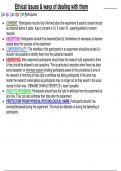
Can Do, Can’t Do With Participants
● CONSENT: Participants must be fully informed about the experiment & explicit consent should
be obtained before it starts. Age of consent is 16. If under 16 - parent/guardian’s consent
required.
● DECEPTION: Participants shouldn’t be deceived [lied to]. Sometimes it’s necessary to deceive
people about the purpose of the experiment
● CONFIDENTIALITY: The identities of the participants in an experiment should be private & it
shouldn’t be possible to identify them from the published research
● DEBRIEFING: After experiment participants should have the research fully explained to them
& they should be allowed to ask questions. This is particularly important when there has been
some deception or informed consent [making participants aware of the procedures & aims of
the research & informing of their right to withdraw but telling participants of the aims may
render the research meaningless as participants may no longer act as they would in the usual
course of their lives - DEMAND CHARACTERISTICS ] wasn’t possible
● RIGHT TO WITHDRAW: Participants should have the right to withdraw from the experiment at
any time. They can also withdraw their data after the experiment
● PROTECTION FROM PHYSICAL/PSYCHOLOGICAL HARM: Participants shouldn’t be
harmed/distressed during the experiment. This must be reflected on during the debriefing of
participants
,Step 1: Constructing an Aim
The Experimental Method
● Aim = a statement of what the
researchers intend to find out in a Step 4: Types of hypothesis
research study
❏ 1 tailed directional hypothesis [more, less,
● Usually start with “To investigate….”
higher, lower, increases, decreases] predicts
E.g. To investigate whether people
the nature of the effect of independent on
work just as well with the TV on or
dependent variable. E.g Adults will correctly
whether their work suffers as a result.
recall MORE words than children = H1
❏ 2 tailed non directional hypothesis predicts
that the independent variable will have an
Step 2: Identifying key variables = effect on dependent variable but the direction
Independent [variable that is manipulated] & of the effect is not specified. E.g. there will be
dependent [variable that is measured] a difference in how many numbers are
correctly recalled by children and adults = H2
❏ Null hypothesis = no difference/no
Step 3: Formulating a hypothesis [a precise, relationship. E.g there is NO difference
testable statement of what the researchers between the amount of 🍫 consumed and the
predict will be the outcome of the study] amount of items correctly recalled = H0
, Control of variables
EXTRANEOUS VARIABLES CONFOUNDING VARIABLES
➢ if we don’t control extraneous variables than this
● Any variable other than the
independent variable that may turns into confounding variables [to ‘confound’
have an affect on the dependent means to confuse].
variable if its not controlled ➢ Changes in the dependent variable may be due to
● Nuisance variables that don’t confounding variable rather than the independent
vary systematically with the
variable and therefore the outcome is meaningless
independent variable
➢ Vary systematically with the independent variable
DEMAND CHARACTERISTICS
INVESTIGATOR EFFECTS
When participants learn the aim of the
❖ Any effect of the investigator’s behaviour
experiment could be due to any cue from
[conscious or unconscious] on the research
the researcher or the research situation
outcome [DV]
❖ May include everything from the design study to
Hawthorne effect = when participants know
the selection & interaction with the participants
they’re being observed so they alter their
❖ Leading questions?
behaviour
, DEMAND CHARACTERISTICS
DEMAND CHARACTERISTICS = when subjects picks up cues during the experiment &
modify their behaviour; thereby possibly affecting & altering the results of the study [when
participants guess the aim of the experiment]. In independent group design, the participants
shouldn’t know that there’s another group to avoid competition.
POSSIBLE SOURCES FOR DEMAND CHARACTERISTICS: tone of voice of the researcher,
setting of the study, researcher’s body language, what the participants heard before about the
study or from other participants, equipment used, instructions given, way the participant is
approached, type of person the researcher is, communication during the study
CONTROLS FOR DEMAND CHARACTERISTICS: Deception {distractor questions, lying
about the aim - ethical?}, single blind {participants is unaware of which conditions they are
in - think about the placebo effect}
Can Do, Can’t Do With Participants
● CONSENT: Participants must be fully informed about the experiment & explicit consent should
be obtained before it starts. Age of consent is 16. If under 16 - parent/guardian’s consent
required.
● DECEPTION: Participants shouldn’t be deceived [lied to]. Sometimes it’s necessary to deceive
people about the purpose of the experiment
● CONFIDENTIALITY: The identities of the participants in an experiment should be private & it
shouldn’t be possible to identify them from the published research
● DEBRIEFING: After experiment participants should have the research fully explained to them
& they should be allowed to ask questions. This is particularly important when there has been
some deception or informed consent [making participants aware of the procedures & aims of
the research & informing of their right to withdraw but telling participants of the aims may
render the research meaningless as participants may no longer act as they would in the usual
course of their lives - DEMAND CHARACTERISTICS ] wasn’t possible
● RIGHT TO WITHDRAW: Participants should have the right to withdraw from the experiment at
any time. They can also withdraw their data after the experiment
● PROTECTION FROM PHYSICAL/PSYCHOLOGICAL HARM: Participants shouldn’t be
harmed/distressed during the experiment. This must be reflected on during the debriefing of
participants
,Step 1: Constructing an Aim
The Experimental Method
● Aim = a statement of what the
researchers intend to find out in a Step 4: Types of hypothesis
research study
❏ 1 tailed directional hypothesis [more, less,
● Usually start with “To investigate….”
higher, lower, increases, decreases] predicts
E.g. To investigate whether people
the nature of the effect of independent on
work just as well with the TV on or
dependent variable. E.g Adults will correctly
whether their work suffers as a result.
recall MORE words than children = H1
❏ 2 tailed non directional hypothesis predicts
that the independent variable will have an
Step 2: Identifying key variables = effect on dependent variable but the direction
Independent [variable that is manipulated] & of the effect is not specified. E.g. there will be
dependent [variable that is measured] a difference in how many numbers are
correctly recalled by children and adults = H2
❏ Null hypothesis = no difference/no
Step 3: Formulating a hypothesis [a precise, relationship. E.g there is NO difference
testable statement of what the researchers between the amount of 🍫 consumed and the
predict will be the outcome of the study] amount of items correctly recalled = H0
, Control of variables
EXTRANEOUS VARIABLES CONFOUNDING VARIABLES
➢ if we don’t control extraneous variables than this
● Any variable other than the
independent variable that may turns into confounding variables [to ‘confound’
have an affect on the dependent means to confuse].
variable if its not controlled ➢ Changes in the dependent variable may be due to
● Nuisance variables that don’t confounding variable rather than the independent
vary systematically with the
variable and therefore the outcome is meaningless
independent variable
➢ Vary systematically with the independent variable
DEMAND CHARACTERISTICS
INVESTIGATOR EFFECTS
When participants learn the aim of the
❖ Any effect of the investigator’s behaviour
experiment could be due to any cue from
[conscious or unconscious] on the research
the researcher or the research situation
outcome [DV]
❖ May include everything from the design study to
Hawthorne effect = when participants know
the selection & interaction with the participants
they’re being observed so they alter their
❖ Leading questions?
behaviour
, DEMAND CHARACTERISTICS
DEMAND CHARACTERISTICS = when subjects picks up cues during the experiment &
modify their behaviour; thereby possibly affecting & altering the results of the study [when
participants guess the aim of the experiment]. In independent group design, the participants
shouldn’t know that there’s another group to avoid competition.
POSSIBLE SOURCES FOR DEMAND CHARACTERISTICS: tone of voice of the researcher,
setting of the study, researcher’s body language, what the participants heard before about the
study or from other participants, equipment used, instructions given, way the participant is
approached, type of person the researcher is, communication during the study
CONTROLS FOR DEMAND CHARACTERISTICS: Deception {distractor questions, lying
about the aim - ethical?}, single blind {participants is unaware of which conditions they are
in - think about the placebo effect}