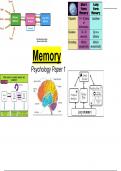
Memory
Psychology Paper 1
, Gender bias • is the theory based on research carried out on an unrepresentative sample?
• does the theory/approach attempts to explain phenomena in terms of basic
Reductionism elements?
• is the theory based on research carried out in one particular type of culture
Ethnocentrism (i.e. Individualistic culture) ?
• Does the theory/approach explain phenomena in terms of nature i.e.
Nature/Nurture genetics neglecting other factors i.e. social factors?
• Situate the theory in one approach (biological, behavioural, cognitive,
Approach psychodynamic)
• Does the theory/approach acknowledge a sense of individual free-will or
Determinism does it argue that our behaviour is determined by a particular set of
factors?
• Does the theory/approach propose/research issues which could be socially
Ethics controversial ? (i.e. correlation between race and IQ)
Scientific method • Is the theory based on evidence which is objective/ valid/ reliable?
,Memory = the process by which we retain information about events
that have happened in the past.
Coding, capacity & duration of memory
Short term & Long term memory
, 🔑words
★ Coding = the format in which information is stored in the various memory stores.
Information enters the brain via senses. It’s then stored in various forms such as
visual codes [like picture], acoustic codes [sounds] or semantic codes [the meaning
of the experience]
★ Capacity = the amount of information that can be held in a memory store.
★ Duration = the length of time information can be held in memory
★ Short term memory [STM] = limited capacity memory store. Coding is mainly
acoustic [sounds], has a limited capacity of between 5 & 9 items on average.
Duration is between approx 18-30 seconds. They disappear unless they’re
rehearsed. This type of memory is sometimes referred to as working memory
★ Long term memory [LTM] = the permanent memory store. Coding is mainly
sematic [meaning]. It has unlimited capacity and can store memories for up to a
lifetime [duration].
, Type of memory Location
Semantic = Concerns facts ● Hippocampus = brain structure involved in memory, learning &
taken independent of emotion. It forms new memories & organises them with related
context. E.g PL winners memories & emotions
{which will be Arsenal in ● Temporal lobe = involved in hearing, identifying objects,
2023}, square root of 9 understanding language. Also play a role in emotion [Auditory &
Wernicke’s area]
Episodic = More personal ● Prefrontal cortex = helps control highest level of thinking &
memories such as conscious functions such as empathy, self-perception,
associations of a particular interaction
place/time. E.g favourite ● Temporal lobe = involved in hearing, identifying objects,
song, primary school understanding language. Also play a role in emotion [Auditory &
Wernicke’s area]
Procedural = concern with ● Basal ganglia/basal nuclei = associated with motor control,
learning motor skills. E.g cognition, emotions & learning
learn to drive, sports, ● Cerebellum = helps with timing & co-ordination of movements
instrument
Psychology Paper 1
, Gender bias • is the theory based on research carried out on an unrepresentative sample?
• does the theory/approach attempts to explain phenomena in terms of basic
Reductionism elements?
• is the theory based on research carried out in one particular type of culture
Ethnocentrism (i.e. Individualistic culture) ?
• Does the theory/approach explain phenomena in terms of nature i.e.
Nature/Nurture genetics neglecting other factors i.e. social factors?
• Situate the theory in one approach (biological, behavioural, cognitive,
Approach psychodynamic)
• Does the theory/approach acknowledge a sense of individual free-will or
Determinism does it argue that our behaviour is determined by a particular set of
factors?
• Does the theory/approach propose/research issues which could be socially
Ethics controversial ? (i.e. correlation between race and IQ)
Scientific method • Is the theory based on evidence which is objective/ valid/ reliable?
,Memory = the process by which we retain information about events
that have happened in the past.
Coding, capacity & duration of memory
Short term & Long term memory
, 🔑words
★ Coding = the format in which information is stored in the various memory stores.
Information enters the brain via senses. It’s then stored in various forms such as
visual codes [like picture], acoustic codes [sounds] or semantic codes [the meaning
of the experience]
★ Capacity = the amount of information that can be held in a memory store.
★ Duration = the length of time information can be held in memory
★ Short term memory [STM] = limited capacity memory store. Coding is mainly
acoustic [sounds], has a limited capacity of between 5 & 9 items on average.
Duration is between approx 18-30 seconds. They disappear unless they’re
rehearsed. This type of memory is sometimes referred to as working memory
★ Long term memory [LTM] = the permanent memory store. Coding is mainly
sematic [meaning]. It has unlimited capacity and can store memories for up to a
lifetime [duration].
, Type of memory Location
Semantic = Concerns facts ● Hippocampus = brain structure involved in memory, learning &
taken independent of emotion. It forms new memories & organises them with related
context. E.g PL winners memories & emotions
{which will be Arsenal in ● Temporal lobe = involved in hearing, identifying objects,
2023}, square root of 9 understanding language. Also play a role in emotion [Auditory &
Wernicke’s area]
Episodic = More personal ● Prefrontal cortex = helps control highest level of thinking &
memories such as conscious functions such as empathy, self-perception,
associations of a particular interaction
place/time. E.g favourite ● Temporal lobe = involved in hearing, identifying objects,
song, primary school understanding language. Also play a role in emotion [Auditory &
Wernicke’s area]
Procedural = concern with ● Basal ganglia/basal nuclei = associated with motor control,
learning motor skills. E.g cognition, emotions & learning
learn to drive, sports, ● Cerebellum = helps with timing & co-ordination of movements
instrument