

Ultra-Structure of kidney
The excretory system is responsible for filtering wastes from the blood and both forming and secreting urine.
These functions help to maintain the composition and volume of body fluids. Although it has far-reaching
effects, the urinary system is relatively simple anatomically and consists of: Kidneys, Ureters, Bladder, and
Urethra.
The main organs are the kidneys, which filter blood and produce urine. The other parts are simply accessory
structures for the transport and storage of urine.
During the normal breakdown of protein and nucleic acids, nitrogen is released into the bloodstream. Some
of this nitrogen is recycled to make new cellular products, but most of it is disposed of. The body has to have
a way to rid itself of this unused nitrogen, as high levels in the blood can be toxic. Most of the nitrogen is
bound with hydrogen as NH3 (ammonia), which is readily dissolved in water. For this reason, fish are able to
excrete much of their nitrogen by simple diffusion into the surrounding water. Terrestrial animals have a
different way of ridding their bodies of excess nitrogen. It is either excreted as uric acid or urea. Animals that
are concerned about water loss, such as birds and reptiles, excrete the more concentrated uric acid as a pasty
white material. Mammals, on the other hand, can excrete urea, along with more water. The mixture of urea,
water, and other wastes is called 'urine.' Urine is still very concentrated in comparison to the blood, and the
system that facilitates this concentration is the 'urinary system.
Kidneys
The kidneys of mammals are round or bean-shaped organs. They are located outside of the peritoneum – the
membrane that encloses the organs of the abdominal cavity. Because of this position, they are referred to as
retroperitoneal. They are surrounded by fat tissue known as perirenal fat. A fibrous capsule covers the
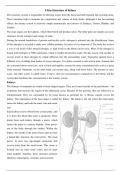
kidney. The indentation of the bean shape is called the 'hilum.' The hilum is the site where the renal artery
enters the kidney and both the renal vein and ureter
exit.
Each kidney receives blood from a renal artery, and
it is from this blood that urine is produced. Urine
drains from each kidney through a ureter, which
carries the urine to a urinary bladder. Urine passes
out of the body through the urethra. Within the
kidney, the mouth of the ureter flares open to form
a funnel-like structure, the renal pelvis. The renal
pelvis, in turn, has cup-shaped extensions that
receive urine from the renal tissue. This tissue is
divided into an outer renal cortex and an inner
renal medulla. Together, these structures perform
filtration, reabsorption, secretion, and excretion.
The excretory system is responsible for filtering wastes from the blood and both forming and secreting urine.
These functions help to maintain the composition and volume of body fluids. Although it has far-reaching
effects, the urinary system is relatively simple anatomically and consists of: Kidneys, Ureters, Bladder, and
Urethra.
The main organs are the kidneys, which filter blood and produce urine. The other parts are simply accessory
structures for the transport and storage of urine.
During the normal breakdown of protein and nucleic acids, nitrogen is released into the bloodstream. Some
of this nitrogen is recycled to make new cellular products, but most of it is disposed of. The body has to have
a way to rid itself of this unused nitrogen, as high levels in the blood can be toxic. Most of the nitrogen is
bound with hydrogen as NH3 (ammonia), which is readily dissolved in water. For this reason, fish are able to
excrete much of their nitrogen by simple diffusion into the surrounding water. Terrestrial animals have a
different way of ridding their bodies of excess nitrogen. It is either excreted as uric acid or urea. Animals that
are concerned about water loss, such as birds and reptiles, excrete the more concentrated uric acid as a pasty
white material. Mammals, on the other hand, can excrete urea, along with more water. The mixture of urea,
water, and other wastes is called 'urine.' Urine is still very concentrated in comparison to the blood, and the
system that facilitates this concentration is the 'urinary system.
Kidneys
The kidneys of mammals are round or bean-shaped organs. They are located outside of the peritoneum – the
membrane that encloses the organs of the abdominal cavity. Because of this position, they are referred to as
retroperitoneal. They are surrounded by fat tissue known as perirenal fat. A fibrous capsule covers the
kidney. The indentation of the bean shape is called the 'hilum.' The hilum is the site where the renal artery
enters the kidney and both the renal vein and ureter
exit.
Each kidney receives blood from a renal artery, and
it is from this blood that urine is produced. Urine
drains from each kidney through a ureter, which
carries the urine to a urinary bladder. Urine passes
out of the body through the urethra. Within the
kidney, the mouth of the ureter flares open to form
a funnel-like structure, the renal pelvis. The renal
pelvis, in turn, has cup-shaped extensions that
receive urine from the renal tissue. This tissue is
divided into an outer renal cortex and an inner
renal medulla. Together, these structures perform
filtration, reabsorption, secretion, and excretion.


