Conscience
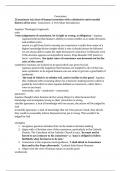
‘[Conscience is] a feat of human invention with a distinctive and eventful
history all its own.’ Conscience: A Very Short Introduction
Aquinas’ Theological Approach
ratio
‘every judgement of conscience, be it right or wrong, is obligatory.’ Aquinas
- Aquinas believed that human’s ability to reason enables us to make decisions
and problem solve.
- reason is a gift from God so sensing our conscience is really have sense of a
higher knowledge/divine insight which is why it should always be followed
- we are always able to make the right decisions if conscience is followed, even
if the decision opposes social/political norms. Pope Benedict XVI points to
Jesus’ crucifixion, ‘the quiet voice of conscience was drowned out by the
cries of the crowd.’
synderesis: humans are inclined to do good which was given by God.
- Aquinas agreed with Augustine that humans are tempted to do evil but was
more optimistic as he argued humans can use ratio to get into a good habit of
synderesis
- ‘the task of which is to rebuke evil, and to incline to the good.’ Aquinas
- this combined with reasoning allows for a decision-making process which is
guided by God which is what Aquinas defined as conscience, rather than a
voice in our head.
- essentially, ratio + synderesis = conscientia
ignorance
Aquinas thought when humans do the wrong thing it is often because their
knowledge was incomplete/wrong so their conscience is wrong.
vincible ignorance: a lack of knowledge with no excuse, the action will be judged by
God
invincible ignorance: a lack of knowledge that isn’t the person’s fault, they did all
they could to reasonably inform themselves but got it wrong. This wouldn’t be
judged by God
strengths
1. recognises genuine mistakes that can be made in decision making
2. aligns with a Christian view of the conscience, particularly in the Catholic
Church. The Catechism of the Catholic Church it says, ‘he must not be
forced to act contrary to his conscience’ as ‘man is obliged to follow
faithfully what he knows to be just.’
3. Conscience is the supreme moral guidance, ‘I shall drink to Conscience
first and to the Pope afterwards.’ Cardinal John Henry Newman
4. Aligns with the view of human nature as mostly good
weaknesses
‘[Conscience is] a feat of human invention with a distinctive and eventful
history all its own.’ Conscience: A Very Short Introduction
Aquinas’ Theological Approach
ratio
‘every judgement of conscience, be it right or wrong, is obligatory.’ Aquinas
- Aquinas believed that human’s ability to reason enables us to make decisions
and problem solve.
- reason is a gift from God so sensing our conscience is really have sense of a
higher knowledge/divine insight which is why it should always be followed
- we are always able to make the right decisions if conscience is followed, even
if the decision opposes social/political norms. Pope Benedict XVI points to
Jesus’ crucifixion, ‘the quiet voice of conscience was drowned out by the
cries of the crowd.’
synderesis: humans are inclined to do good which was given by God.
- Aquinas agreed with Augustine that humans are tempted to do evil but was
more optimistic as he argued humans can use ratio to get into a good habit of
synderesis
- ‘the task of which is to rebuke evil, and to incline to the good.’ Aquinas
- this combined with reasoning allows for a decision-making process which is
guided by God which is what Aquinas defined as conscience, rather than a
voice in our head.
- essentially, ratio + synderesis = conscientia
ignorance
Aquinas thought when humans do the wrong thing it is often because their
knowledge was incomplete/wrong so their conscience is wrong.
vincible ignorance: a lack of knowledge with no excuse, the action will be judged by
God
invincible ignorance: a lack of knowledge that isn’t the person’s fault, they did all
they could to reasonably inform themselves but got it wrong. This wouldn’t be
judged by God
strengths
1. recognises genuine mistakes that can be made in decision making
2. aligns with a Christian view of the conscience, particularly in the Catholic
Church. The Catechism of the Catholic Church it says, ‘he must not be
forced to act contrary to his conscience’ as ‘man is obliged to follow
faithfully what he knows to be just.’
3. Conscience is the supreme moral guidance, ‘I shall drink to Conscience
first and to the Pope afterwards.’ Cardinal John Henry Newman
4. Aligns with the view of human nature as mostly good
weaknesses