
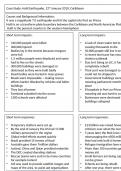
Case Study: Haiti Earthquake, 12th January 2010, Caribbean
Causes and Background Information:
It was a magnitude 7.0 earthquake and hit the capital city Port au Prince
Haiti is on a transform plate boundary between the Caribbean and North American Plate
Haiti is the poorest country in the western hemisphere
Short term impacts: Long term impacts:
• 316,000 people were killed • A lack of clean water led to
• 300,000 injured causing thousands to die
• Bodies lay in the streets because morgues • 50,000 people still live in tem
were full • A recent hurricane has resu
• 1.5 million people were displaced and some cholera outbreak
had to live on the streets • Due to it being an LIC, it has
• 300,000 buildings were damaged or completely rebuilt
destroyed as they were built badly • Their port was damaged so
• Dead bodies were buried in mass graves could not be shipped in
• Roads were impassable – making rescue • Government buildings were
efforts harder. Blocked by vehicles and fallen meaning parliament meetin
buildings place
• They lost all power • 8 hospitals in Port-au-Prince
• Farmland subsided into the ocean meaning aid was hard to co
• 1300 schools were affected • Businesses were destroyed
buildings collapsed
Short term responses Long term responses:
• Temporary shelters were set up • $13 billion was raised howe
• By the end of January the US had 17,000 criticism over what the mon
military personnel in the region • 5 years later the Red Cross w
• Global relief efforts started quickly mismanaging the $500 milli
• Brazil provided 15 tonnes of food they had only built 6 homes
• Australia gave them 7million dollars • Refugee immigration laws w
• Iceland, China and Qatar provided materials • More than 100 countries ga
• The DEC created donating stations money aid
• Rescue teams were sent in by many countries • Small farmers are being sup
for example Iceland can be grown
• GIS was used to provide satellite images and • Schools are being rebuilt
maps of the area, to assist aid organisations • After one year, there were s
Causes and Background Information:
It was a magnitude 7.0 earthquake and hit the capital city Port au Prince
Haiti is on a transform plate boundary between the Caribbean and North American Plate
Haiti is the poorest country in the western hemisphere
Short term impacts: Long term impacts:
• 316,000 people were killed • A lack of clean water led to
• 300,000 injured causing thousands to die
• Bodies lay in the streets because morgues • 50,000 people still live in tem
were full • A recent hurricane has resu
• 1.5 million people were displaced and some cholera outbreak
had to live on the streets • Due to it being an LIC, it has
• 300,000 buildings were damaged or completely rebuilt
destroyed as they were built badly • Their port was damaged so
• Dead bodies were buried in mass graves could not be shipped in
• Roads were impassable – making rescue • Government buildings were
efforts harder. Blocked by vehicles and fallen meaning parliament meetin
buildings place
• They lost all power • 8 hospitals in Port-au-Prince
• Farmland subsided into the ocean meaning aid was hard to co
• 1300 schools were affected • Businesses were destroyed
buildings collapsed
Short term responses Long term responses:
• Temporary shelters were set up • $13 billion was raised howe
• By the end of January the US had 17,000 criticism over what the mon
military personnel in the region • 5 years later the Red Cross w
• Global relief efforts started quickly mismanaging the $500 milli
• Brazil provided 15 tonnes of food they had only built 6 homes
• Australia gave them 7million dollars • Refugee immigration laws w
• Iceland, China and Qatar provided materials • More than 100 countries ga
• The DEC created donating stations money aid
• Rescue teams were sent in by many countries • Small farmers are being sup
for example Iceland can be grown
• GIS was used to provide satellite images and • Schools are being rebuilt
maps of the area, to assist aid organisations • After one year, there were s


