
4. Cell Membranes and
Transport
4. 1 Fluid mosaic membranes
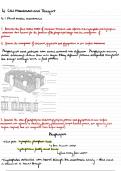
1 .
Describe the
fluid mosaic model
of membrane structure with
reference to the hydrophobic and hydrophilic
inieiuuious that
for the formation ofthe phospholipid bilayer the arrangement of
amount and
proteins
2. Describe the arrangement of cholesterol glycolipids and glycoproteins
,
in au
surface membranes
Phospholipids and
proteins
can move around via
diffusion Phospholipids mainly
.
sideways Many different proteins interspersed throughout
within their
move
layers
own .
the
bilayer although
some in
fixed positions .
3. Describe the roles
of phospholipids cholesterol glycolipids proteins
, , ,
and
glycoproteins in au surface
membranes with,
reference to stability fluidity permeability transport &channel proteins
, , . ,
an
nfirwuiny can
snfene receptors and an recognition can surface antigens)
Phospholipids
→ two pairs
:
hydrophilic phosphate head
↳ face towards water
hydrophobic fatty acid tails
↳ fine
away from
over
travel the membrane others need
hydrophobic
molecules
through easily
→ can -
through
a channel to travel
, → air as a barrier to most water-soluble substances
→ ensures water soluble substances cannot leak out
of the cell
-
cholesterol
permeability of
→ reduces cell membrane
+ fits into spaces between phospholipids
↳ prevents
the membrane
water-soluble molecules
diffusing across
high temperatures by retaining fluidity
+ stabilisers the an membrane our
→ bind to
hydrophobic tails of phospholipids
to
park closer
together
→ mineuses mechanical
smuyth
and
stability of membranes
→
strengthens
membrane - adds
fluidity
Glycolipids glycoproteins and proteins
,
bhpohjnits :
maintain
stability of an
→ membrane
→ fnihinves recognition crucial
cellular -
to iuniune
response
→ allows cells to to
convert one another to
form tissues
Chpopwheins :
→ air in cen cell
rewyniuim and binding of other molecules
-
three
receptor types
→
signalling receptors for hormones and neurotransmitters
involved in
→ receptors endocytosis
involved in an adhesion and stabilisation
→ revpnrs
4 carbohydrate form hydrogen
bonds
surrounding
with worker
molecules them are own ill the cell
Roles of Proteins
Channel
proteins
:
→ allow
movement
of surnames too large /
hydrophilic to
pass through
the
that
goes through
the whole membrane
membrane
forming tube like smuhwe
a
-
Transport
4. 1 Fluid mosaic membranes
1 .
Describe the
fluid mosaic model
of membrane structure with
reference to the hydrophobic and hydrophilic
inieiuuious that
for the formation ofthe phospholipid bilayer the arrangement of
amount and
proteins
2. Describe the arrangement of cholesterol glycolipids and glycoproteins
,
in au
surface membranes
Phospholipids and
proteins
can move around via
diffusion Phospholipids mainly
.
sideways Many different proteins interspersed throughout
within their
move
layers
own .
the
bilayer although
some in
fixed positions .
3. Describe the roles
of phospholipids cholesterol glycolipids proteins
, , ,
and
glycoproteins in au surface
membranes with,
reference to stability fluidity permeability transport &channel proteins
, , . ,
an
nfirwuiny can
snfene receptors and an recognition can surface antigens)
Phospholipids
→ two pairs
:
hydrophilic phosphate head
↳ face towards water
hydrophobic fatty acid tails
↳ fine
away from
over
travel the membrane others need
hydrophobic
molecules
through easily
→ can -
through
a channel to travel
, → air as a barrier to most water-soluble substances
→ ensures water soluble substances cannot leak out
of the cell
-
cholesterol
permeability of
→ reduces cell membrane
+ fits into spaces between phospholipids
↳ prevents
the membrane
water-soluble molecules
diffusing across
high temperatures by retaining fluidity
+ stabilisers the an membrane our
→ bind to
hydrophobic tails of phospholipids
to
park closer
together
→ mineuses mechanical
smuyth
and
stability of membranes
→
strengthens
membrane - adds
fluidity
Glycolipids glycoproteins and proteins
,
bhpohjnits :
maintain
stability of an
→ membrane
→ fnihinves recognition crucial
cellular -
to iuniune
response
→ allows cells to to
convert one another to
form tissues
Chpopwheins :
→ air in cen cell
rewyniuim and binding of other molecules
-
three
receptor types
→
signalling receptors for hormones and neurotransmitters
involved in
→ receptors endocytosis
involved in an adhesion and stabilisation
→ revpnrs
4 carbohydrate form hydrogen
bonds
surrounding
with worker
molecules them are own ill the cell
Roles of Proteins
Channel
proteins
:
→ allow
movement
of surnames too large /
hydrophilic to
pass through
the
that
goes through
the whole membrane
membrane
forming tube like smuhwe
a
-


